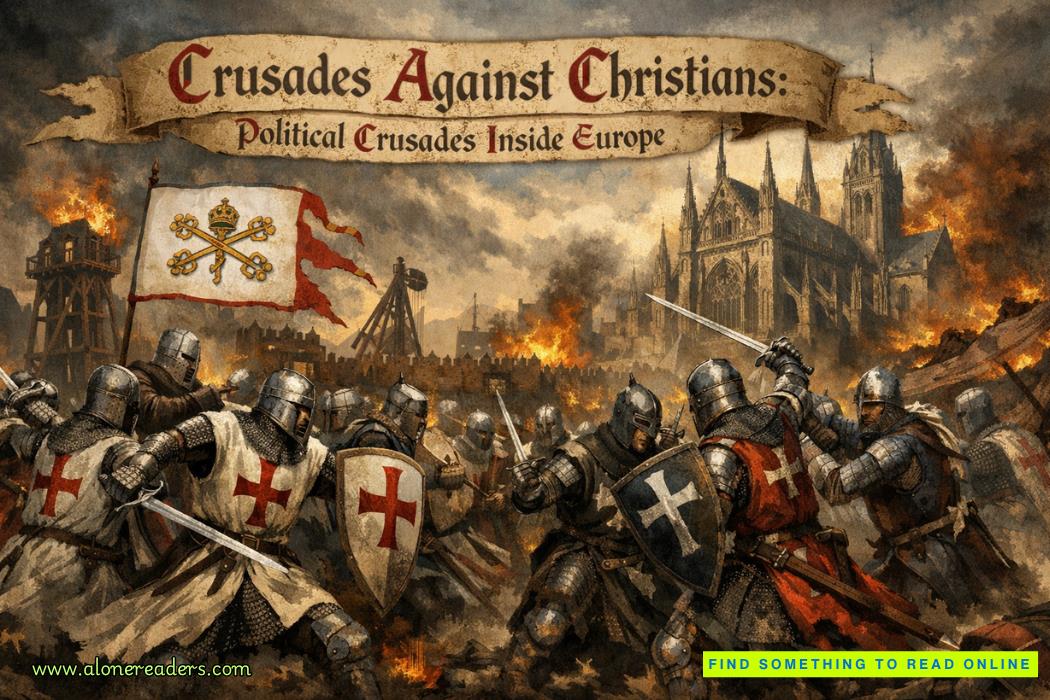
The popular imagination frames the Crusades as epic clashes between Latin Christendom and the Islamic world. Yet this image obscures a critical and deeply uncomfortable reality: some of the most destructive crusades were waged not against Muslims, but against fellow Christians. By the thirteenth century, the crusading apparatus—indulgences, papal bulls, taxation systems, military vows—had evolved into a powerful political instrument capable of being redirected inward. The result was a series of conflicts in which Christian armies marched under the cross against other baptized populations, reshaping Europe’s political landscape and transforming the papacy into a formidable geopolitical actor.
To understand these internal crusades, one must first grasp how crusading ideology developed. The First Crusade had established a theological framework in which violence, if sanctioned by papal authority and directed toward a sacred cause, could be not only justified but sanctified. Over time, the definition of “holy war” broadened. The enemy need no longer be geographically distant or religiously distinct. Instead, the enemy became anyone defined as a threat to orthodoxy or papal supremacy. This doctrinal flexibility enabled the transformation of crusading from a defensive pilgrimage-war to a political weapon.
The Albigensian Crusade (1209–1229) remains the most notorious example of a crusade directed against Christians. Launched against the Cathars of southern France, it was ostensibly a campaign to eradicate heresy. Catharism challenged key doctrines of the Catholic Church, promoting a dualistic theology that rejected materialism and clerical hierarchy. However, the campaign quickly transcended theological concerns. Northern French nobles, backed by papal authority, seized lands in Languedoc, a region long characterized by relative autonomy and cultural distinctiveness. The infamous massacre at Béziers—where thousands were slaughtered indiscriminately—revealed that the crusade functioned as a blunt instrument of conquest as much as religious purification.
What makes the Albigensian Crusade particularly significant is how it institutionalized a new precedent: crusading privileges could be granted for campaigns within Europe. Participants received indulgences identical to those offered to crusaders traveling to the Holy Land. The theological message was unmistakable: fighting heretics at home was spiritually equivalent to fighting Muslims abroad. The spiritual economy of salvation had merged seamlessly with territorial ambition.
The campaign’s long-term consequences were profound. Southern France was politically integrated into the Capetian monarchy, dramatically expanding royal authority. Meanwhile, the papacy demonstrated its capacity to mobilize armies against internal dissent. Heresy became not merely a spiritual error but a political crime warranting militarized annihilation. The establishment of the medieval Inquisition followed in this context, signaling the shift from ad hoc crusading violence to institutionalized surveillance and control.
The Northern Crusades provide another illustration of crusading ideology turned inward, though in a more complex fashion. While often framed as campaigns against pagan Baltic populations, these crusades also entangled Christian polities in violent rivalry. The Teutonic Knights, originally formed to defend pilgrims in the Holy Land, relocated to the Baltic region and began carving out a territorial state. Their campaigns did not only target pagans; they repeatedly clashed with Christian neighbors, including Poland and Lithuania after its conversion. Conversion did not automatically eliminate the logic of conquest.
Here, crusading rhetoric masked strategic ambition. The Teutonic Order justified territorial expansion by questioning the sincerity or orthodoxy of newly converted rulers. Even when Lithuania formally adopted Christianity, military campaigns persisted under the claim that conversion was insufficiently genuine. This reveals a disturbing elasticity in crusading logic: religious identity could be contested whenever political interests demanded it. The crusade had become a mechanism for legitimizing territorial aggression.
Perhaps the most politically revealing internal crusades were those launched by popes against secular rulers. The conflict between the papacy and the Holy Roman Empire during the thirteenth century produced a remarkable development: papal crusades against Christian emperors. When Emperor Frederick II defied papal authority, he was excommunicated and eventually declared a target of crusade. Armies were raised under the cross to fight not infidels, but a crowned Christian monarch.
This moment marks a critical transformation. Crusading had evolved into a weapon in the struggle between sacerdotium and imperium—the competing claims of spiritual and temporal supremacy. The cross was no longer exclusively a symbol of external defense; it had become an emblem of internal coercion. The papacy’s willingness to mobilize crusades against political adversaries demonstrated how deeply crusading ideology had been absorbed into the machinery of European power politics.
In Italy, crusades were declared against city-states aligned with imperial factions. In Germany, rival claimants to the throne sought papal backing to legitimize their positions. The language of heresy and excommunication blurred into the language of political rebellion. By sacralizing political conflict, the Church amplified both the scale and intensity of warfare. What might otherwise have been dynastic disputes acquired the aura of cosmic struggle.
The concept of crusade also intersected with campaigns against minority Christian communities deemed schismatic or heterodox. The Bosnian Crusades targeted a local church accused of heretical tendencies. Similarly, campaigns were mounted against the Hussites in fifteenth-century Bohemia. The Hussite Crusades reveal the limits of papal authority: despite repeated attempts, crusading armies failed to suppress the movement. This failure exposed the declining effectiveness of crusading as a universal mobilizing force in late medieval Europe.
What unites these diverse cases is not merely violence but the strategic deployment of sacred language. The cross functioned as a political technology. By granting indulgences, authorizing taxation, and invoking divine mandate, the papacy could mobilize resources on an unprecedented scale. Crusading privileges created incentives that transcended ordinary feudal obligations. Participation was no longer simply a matter of loyalty to a lord; it became a pathway to spiritual reward.
This fusion of theology and power altered European political culture. Rulers learned to frame their conflicts in moralized, eschatological terms. Opponents were not merely rivals but enemies of God. Such rhetoric reduced space for compromise and elevated warfare to existential stakes. The normalization of internal crusades contributed to cycles of violence that reshaped territorial boundaries and centralized authority.
Yet it would be simplistic to portray these crusades as mere cynical manipulations. Many participants genuinely believed they were defending orthodoxy or divine order. Medieval society operated within a cosmology in which religious and political categories were inseparable. To challenge papal authority was to risk destabilizing the moral fabric of Christendom. Thus, crusades against Christians were often experienced as tragic necessities rather than contradictions.
Nevertheless, the long-term implications were destabilizing. The overextension of crusading rhetoric diluted its moral clarity. When the same indulgences were granted for fighting neighbors as for liberating Jerusalem, the symbolic coherence of crusade weakened. By the late Middle Ages, skepticism toward crusading campaigns increased, particularly when they appeared transparently political.
The internalization of crusade also accelerated state formation. In France, the Albigensian Crusade facilitated royal expansion. In Prussia, the Teutonic Order constructed a theocratic state. In Italy and Germany, papal-imperial conflicts shaped emerging political identities. Crusading became intertwined with the consolidation of territorial sovereignty. Ironically, a movement originally aimed at defending a universal Christian order contributed to the fragmentation and differentiation of European states.
Moreover, these campaigns exposed deep fissures within Christendom. The rhetoric of unity masked persistent regional, cultural, and theological diversity. When violence erupted between Christians, it revealed the fragility of the notion of a cohesive Christian civilization. The bloodshed at Béziers, the sieges of Bohemian towns, the battles between imperial and papal forces—all demonstrated that the greatest threat to medieval Christendom often came from within.
By the fifteenth century, the credibility of crusading ideology had eroded. The rise of stronger centralized monarchies, the growing authority of national churches, and the intellectual currents that would culminate in the Reformation all contributed to a changing landscape. When Protestant and Catholic states later engaged in religious warfare, they did so without relying on papal crusade proclamations in the traditional sense. The conceptual framework of holy war persisted, but the institutional machinery of crusade had lost its universal authority.
Examining crusades against Christians forces a reassessment of medieval Europe. Rather than a monolithic civilization united against external foes, Europe appears as a dynamic arena of competing claims to legitimacy. Crusading was not merely a response to external pressure; it was a tool for internal restructuring. The sanctification of violence within Europe reveals how deeply intertwined faith and governance were in medieval political imagination.
These internal crusades also raise enduring questions about the relationship between ideology and power. When religious narratives legitimize political ambition, moral boundaries can become dangerously elastic. The medieval experience illustrates how easily a language of defense can become a language of domination.
Ultimately, crusades against Christians were not aberrations but logical extensions of a system that equated spiritual authority with coercive power. Once the principle was established that violence could be divinely mandated, the identity of the enemy became secondary to the perceived necessity of enforcement. The tragedy lies not only in the suffering inflicted but in the transformation of a spiritual movement into a versatile instrument of political consolidation.
In confronting this history, one recognizes that the Crusades were as much about shaping Europe as they were about confronting the East. The battles fought in Languedoc, Bohemia, Prussia, and Italy were crucibles in which new political realities were forged. The cross, raised as a banner of unity, became a symbol of division within Christendom itself.



 The Hundred Days Offensive: How the Allies Defeated Germany in World War I
 The Second Battle of the Marne: The Turning Point of World War I in 1918
 The Spring Offensive of 1918: Germany's Final Gamble to Win World War I
 The Treaty of Brest-Litovsk: How Russia Left World War I
 The Russian Revolution and World War I: How War Brought Down the Tsar
 The Zimmermann Telegram Explained: Germany's Secret Offer to Mexico in World War I