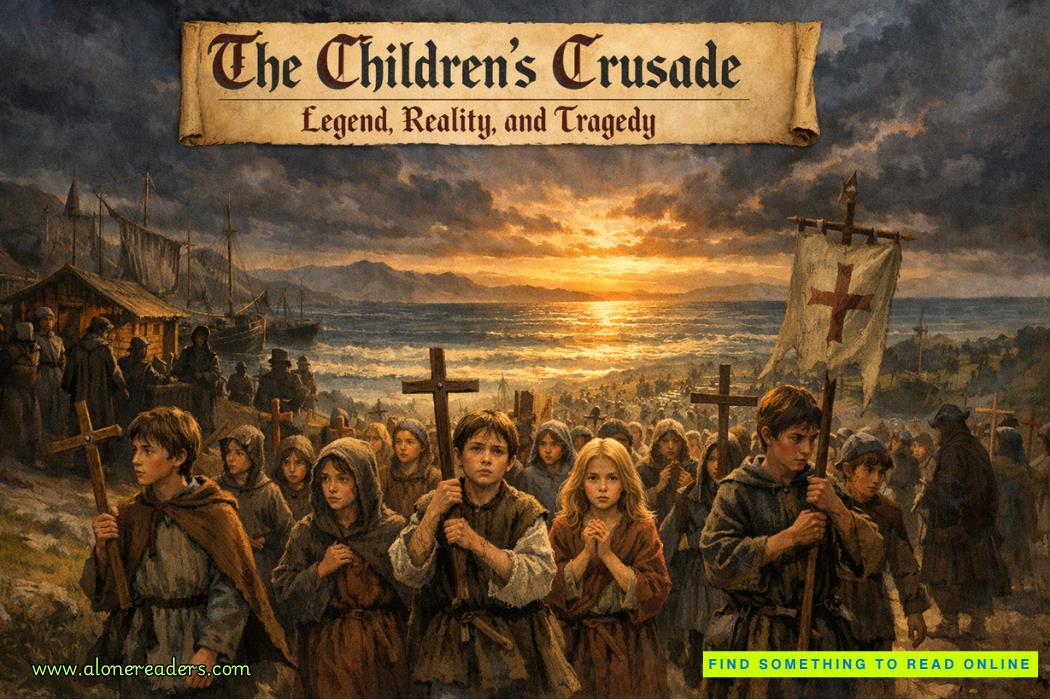
The story known as the Children’s Crusade has long occupied a peculiar place in the history of the Crusades. It stands at the intersection of piety and delusion, devotion and exploitation, legend and archival record. In the popular imagination, thousands of innocent children marched across Europe in 1212, convinced that God would part the Mediterranean Sea and grant them peaceful access to Jerusalem. Betrayed by merchants, sold into slavery, and scattered across foreign lands, they became victims of naïve faith and adult greed.
Yet the reality is more complex. Modern historical analysis reveals that the term “children” is itself problematic. Medieval sources speak of pueri, a Latin term that does not necessarily mean small children; it often referred to young people, adolescents, servants, landless poor, or socially marginal peasants. What unfolded in 1212 was not an officially sanctioned crusade, but a spontaneous popular religious movement shaped by economic distress, apocalyptic expectation, and the lingering memory of crusading triumphs and failures.
To understand the movement, one must situate it within the broader context of the Crusading era. The early thirteenth century was a time of profound tension in Latin Christendom. The Fourth Crusade had recently ended in disaster, culminating in the sack of Constantinople in 1204. The Holy Land remained largely under Muslim control, and enthusiasm for crusading had not dissipated, but it had become increasingly institutionalized and politically entangled. Simultaneously, Europe experienced social and economic pressures: population growth strained rural resources; marginal peasants and laborers drifted in search of opportunity; millenarian ideas circulated among the devout poor.
In this environment, two charismatic figures emerged independently in 1212: Stephen of Cloyes in France and Nicholas of Cologne in the German Rhineland. Their movements, though separate, became fused in later retellings.
Stephen, reportedly a shepherd boy from Cloyes near Vendôme, claimed to have received a letter from Christ delivered through a pilgrim—sometimes identified in legend as Christ in disguise. According to chroniclers, Stephen began preaching that a new crusade was necessary, not one of knights and princes, but of the pure and humble. His message resonated deeply among rural populations. Crowds gathered, drawn not merely by youthful fervor but by a profound sense that divine intervention might come through the innocent.
Accounts describe Stephen performing miracles—healing the sick, preaching with astonishing eloquence. Whether these miracles occurred is impossible to determine, but the reports reflect the emotional intensity and spiritual hunger of the crowds. Thousands followed him, moving southward toward Marseille. Their objective, according to later legend, was breathtaking in its simplicity: the sea would part for them as the Red Sea had parted for Moses, allowing them to walk dry-shod to the Holy Land.
This motif of miraculous passage likely emerged or expanded in later storytelling. Contemporary records are sparse and inconsistent. What is clearer is that a large popular procession moved toward the Mediterranean, expecting divine favor and possibly transportation.
In Germany, Nicholas of Cologne inspired a similar movement. His followers crossed the Alps into northern Italy, an arduous journey that would have tested even trained soldiers. Many likely perished from exhaustion, hunger, and exposure. Those who reached Italian cities such as Genoa found no parted sea awaiting them. Some dispersed and settled; others sought ships. A fraction may have attempted to continue toward Rome, hoping for papal endorsement.
The papal response is revealing. Pope Innocent III did not authorize the movement as a formal crusade. Chroniclers record that he reportedly praised the zeal of the participants but instructed them to return home. This suggests that ecclesiastical authorities viewed the movement with a mixture of admiration and alarm. It demonstrated the power of crusading ideology, yet it unfolded outside hierarchical control.
The most tragic and enduring legend concerns the fate of the French contingent at Marseille. According to later narratives, two merchants offered ships to transport the crusaders free of charge. Instead, the ships allegedly carried them to North Africa, where many were sold into slavery. While this story appears in thirteenth-century sources, historians debate its scale and reliability. It is plausible that some participants were indeed exploited. The Mediterranean slave trade was active, and vulnerable migrants would have been easy targets. However, the dramatic image of thousands of children betrayed en masse likely reflects narrative embellishment layered onto a smaller core of exploitation.
Modern scholarship has significantly revised the traditional understanding of the Children’s Crusade. Research into contemporary documents indicates that the participants were not exclusively children. Rather, they were primarily adolescents and impoverished young adults, accompanied by some older followers. The romanticized image of tiny, barefoot children marching in vast columns owes much to later medieval and early modern retellings, which amplified the pathos.
Nevertheless, even if we remove exaggeration, what remains is profoundly tragic. Thousands of marginal people left their homes under the conviction that God would intervene directly in history. Many suffered death, enslavement, starvation, or permanent displacement. Others simply faded back into obscurity, absorbed into Italian towns or rural communities.
The movement reveals crucial aspects of medieval religiosity. First, it underscores the intensity of crusading ideology. By 1212, crusading was not merely a policy of kings and popes; it was a cultural and spiritual current permeating village life. Second, it highlights the social instability of early thirteenth-century Europe. The term pueri often designated landless peasants detached from feudal protection. For them, crusading may have represented both spiritual purpose and escape from economic precarity.
Third, the episode exposes the tension between popular religious enthusiasm and institutional authority. The medieval Church carefully regulated crusading vows, indulgences, and military organization. An unsanctioned mass movement threatened ecclesiastical order. The Children’s Crusade thus stands as a case study in how grassroots piety could exceed clerical control.
It is also important to consider the power of narrative memory. Later medieval chroniclers, writing decades after 1212, shaped the event into a moral lesson. The innocence of children symbolized spiritual purity; their suffering symbolized the consequences of misguided zeal or corrupt exploitation. Over time, the story acquired allegorical resonance. It became a cautionary tale about blind faith and worldly deceit.
In modern historiography, the Children’s Crusade has been reinterpreted not as a singular “crusade” but as two overlapping popular religious movements embedded in broader patterns of medieval pilgrimage, poverty migration, and apocalyptic expectation. The fact that the term “Children’s Crusade” itself appears only in later sources underscores how memory can crystallize around emotionally potent imagery.
Yet legend persists for a reason. The image of children walking toward the sea, believing that God would part the waters, speaks to enduring themes in human history: the vulnerability of innocence, the magnetism of charismatic leadership, and the peril of collective delusion. Even stripped of exaggeration, the event remains a stark illustration of how faith, when detached from pragmatic structure, can expose the powerless to catastrophic risk.
The tragedy also reflects the Mediterranean world’s harsh realities. In the early thirteenth century, maritime commerce connected Christian and Muslim lands in complex networks of trade and conflict. Slavery, piracy, and mercenary warfare were not anomalies but integral components of the economic landscape. A mass of unprotected migrants arriving at a port city would have been highly vulnerable. Whether the scale reached legendary proportions or not, exploitation was entirely plausible.
Furthermore, the episode complicates simplistic narratives of medieval childhood. The modern conception of childhood as a protected, prolonged stage of dependency did not exist in the same form. Adolescents frequently worked, traveled, and assumed adult responsibilities. The participants in 1212 were likely capable of arduous travel, yet still socially marginal and easily manipulated.
Ultimately, the Children’s Crusade occupies a liminal space between documented history and mythic construction. It was neither the pure fairy-tale tragedy of thousands of tiny innocents nor a trivial footnote of peasant unrest. It was a moment when popular piety surged beyond institutional boundaries, when hope collided with geopolitical reality, and when Europe’s poorest sought divine transformation in a world governed by power and profit.
Its legacy endures precisely because it resists reduction. It invites reflection on the nature of faith movements, on how narratives evolve, and on the ethical responsibility of leadership. The tragedy was not merely that some participants may have perished or been enslaved. The deeper tragedy was that their belief in miraculous deliverance confronted a Mediterranean world shaped by commerce, politics, and violence.
In that collision between expectation and reality lies the enduring power of the Children’s Crusade—a story born in the fervor of 1212, refracted through centuries of retelling, and still capable of unsettling modern readers who confront the fragile boundary between devotion and disaster.



 The Hundred Days Offensive: How the Allies Defeated Germany in World War I
 The Second Battle of the Marne: The Turning Point of World War I in 1918
 The Spring Offensive of 1918: Germany's Final Gamble to Win World War I
 The Treaty of Brest-Litovsk: How Russia Left World War I
 The Russian Revolution and World War I: How War Brought Down the Tsar
 The Zimmermann Telegram Explained: Germany's Secret Offer to Mexico in World War I