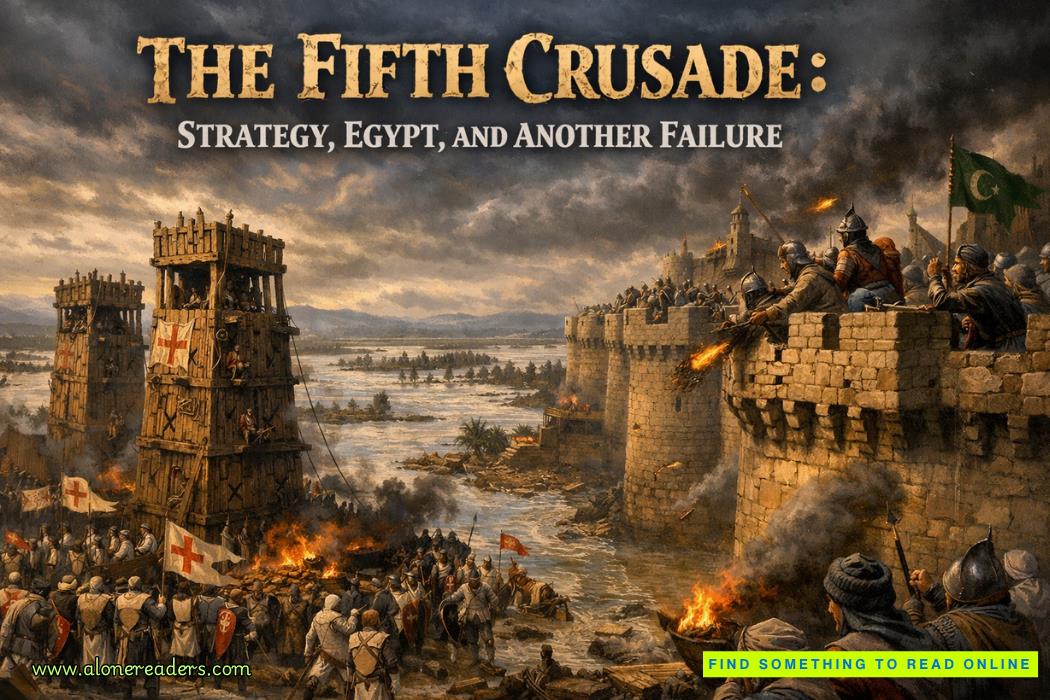
The Fifth Crusade stands as one of the most revealing episodes of medieval holy war, not because of its victories, but because of its strategic ambition, political fragmentation, and ultimate collapse in Egypt. Launched between 1217 and 1221, it was conceived as a calculated departure from earlier expeditions that had focused directly on Jerusalem. Instead, its architects believed that the key to reclaiming the Holy City lay elsewhere—in the fertile and militarily vital lands of Egypt. The logic appeared sound; the execution proved disastrous.
By the early thirteenth century, the Crusader states in the Levant were fragile enclaves. Jerusalem had been lost again in 1187 after the Battle of Hattin, briefly recovered through negotiation during the Third Crusade, and then forfeited once more. European leaders increasingly recognized that the Ayyubid Sultanate, founded by Saladin, derived its strength from Egypt’s immense agricultural wealth and strategic position. Egypt financed armies, supplied grain, and provided naval access through the Mediterranean and the Red Sea. Thus emerged a new strategic doctrine: strike Egypt to secure Jerusalem.
Pope Innocent III, one of the most assertive pontiffs of the Middle Ages, envisioned a disciplined and centrally coordinated crusade. He sought to avoid the factional chaos that had plagued earlier expeditions. Yet even before the crusade began, fissures appeared. European monarchs hesitated. Political conflicts within Christendom diverted resources. When Innocent died in 1216, his successor Honorius III inherited both the crusading project and its structural weaknesses.
The initial phase of the campaign saw forces from Hungary, Austria, and various German territories arrive in the eastern Mediterranean in 1217. Their early operations in the Levant achieved little beyond limited raids. The decisive shift came with the decision to target Damietta, a heavily fortified port city at the mouth of the Nile. Damietta controlled access to the river and, by extension, the path toward Cairo. Capturing it would provide a foothold in Egypt and potentially force the Ayyubids into negotiation.
The siege of Damietta, begun in 1218, illustrates both the ingenuity and the rigidity of Crusader strategy. The city’s defenses were formidable, including a massive tower guarding the Nile channel, secured by chains that prevented naval access. Crusaders engineered floating siege towers and eventually captured this defensive structure in a daring assault. It was a rare moment of tactical brilliance, demonstrating adaptability and technical skill.
Yet the siege dragged on for months, revealing deeper problems. Disease spread through the Crusader camp. Supplies dwindled. Coordination between contingents deteriorated. Leadership disputes emerged, most notably between secular nobles and the papal legate, Cardinal Pelagius. Pelagius insisted on strict ecclesiastical control and refused compromise with Muslim negotiators. This rigidity would become one of the defining characteristics of the expedition.
In 1219, after a prolonged blockade and severe famine within the city, Damietta finally fell to the Crusaders. The victory appeared monumental. Chroniclers described streets littered with the dead and survivors weakened by starvation. The capture of the city seemed to validate the Egyptian strategy. At this pivotal moment, however, an extraordinary diplomatic opportunity arose.
Al-Kamil, the Ayyubid sultan of Egypt, offered a proposal: he would return Jerusalem and other territories in exchange for the Crusaders’ withdrawal from Egypt. The offer reflected the internal pressures facing the Ayyubid realm, including rivalries among Saladin’s successors. From a purely strategic perspective, the proposal was astonishingly generous. The original objective of the Crusades—the recovery of Jerusalem—could have been achieved without further bloodshed.
Pelagius rejected the offer.
The refusal was rooted in both theological conviction and political calculation. Many crusaders believed total victory was within reach. They interpreted their success at Damietta as divine favor, a sign that Cairo itself might fall. Accepting compromise seemed tantamount to faithlessness. Moreover, some doubted the sincerity of al-Kamil’s proposal. The legate’s decision would prove catastrophic.
In 1221, the Crusader army advanced southward along the Nile toward Cairo. Here, environmental realities intersected fatally with strategic overconfidence. Egypt’s geography is governed by the annual Nile flood. As the Crusaders moved inland, the river rose, inundating fields and transforming terrain into marshland. Ayyubid forces, familiar with the environment, manipulated canals and floodgates to worsen conditions. The Crusaders found themselves trapped, cut off from supply lines, surrounded by hostile forces, and stranded in rising waters.
The resulting encirclement near al-Mansurah was a masterpiece of defensive strategy. Rather than engaging in a decisive pitched battle, the Ayyubids allowed nature to weaken their enemy. Starvation and disease spread. Morale collapsed. The once-confident invaders faced annihilation.
Negotiations resumed—but now from a position of desperation. The Crusaders agreed to surrender Damietta and evacuate Egypt in exchange for safe passage. The campaign ended not in triumphant conquest but in humiliating retreat. The Egyptian strategy, conceived as a bold masterstroke, had unraveled through miscalculation, inflexibility, and environmental ignorance.
The Fifth Crusade exposes the limits of medieval strategic thinking. On paper, the decision to target Egypt was logical. Egypt was the economic heart of the Ayyubid state. Controlling it would have shifted the balance of power irreversibly. Yet strategy cannot succeed without cohesion, adaptability, and realistic assessment of logistics. The Crusaders possessed neither unity of command nor sufficient understanding of Nile hydrology.
Political fragmentation compounded these weaknesses. Secular leaders often clashed with ecclesiastical authority. Pelagius’s dominance alienated experienced nobles. Coordination between European contingents was inconsistent. The absence of a powerful monarch—such as Richard the Lionheart in the Third Crusade—left leadership diffused and contested.
Equally significant was the failure to appreciate diplomatic opportunity. The rejection of al-Kamil’s offer remains one of the most debated decisions in crusading history. Some argue that distrust was justified; others contend that the crusaders squandered their best chance to secure Jerusalem for generations. What is undeniable is that ideological absolutism overrode pragmatic calculation.
The campaign also underscores the interplay between environment and warfare. Medieval armies depended heavily on local supply lines and favorable terrain. In Egypt, unfamiliar climate, seasonal flooding, and engineered waterways became decisive factors. The Ayyubids’ ability to weaponize geography transformed the Nile into an ally. The Crusaders, by contrast, were trapped by their ignorance.
The Fifth Crusade’s failure reverberated across Christendom. Confidence in papal leadership suffered. The immense financial and human costs deepened fatigue toward crusading ventures. Yet paradoxically, the defeat did not end crusading zeal. Instead, it paved the way for the Sixth Crusade, led by Emperor Frederick II, who pursued negotiation rather than conquest to regain Jerusalem temporarily.
In broader perspective, the Fifth Crusade illustrates a recurring pattern within the Crusading movement: grand strategic vision undermined by internal division and overreach. The idea of striking Egypt would resurface in later campaigns, including the Seventh Crusade under Louis IX. The logic endured; the practical challenges persisted.
The episode also highlights the adaptability of the Ayyubid state. Despite internal rivalries, it demonstrated resilience, tactical sophistication, and diplomatic agility. Al-Kamil’s willingness to negotiate reveals a pragmatic approach to power, contrasting sharply with the ideological rigidity of some Crusader leaders.
Ultimately, the Fifth Crusade was not merely another failed expedition; it was a cautionary tale about the dangers of conflating faith with strategy. Religious conviction provided motivation and unity of purpose, but it could not compensate for logistical misjudgment or environmental miscalculation. The campaign’s collapse in the flooded plains of Egypt symbolizes the broader limitations of crusading warfare in a complex and shifting geopolitical landscape.
In examining this episode, one sees that failure was not inevitable. Damietta’s capture created genuine leverage. A negotiated settlement might have altered the trajectory of Near Eastern history. Instead, ambition outran capacity. The Crusaders mistook tactical success for strategic inevitability.
The Fifth Crusade therefore occupies a critical place in the history of the Crusades. It reveals the transformation of crusading thought from impulsive pilgrimage-war to calculated geopolitical campaign. It demonstrates the maturation of Islamic defensive strategy. And it underscores a timeless lesson: strategy divorced from adaptability invites disaster.
When the Crusaders departed Egypt in 1221, they left behind more than a relinquished city. They left behind an opportunity lost to pride and misjudgment. The Nile continued to flow, indifferent to ideology. The dream of securing Jerusalem through conquest of Egypt remained unrealized, another chapter in a series of ambitious undertakings undone by human frailty.
In the end, the Fifth Crusade stands as a study in contrast—bold conception and flawed execution, momentary triumph and lasting failure, fervent belief and harsh reality. Its story is not simply one of defeat, but of strategic evolution and the sobering recognition that even the most compelling plans can falter when confronted by the complexities of politics, environment, and human ambition.




 The Hundred Days Offensive: How the Allies Defeated Germany in World War I
 The Second Battle of the Marne: The Turning Point of World War I in 1918
 The Spring Offensive of 1918: Germany's Final Gamble to Win World War I
 The Treaty of Brest-Litovsk: How Russia Left World War I
 The Russian Revolution and World War I: How War Brought Down the Tsar
 The Zimmermann Telegram Explained: Germany's Secret Offer to Mexico in World War I