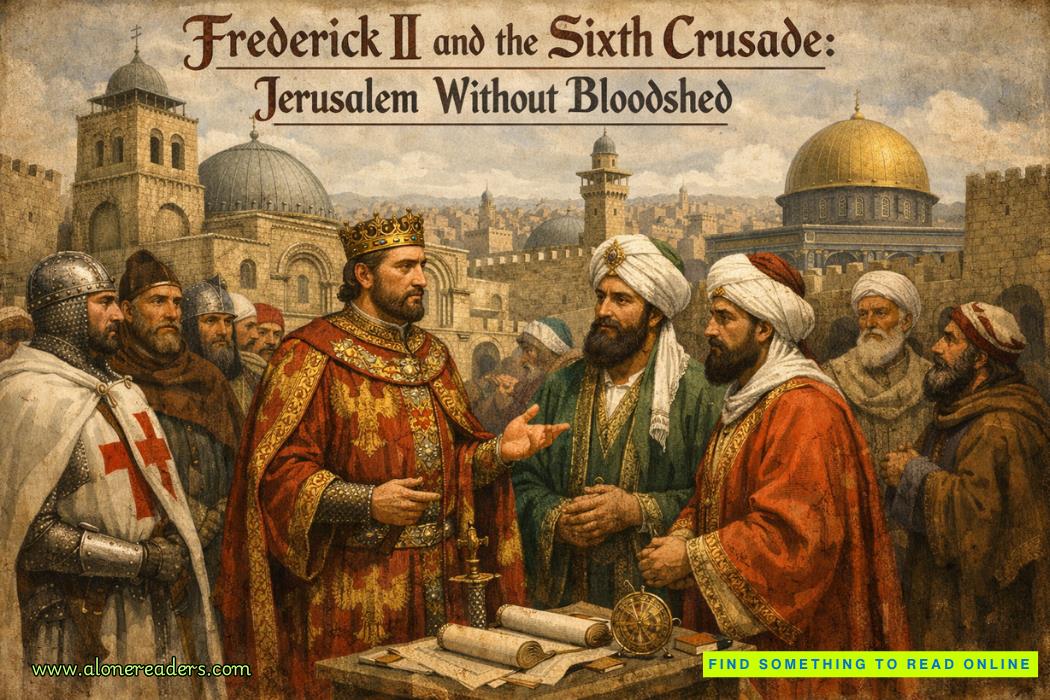
The history of the Crusades is overwhelmingly associated with siege warfare, fanaticism, massacre, and prolonged bloodshed. Yet within this violent tapestry stands a striking anomaly: the Sixth Crusade, led not by a typical crusading warlord but by one of medieval Europe’s most intellectually complex rulers, Frederick II. In 1229, without waging a major battle, without storming walls, and without orchestrating mass slaughter, Frederick secured control of Jerusalem through negotiation with Al-Kamil. It was an outcome so unusual that contemporaries struggled to categorize it. Was this a crusade—or a diplomatic coup?
To understand the uniqueness of the Sixth Crusade, one must first grasp Frederick’s extraordinary personality. Born in 1194, King of Sicily from childhood and later Holy Roman Emperor, Frederick was not a conventional medieval monarch. He was fluent in multiple languages, fascinated by science, falconry, philosophy, and Islamic culture. Raised in multicultural Sicily—where Latin Christians, Greek Christians, Muslims, and Jews coexisted—he developed an intellectual openness that set him apart from other crusader leaders. Unlike earlier crusading monarchs who framed their expeditions in strictly apocalyptic or penitential terms, Frederick approached the East with the mind of a statesman.
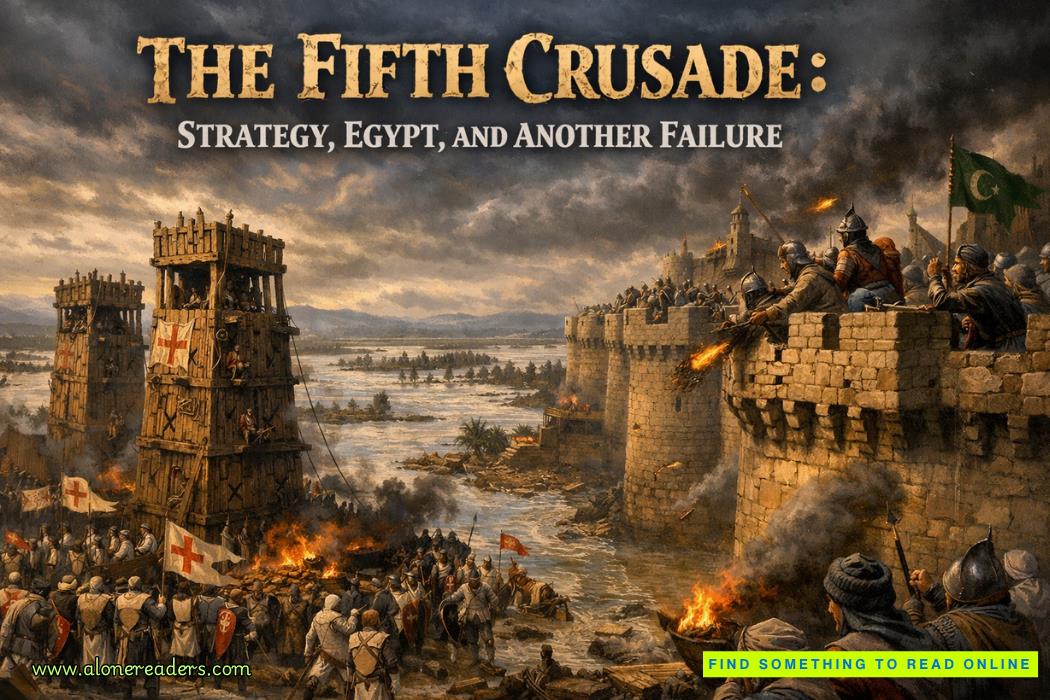
By the early 13th century, the crusading movement was faltering. The catastrophic Fourth Crusade had diverted to Constantinople in 1204, leaving a fractured Byzantine world. The Fifth Crusade (1217–1221) had attempted to capture Egypt but ended in humiliating failure at Damietta. Yet the papacy remained committed to recovering Jerusalem, which had been under Muslim control since 1187, when Saladin defeated the Crusader states at Hattin.
Frederick had taken the cross in 1215, promising to lead a new crusade. However, his repeated delays—due to political consolidation in Germany and Sicily—infuriated the papacy. Pope Gregory IX eventually excommunicated him in 1227 for failing to fulfill his vow. It is one of the great paradoxes of medieval history that the only crusade to regain Jerusalem peacefully was led by an excommunicated emperor.
Despite his excommunication, Frederick sailed east in 1228. His army was modest by crusading standards. There was no massive host of European knights; no grand coalition of princes. The military resources available to him were limited, and he understood that a direct confrontation with the Ayyubid forces would likely fail. But the geopolitical situation in the Islamic world presented an opportunity.
After Saladin’s death in 1193, the Ayyubid realm fragmented among his heirs. By the 1220s, al-Kamil, Sultan of Egypt, was locked in internal rivalries with his relatives who controlled Syria. He feared that Jerusalem, strategically vulnerable and difficult to defend, could become a liability if attacked by his Muslim rivals. Thus, from al-Kamil’s perspective, negotiation with Frederick might serve both tactical and strategic purposes.
Frederick and al-Kamil had already initiated correspondence before the crusade began. Their letters reveal mutual respect and intellectual curiosity. Frederick admired Islamic learning; al-Kamil recognized Frederick as a rational monarch rather than a zealot. Their communication was pragmatic, not ideological.
The negotiations culminated in the Treaty of Jaffa in February 1229. Under its terms, Jerusalem, Bethlehem, and Nazareth were ceded to Christian control for ten years. Crucially, the Temple Mount—including the Dome of the Rock and Al-Aqsa Mosque—remained under Muslim administration. Muslim residents retained access to their holy sites. There was no forced conversion, no expulsion, and no mass violence.
For the first time since 1187, Jerusalem returned to Christian hands—without siege, without massacre, without crusader carnage.
The agreement shocked both Christian and Muslim observers. Many Muslim scholars condemned al-Kamil for surrendering Islam’s third-holiest city without battle. Yet al-Kamil likely calculated that Jerusalem’s symbolic value outweighed its strategic utility. The city lacked strong fortifications and had little economic significance compared to Cairo or Damascus. By conceding it temporarily, he secured peace on his western flank while focusing on internal threats.
On the Christian side, reaction was equally ambivalent. The papacy, still hostile toward Frederick, refused to recognize his achievement as legitimate. Because he was excommunicated, the Church hierarchy in the Latin East declined to cooperate with him. When Frederick entered Jerusalem in March 1229, no clergy officiated his coronation.
In a dramatic and controversial gesture, Frederick crowned himself King of Jerusalem inside the Church of the Holy Sepulchre. It was a symbolic act of sovereignty achieved not through papal blessing but through political calculation.
Yet his kingship was fragile. The treaty guaranteed access and nominal sovereignty, but Jerusalem’s fortifications had been dismantled. The city was vulnerable. Moreover, many crusader barons in the region distrusted Frederick’s centralized authority. The Teutonic Knights supported him; the Templars and Hospitallers were more skeptical.
Frederick’s approach represented a profound shift in crusading ideology. Earlier crusades were framed as penitential warfare—armed pilgrimage infused with eschatological urgency. The Sixth Crusade instead resembled high diplomacy conducted under crusading rhetoric. Frederick did not deliver sermons calling for holy slaughter. He negotiated territorial concessions in exchange for political stability.
This pragmatic methodology unsettled contemporaries because it blurred moral boundaries. Was the recovery of Jerusalem valid if achieved through compromise? Could a city sacred to Christianity be shared administratively with Muslims? For hardliners, the answer was no. For Frederick, the answer was unequivocally yes.
The episode exposes the tension between ideology and realpolitik in medieval geopolitics. Frederick recognized that Jerusalem was more valuable as a diplomatic asset than as a battlefield trophy. He leveraged al-Kamil’s internal vulnerabilities and secured what decades of crusading warfare had failed to achieve permanently.
However, the settlement was inherently temporary. In 1244, just fifteen years after the treaty, Khwarazmian forces allied with Egyptian Ayyubids recaptured Jerusalem violently. The city would not return to lasting Christian control. Thus, some historians argue that Frederick’s triumph was ephemeral.
Yet its significance transcends its duration. The Sixth Crusade demonstrates that even during one of history’s most polarized religious conflicts, negotiation was possible. It challenges simplistic narratives portraying the Crusades as monolithic clashes of civilizations. Instead, it reveals a landscape of shifting alliances, political pragmatism, and strategic compromise.
Frederick’s intellectual disposition played a central role. He surrounded himself with scholars, engaged in theological debates with Muslim thinkers, and sponsored translations of Arabic scientific works. His court in Palermo was a crossroads of Mediterranean knowledge. Unlike crusaders who demonized Islam categorically, Frederick treated Muslim rulers as political counterparts rather than existential enemies.
This attitude does not make him a modern secularist; he remained a Christian monarch committed to dynastic ambition. But his worldview was unusually cosmopolitan for his era. He understood power not merely as military dominance but as negotiation, leverage, and perception.
The Sixth Crusade also reshaped papal-imperial relations. Pope Gregory IX viewed Frederick’s independent diplomacy as a threat to papal authority. If an excommunicated emperor could reclaim Jerusalem without papal sanction, it undermined the Church’s claim to spiritual leadership over crusading. The conflict between Frederick and the papacy intensified, contributing to broader struggles between empire and papal monarchy throughout the 13th century.
In many ways, Frederick embodied contradictions. He was labeled “Stupor Mundi”—the Wonder of the World—by admirers and “Antichrist” by critics. He championed scientific inquiry yet ruled with autocratic authority. He pursued crusade yet defied the pope. He reclaimed Jerusalem yet alienated many crusaders.
The Sixth Crusade therefore stands not merely as a diplomatic success but as a mirror reflecting the complexity of medieval politics. It forces us to reconsider assumptions about inevitability of violence in religious conflicts. It illustrates that even amid crusading fervor, political rationality could prevail over fanaticism.
Jerusalem’s peaceful transfer in 1229 did not erase centuries of hostility. It did not end the Crusades. But it momentarily redefined what crusading could mean. Instead of swords clashing at city gates, we see envoys exchanging proposals. Instead of mass graves, we see shared custodianship of sacred space.
Frederick’s experiment in diplomacy ultimately failed to produce lasting stability, yet its symbolism endures. It reminds historians that medieval actors were not caricatures driven solely by blind faith. They were strategists navigating fluid political landscapes.
In assessing Frederick II and the Sixth Crusade, one must resist both romanticization and dismissal. He was neither a modern pacifist nor a cynical opportunist alone. He was a ruler operating within medieval constraints who recognized an opportunity for bloodless gain and seized it.
Jerusalem Without Bloodshed was not an accident. It was the product of calculation, cultural fluency, and geopolitical timing.
And in the long arc of crusading history—defined so often by carnage—the Sixth Crusade remains a rare and compelling anomaly: a moment when diplomacy briefly triumphed over war.



 The Hundred Days Offensive: How the Allies Defeated Germany in World War I
 The Second Battle of the Marne: The Turning Point of World War I in 1918
 The Spring Offensive of 1918: Germany's Final Gamble to Win World War I
 The Treaty of Brest-Litovsk: How Russia Left World War I
 The Russian Revolution and World War I: How War Brought Down the Tsar
 The Zimmermann Telegram Explained: Germany's Secret Offer to Mexico in World War I










