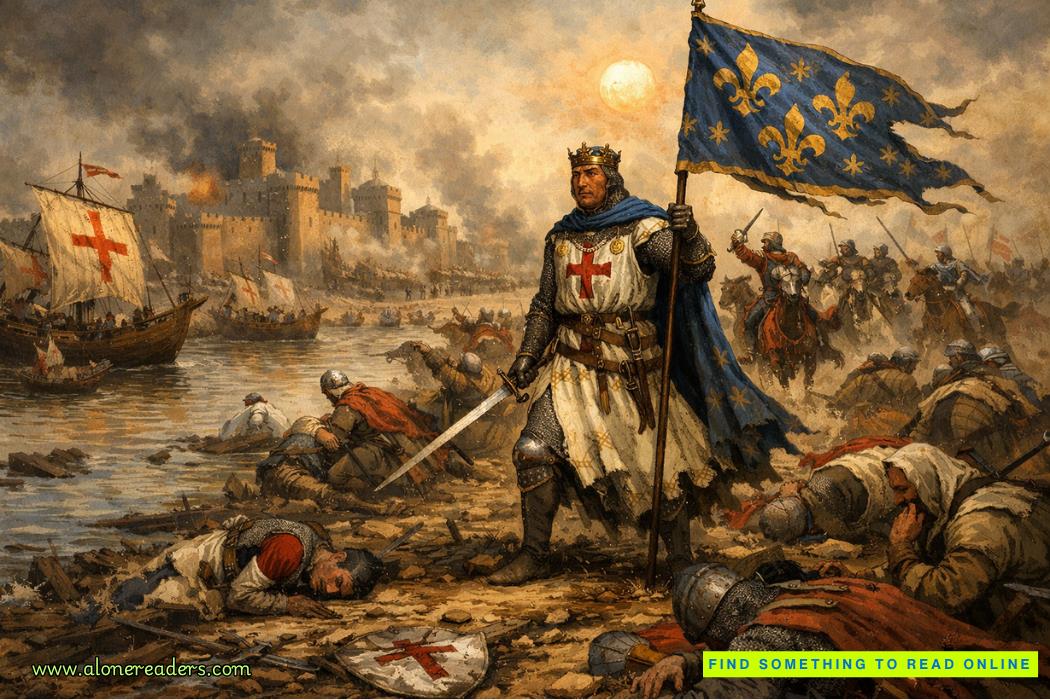
The Seventh Crusade stands as one of the most revealing episodes of the medieval crusading movement, not because of triumph but because of ambition undone by miscalculation. Led by King Louis IX of France, later canonized as a saint, the campaign (1248–1254) sought to strike at the heart of Islamic power in the eastern Mediterranean by attacking Egypt. Instead, it culminated in military disaster, mass death, and the unprecedented capture of a reigning European monarch. In this catastrophe lay the unraveling of old crusading assumptions and the exposure of a new political reality in the Near East.
By the mid-thirteenth century, the crusading enterprise was already weakened. The catastrophic loss of Jerusalem in 1244 to the Khwarazmian Turks and their Ayyubid allies sent shockwaves across Latin Christendom. The defeat of crusader forces at La Forbie the same year destroyed much of the remaining military strength of the Kingdom of Jerusalem. The symbolic and spiritual heart of the crusader states had fallen once more, and Europe was confronted with the grim reality that the Holy Land could not be secured through piecemeal defense. It required decisive action.
Louis IX, king of France since 1226, was uniquely suited to take up this mantle. Deeply pious, disciplined, and convinced of his sacred duty as a Christian ruler, Louis had already cultivated a reputation as a just and devout monarch. After recovering from a near-fatal illness in 1244, he took the cross, believing his survival to be divinely ordained for a holy mission. For Louis, crusading was not political opportunism; it was an act of spiritual obedience. Yet religious conviction does not guarantee strategic clarity.
The strategic logic behind targeting Egypt was not new. During the Fifth Crusade (1218–1221), crusaders had recognized Egypt as the economic and logistical center of Muslim power in the eastern Mediterranean. Control of the Nile Delta and Cairo would, in theory, cripple Ayyubid authority and force concessions in Palestine. Egypt’s wealth financed armies; its grain fed populations; its ports linked the Islamic world with Mediterranean trade networks. To seize Egypt was to strike at the heart.
Louis spent years preparing meticulously. He assembled one of the most formidable armies of the crusading era, financed through royal taxation and extraordinary levies. He constructed a new port at Aigues-Mortes to facilitate departure. His forces included French knights, infantry, and allied contingents, supported by naval strength that allowed direct transport to the eastern Mediterranean. In scale and organization, the expedition reflected the growing centralization and administrative sophistication of Capetian France.
The crusade departed in 1248, wintering in Cyprus before launching its assault on Egypt in June 1249. The first objective was Damietta, a key port in the Nile Delta. In a striking early success, crusader forces captured the city with relative ease after the Ayyubid defenders abandoned it. This rapid victory emboldened the army and seemed to confirm the strategic soundness of the Egyptian plan. Louis established Damietta as a base of operations, and for a moment, it appeared that history might repeat the initial triumphs of the Fifth Crusade.
Yet this early success concealed structural weaknesses. The Nile Delta was not simply a battlefield; it was a living hydraulic system governed by seasonal flooding. Military operations depended on river levels, supply lines, and control of narrow causeways threading through marshlands. European knights, trained for open-field cavalry warfare, struggled in terrain that neutralized their strengths. Moreover, the climate proved punishing. Disease began to spread through the crusader camp, and supply shortages loomed as months passed.
Complicating matters further was a political transformation within Egypt itself. The Ayyubid sultan al-Salih Ayyub fell gravely ill and died in November 1249. His death might have precipitated collapse, but instead it triggered the rise of a new military elite: the Mamluks. These slave-soldiers, trained in rigorous cavalry warfare and fiercely loyal to their commanders, rapidly consolidated power. Under leaders such as Baybars, they organized a disciplined resistance that would soon define the future of the region.
Louis faced a critical decision: remain in Damietta and consolidate, or march toward Cairo and force a decisive confrontation. Driven by the logic of offensive momentum and perhaps by a desire to capitalize on perceived instability among the Egyptians, he advanced southward in late 1249 and early 1250. The target was Mansurah, a fortified position guarding the approach to Cairo.
The approach to Mansurah revealed the fatal flaw in crusader strategy. The Nile’s branching waterways forced the army into vulnerable crossings. At one such crossing, a daring assault led by Robert of Artois, the king’s brother, initially achieved surprise but devolved into chaos within the city’s narrow streets. Mamluk forces counterattacked with ferocity and tactical discipline. Robert was killed, along with much of the attacking force. The engagement demonstrated a stark truth: the crusaders were fighting an enemy that had adapted, learned, and hardened since earlier crusading encounters.
The Battle of Mansurah became a grinding stalemate. Crusader forces, weakened by dysentery and scurvy, found themselves trapped between fortified opposition and dwindling supplies. The Nile, once envisioned as a highway of conquest, became a barrier. Egyptian forces harassed the crusader camp relentlessly, cutting supply lines and exploiting mobility advantages. Morale deteriorated as the army’s condition worsened.
In April 1250, the crusaders attempted retreat toward Damietta. It was a disastrous withdrawal. Harried by Mamluk cavalry and ravaged by disease, the army disintegrated. Near Fariskur, Louis IX himself was captured along with thousands of his men. The spectacle of a crowned king in chains was unprecedented in crusading history. It shattered the aura of invincibility surrounding European monarchs and underscored the scale of the defeat.
The ransom demanded for Louis’s release was enormous: a substantial sum in gold and the surrender of Damietta. The terms were accepted. In May 1250, Louis was freed, and Damietta returned to Egyptian control. The crusade’s central objective had not merely failed—it had reversed itself.
Yet the story did not end with immediate departure. In a remarkable display of resolve, Louis chose not to return directly to France. Instead, he remained in the Levant for several years, attempting to strengthen the remaining crusader states through diplomacy, fortification projects, and negotiations. He fortified cities such as Acre and sought alliances with local powers, including Mongol forces advancing from the east. His presence provided temporary stability and moral encouragement to the beleaguered Latin communities.
Nevertheless, the structural realities had shifted irreversibly. The Mamluks, having seized power in Egypt, would soon become the dominant military force in the eastern Mediterranean. Their leadership was pragmatic, militarized, and uncompromising. Within decades, they would systematically dismantle the remaining crusader strongholds, culminating in the fall of Acre in 1291.
The Seventh Crusade’s failure illuminated deeper transformations within both Christendom and the Islamic world. For Europe, it revealed the limits of chivalric warfare in unfamiliar terrain and against adaptive opponents. It exposed logistical fragility and the dangers of overconfidence born from early victories. For the Islamic Near East, it marked the consolidation of Mamluk authority and the emergence of a centralized military state capable of resisting and eventually expelling crusader forces.
Louis IX himself emerged from captivity with his personal piety intact but his strategic vision chastened. He would later launch another crusade in 1270, targeting Tunis in what became the Eighth Crusade. That expedition ended with his death from disease. His sainthood reflects the medieval Church’s valuation of intention and devotion over military success. Yet historically, the Seventh Crusade stands not as a testament to sanctity but as a study in strategic miscalculation.
The campaign underscores a recurring pattern in crusading history: the tension between spiritual aspiration and geopolitical complexity. European rulers often framed crusades in absolutist religious terms, but the operational theater of the eastern Mediterranean was shaped by shifting alliances, internal rivalries, and ecological constraints. Egypt was not merely an objective; it was a sophisticated political and economic center defended by increasingly professionalized forces.
Moreover, the Seventh Crusade highlighted the evolution of warfare. The heavily armored knight, once dominant on European battlefields, proved vulnerable in riverine and urban environments where mobility and coordination mattered more than individual valor. The Mamluks’ disciplined cavalry tactics, combined with knowledge of terrain and flexible command structures, outmatched crusader methods.
Perhaps most significantly, the crusade demonstrated that the crusading movement had entered a new phase. The era of dramatic territorial conquests was over. What remained were defensive struggles, diplomatic maneuvering, and isolated campaigns lacking the broad, pan-European mobilization of earlier centuries. The spiritual rhetoric persisted, but the geopolitical landscape had hardened against it.
In retrospect, the disaster in Egypt was not an aberration but a culmination. It reflected accumulated strains within the crusading enterprise and heralded its gradual decline. Louis IX’s ambition to secure Christendom’s eastern frontier through decisive conquest faltered against the realities of climate, logistics, and adaptive opposition.
Yet the Seventh Crusade endures as a compelling episode precisely because of its human dimension. A devout king risking everything for faith; soldiers enduring disease and despair in foreign lands; emerging powers reshaping regional politics; and a dramatic reversal that altered historical trajectories. It encapsulates the fragility of medieval grand strategy and the enduring gap between aspiration and outcome.
In the sands and waterways of Egypt, beneath the burning sun of the Nile Delta, the dream of reconquering Jerusalem through Egyptian conquest dissolved. What remained was a sobering lesson: holy war could inspire courage, but it could not suspend geography, climate, or political evolution. The Seventh Crusade thus stands not merely as a failed campaign, but as a turning point—where the confidence of crusading Europe confronted the rising strength of a transformed Islamic world, and where devotion met disaster.



 The Hundred Days Offensive: How the Allies Defeated Germany in World War I
 The Second Battle of the Marne: The Turning Point of World War I in 1918
 The Spring Offensive of 1918: Germany's Final Gamble to Win World War I
 The Treaty of Brest-Litovsk: How Russia Left World War I
 The Russian Revolution and World War I: How War Brought Down the Tsar
 The Zimmermann Telegram Explained: Germany's Secret Offer to Mexico in World War I










