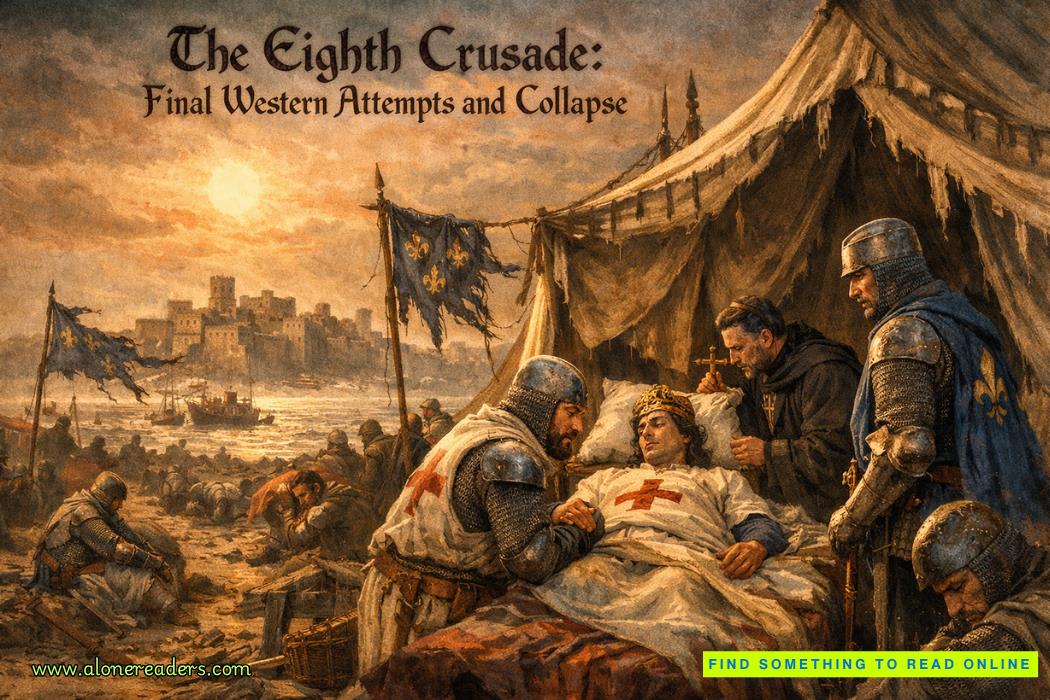
The Eighth Crusade of 1270 stands not as a triumphant campaign of faith, nor even as a desperate military gamble, but as a solemn epilogue to two centuries of crusading ambition. When King Louis IX of France sailed once more under the banner of the cross, he was not merely launching another expedition to the eastern Mediterranean; he was attempting to revive a crusading movement that had already begun to rot from within. The expedition would end not in battle glory, nor in negotiated conversion, but in disease, political embarrassment, and the quiet recognition that Western Christendom had exhausted its crusading momentum.
To understand the Eighth Crusade is to situate it within the long arc of crusading decline. By 1270, the Latin Kingdom of Jerusalem had been reduced to a fragile chain of coastal enclaves. The fall of Jerusalem in 1244, followed by the catastrophic defeat at La Forbie, had permanently shattered hopes of restoring stable Frankish rule inland. Louis IX’s earlier expedition, often referred to as the Seventh Crusade, had already demonstrated the limitations of Western power projection into the Islamic world. His capture at Mansurah in Egypt in 1250 exposed the vulnerability of even the most disciplined European armies when confronted by experienced Muslim forces under the emerging Mamluk regime. Yet Louis, canonized later as a saint, remained convinced that divine providence still demanded action.
What distinguishes the Eighth Crusade is not its scale, but its strategic miscalculation. Rather than directly targeting the Levant or Egypt, Louis turned his attention to Tunis. This decision was not impulsive. Tunis, ruled by the Hafsid dynasty, occupied a pivotal position in Mediterranean trade networks and maintained diplomatic contact with Christian powers. There were rumors—likely exaggerated or misinterpreted—that the Hafsid ruler might be open to conversion or at least political alignment with France. Moreover, Louis’s brother, Charles of Anjou, king of Sicily, had his own geopolitical ambitions in North Africa. The crusade thus began less as a coherent holy war and more as a convergence of dynastic strategy and fading religious zeal.
When the crusading fleet departed in the summer of 1270, the expedition lacked the overwhelming enthusiasm that had characterized earlier crusades. The age of spontaneous mass mobilization was over. Urban economies were more sophisticated; monarchies were consolidating administrative power; and the papacy’s ability to ignite universal fervor had diminished. The crusade was, in effect, a royal enterprise, heavily dependent on French leadership rather than pan-European momentum.
Upon arrival near Tunis in July 1270, the crusaders established camp in sweltering heat. North Africa in high summer was a brutal environment for European troops unfamiliar with its climate. Sanitation deteriorated rapidly. Supplies became strained. Disease—likely dysentery or typhus—spread through the camp with merciless efficiency. Instead of confronting Muslim armies in a decisive clash, the crusaders were immobilized by sickness.
It was in this environment that Louis IX himself fell ill. The king, already weakened by age and prior campaigns, succumbed on August 25, 1270. His death transformed the expedition from a military campaign into a symbolic catastrophe. The crusade had lost not merely its commander but its moral center. Louis had embodied the ideal of the crusading monarch: pious, disciplined, and unwavering in his conviction that faith justified sacrifice. With his passing, the enterprise seemed hollow.
Charles of Anjou soon assumed leadership, but his priorities differed markedly. Where Louis had framed the expedition as a sacred duty, Charles approached it with political pragmatism. Negotiations with the Hafsid ruler resulted in a treaty that granted commercial concessions and indemnities to Sicily and France. The crusading army withdrew without achieving territorial conquest, conversion, or decisive strategic gain. The outcome resembled a trade agreement more than a holy war. In this sense, the Eighth Crusade marked the transformation of crusading from spiritual warfare into transactional diplomacy.
The broader geopolitical context underscores the campaign’s futility. The Mamluk Sultanate under Sultan Baybars—and later Qalawun—was systematically dismantling the remaining Crusader strongholds in the Levant. Antioch had fallen in 1268. The Latin presence was contracting year by year. The notion that a campaign in Tunis could meaningfully reverse this trajectory was strategically naive. The center of Muslim power had consolidated in Egypt and Syria, and the Mamluks possessed a highly professionalized military elite. Western forces, by contrast, were logistically stretched and politically fragmented.
Furthermore, the crusading ideal itself had eroded. In earlier centuries, crusading indulgences, papal preaching, and apocalyptic expectation had generated waves of collective religious fervor. By the late thirteenth century, crusading rhetoric struggled to compete with emerging national interests. Monarchs were increasingly preoccupied with territorial consolidation within Europe. Economic priorities shifted toward trade expansion rather than costly overseas warfare. Italian maritime republics—Venice, Genoa, and Pisa—had long treated crusading theaters as commercial zones rather than sacred battlegrounds. The Eighth Crusade unfolded in a world where economic rationality was beginning to outweigh millenarian passion.
The death of Louis IX also had profound symbolic consequences. Canonized in 1297, he would be remembered as the last great crusader king. Yet his final campaign did not inspire renewal; it confirmed exhaustion. The crusading project had depended heavily on charismatic leadership capable of fusing piety with military authority. Without such figures, the movement lacked cohesion. Later attempts, including the Ninth Crusade led by Prince Edward of England, would be limited in scale and impact. The fall of Acre in 1291 would ultimately extinguish the last significant Crusader stronghold in the Holy Land.
The Eighth Crusade thus represents a terminal phase in Western crusading. Its failure was not merely tactical but structural. The logistical challenges of long-distance warfare, the resilience of Muslim polities, and the shifting priorities of European states rendered large-scale crusades increasingly untenable. Moreover, the moral narrative had changed. Early crusaders marched under the conviction that they were reclaiming sacred geography. By 1270, the concept of a unified Christendom fighting for Jerusalem had fragmented under political realism.
It is also important to note the Mediterranean dimension. The crusade to Tunis reveals how the crusading movement had expanded geographically beyond the Levant, targeting North Africa, Iberia, and even Eastern Europe. Yet this expansion diluted its focus. Tunis was not Jerusalem. Its selection exposed the adaptability—but also the opportunism—of crusading ideology. Holy war could now be invoked to justify campaigns aligned with dynastic or commercial interests.
From the Islamic perspective, the Eighth Crusade reinforced confidence in Muslim military superiority. The Mamluks had already demonstrated their effectiveness against both Mongols and Crusaders. The failure of Louis IX’s final campaign signaled that Western Christendom lacked the capacity to mount sustained offensives against consolidated Muslim states. This psychological shift mattered. The era of Crusader states threatening inland Muslim cities was definitively over.
Internally, the crusade also strained French resources. Financing such expeditions required taxation and borrowing on a scale that increasingly burdened royal administrations. The economic cost-to-benefit ratio grew unfavorable. As bureaucratic states matured, rulers calculated risk more pragmatically. Crusading, once framed as spiritual investment with eternal reward, became subject to fiscal scrutiny.
The environmental factor should not be underestimated. Medieval armies were acutely vulnerable to disease. In Tunisia, climate proved more lethal than enemy swords. The image of crusaders perishing from illness rather than martyrdom undermined the romanticized aura of holy war. Death by plague lacked the narrative potency of death in battle. It exposed the fragility of crusading enterprise against natural forces beyond theological interpretation.
Ultimately, the Eighth Crusade serves as a lens through which we observe the transformation of medieval Europe itself. By the late thirteenth century, Europe was entering a phase of political centralization, commercial expansion, and intellectual diversification. Universities flourished. Scholastic theology matured. Maritime trade networks expanded across the Mediterranean and into the Atlantic. The energies once channeled into crusading were redirected toward statecraft, commerce, and internal development.
Yet the memory of crusading did not vanish. It lingered as rhetoric, as cultural myth, and as political tool. Later centuries would romanticize figures like Louis IX while overlooking the strategic futility of their final campaigns. The Eighth Crusade, stripped of legend, reveals a sobering reality: the age of expansive Western holy war had reached its practical limits.
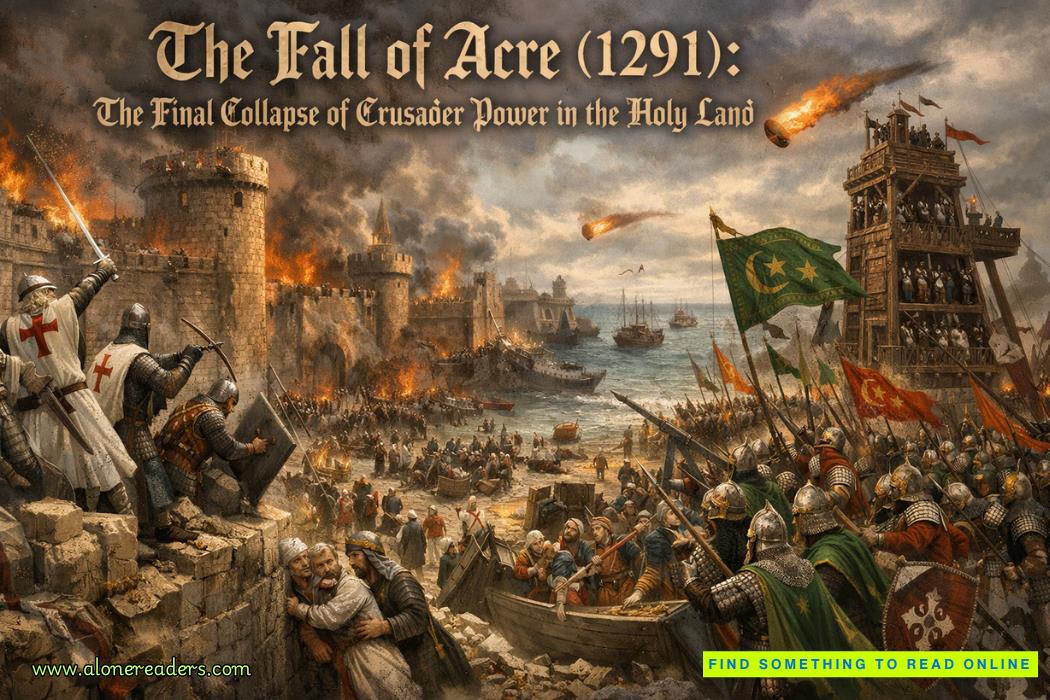
When Acre fell two decades later, it confirmed what Tunis had already foreshadowed. The Crusader experiment in the Levant was unsustainable against unified and militarily sophisticated Muslim powers. The maritime evacuation of remaining Latin forces marked the end of an era begun with the First Crusade in 1096. Between those bookends lies a story of faith, violence, ambition, and adaptation.
In evaluating the Eighth Crusade, one must resist the temptation to view it merely as an isolated failure. It was the cumulative endpoint of structural decline. Its significance lies less in battlefield outcomes and more in what it symbolizes: the waning of a worldview that once mobilized entire societies. The crusading movement had promised redemption through conquest. By 1270, it delivered negotiation, retreat, and exhaustion.
Thus, the Eighth Crusade stands as a quiet collapse rather than a dramatic defeat. No single catastrophic battle ended the crusading age. Instead, it ebbed through miscalculation, disease, diplomacy, and shifting priorities. Louis IX’s death in a North African camp encapsulates the paradox: a king sanctified for his devotion, yet presiding over the twilight of the very cause he embodied.
In the broader narrative of medieval history, the campaign marks a transition from crusading Christendom to emerging nation-states. The ideological unity that had once bound Europe under papal banners gave way to regional interests and pragmatic governance. The Mediterranean would remain contested, but increasingly through trade competition and naval rivalry rather than universal holy war.
The Eighth Crusade, therefore, should be remembered not for territorial gain or military innovation, but for its profound symbolism. It reveals how movements sustained by spiritual intensity can falter when confronted by logistical reality and geopolitical evolution. It demonstrates how dynastic politics can appropriate sacred language. And it illustrates how the momentum of history often fades not with thunder, but with quiet resignation beneath a foreign sun.
By the time Louis IX was laid to rest, the dream of reclaiming Jerusalem through grand Western crusades had effectively ended. What remained were fragmented enclaves, diplomatic overtures, and the slow acceptance that the crusading epoch had passed. The Eighth Crusade did not merely fail—it signaled that the world which had created the Crusades was itself transforming beyond recognition.



 The Hundred Days Offensive: How the Allies Defeated Germany in World War I
 The Second Battle of the Marne: The Turning Point of World War I in 1918
 The Spring Offensive of 1918: Germany's Final Gamble to Win World War I
 The Treaty of Brest-Litovsk: How Russia Left World War I
 The Russian Revolution and World War I: How War Brought Down the Tsar
 The Zimmermann Telegram Explained: Germany's Secret Offer to Mexico in World War I