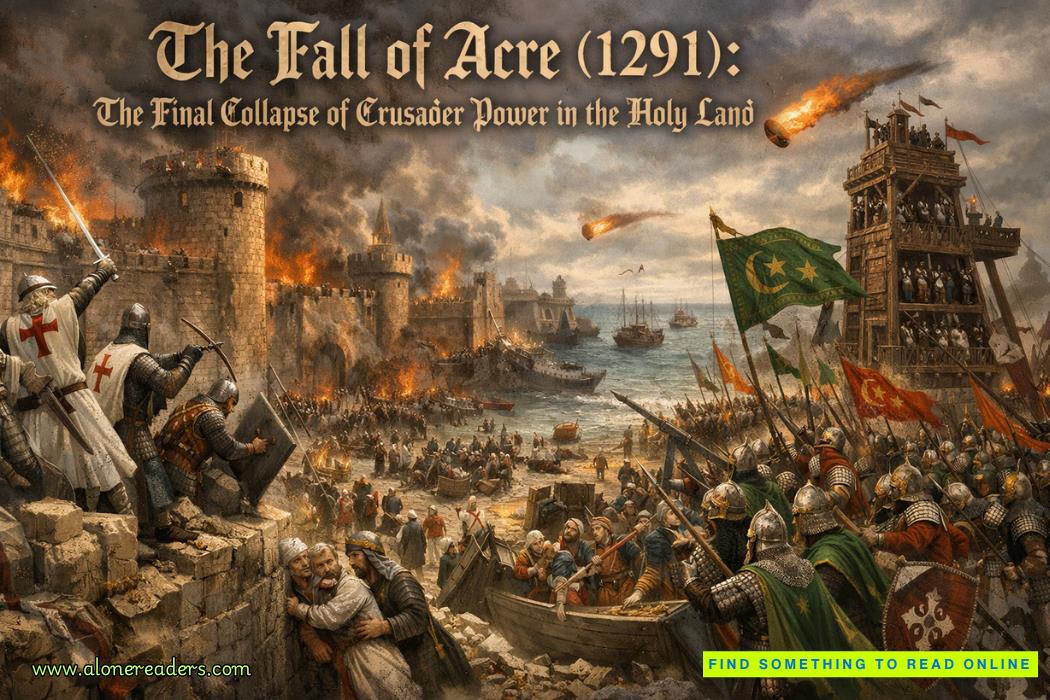
In May 1291, the Mediterranean city of Acre—once the glittering capital of the Latin Kingdom of Jerusalem—fell to the forces of the al-Ashraf Khalil. With its capture, nearly two centuries of Crusader rule in the Levant came to a violent and definitive end. The fall of Acre was not merely the loss of a city; it was the collapse of a political, religious, and military experiment that had reshaped the eastern Mediterranean since 1099.
To understand why Acre’s fall was so decisive, one must recognize that by 1291 it was far more than a fortress. It was the administrative heart of what remained of the Crusader states, the primary commercial hub linking Europe with the Levant, and the symbolic embodiment of Latin Christian persistence in the Holy Land. When its walls crumbled, so too did the last realistic hope of maintaining a territorial Latin presence in Palestine.
The origins of this final confrontation lay in the gradual contraction of Crusader territory during the thirteenth century. After the initial triumph of the First Crusade and the establishment of the Kingdom of Jerusalem, the Latin East faced relentless pressure from Muslim powers. The rise of figures such as Saladin in the late twelfth century had already shattered Crusader dominance, culminating in the loss of Jerusalem in 1187. Although coastal enclaves were later regained through diplomacy and subsequent crusades, the interior was never fully recovered.
By the mid-thirteenth century, the geopolitical balance had shifted dramatically. The Ayyubid dynasty gave way to the Mamluks, a military elite of slave origin who seized control of Egypt and Syria. Under leaders such as Baybars, the Mamluks adopted a systematic strategy of eliminating Crusader strongholds one by one. Unlike earlier Muslim rulers who often balanced warfare with negotiation, the Mamluks pursued methodical territorial annihilation. Fortresses were dismantled after capture to prevent reoccupation, and remaining enclaves were isolated economically and militarily.
Acre survived longer than most cities because of its formidable fortifications and its importance to Mediterranean trade. Italian merchant republics—particularly Republic of Venice and Republic of Genoa—maintained quarters within the city, using it as a gateway to eastern markets. Within Acre’s walls, one could find Templars, Hospitallers, Teutonic Knights, Syrian Christians, Armenians, and Muslim merchants. It was a cosmopolitan city sustained by commerce as much as crusading zeal.
Yet beneath this vibrancy lay fatal weakness. The Latin states were politically fragmented. Rivalries between military orders, disputes among European monarchs, and conflicts between Italian trading factions undermined unity. The Papacy continued to call for crusades, but enthusiasm in Europe had waned. Resources were diverted to conflicts closer to home. By 1291, Acre was strategically isolated and diplomatically abandoned.
The immediate catalyst for the siege was a breakdown in fragile truces between the Crusaders and the Mamluks. In 1290, violence erupted when newly arrived Crusaders allegedly attacked Muslim merchants in Acre. Sultan al-Ashraf Khalil seized upon this incident as justification for full-scale war. In early 1291, he assembled one of the largest Mamluk armies ever fielded against a Crusader city. Contemporary chroniclers describe siege engines, mangonels, and massive wooden towers advancing toward the walls.
The Mamluk army encircled Acre in April 1291. Their forces included experienced Syrian and Egyptian contingents, engineers skilled in siegecraft, and a logistical apparatus capable of sustaining prolonged operations. Against them stood a garrison composed of remnants of the military orders, local levies, and a limited number of reinforcements from Cyprus. The Cypriot king, Henry II of Cyprus, provided support, but it was insufficient to offset the overwhelming Mamluk advantage.
Acre’s defenses were impressive: double walls, fortified towers, and a seaward harbor that allowed limited resupply. However, the Mamluks deployed relentless artillery bombardment. Stone projectiles battered towers day and night. Mining operations undermined foundations. The psychological toll was immense. The defenders were fighting not for expansion or pilgrimage routes, but for sheer survival.
By mid-May, breaches appeared in the outer defenses. On 18 May 1291, Mamluk forces stormed the city. Street fighting erupted. The military orders made desperate stands—particularly the Knights Templar, who retreated to their fortified compound near the harbor. Civilians rushed to the docks, hoping to board ships bound for Cyprus. Panic and chaos defined the final hours.
The fall was brutal. Chroniclers recount massacres, enslavement, and widespread destruction. Although some inhabitants escaped by sea, thousands were killed or captured. The Templar stronghold held briefly after the main city fell, but it too collapsed days later when part of its structure gave way during renewed assault. With its fall, the organized Latin defense in the Levant effectively ceased to exist.
In the aftermath, the Mamluks methodically dismantled Acre’s fortifications to prevent any future Crusader return. Other remaining coastal outposts—Tyre, Sidon, Beirut—fell in rapid succession. By the end of 1291, there was no significant Crusader territory left on the mainland. The dream born in 1099 had ended in fire and rubble.
The consequences reverberated across Europe and the Islamic world alike. For Europe, Acre’s fall marked the symbolic end of the age of crusading in the Holy Land. Although crusading rhetoric persisted and campaigns continued elsewhere, the vision of a Latin Jerusalem sustained by fortified coastal cities was gone. Papal proclamations urging new expeditions failed to produce lasting results.
For the Mamluks, victory solidified their control over the eastern Mediterranean coastline. They eliminated the threat of Western enclaves that had served as potential staging grounds for invasion. Control of trade routes strengthened their economic position, even as maritime commerce continued indirectly through negotiated arrangements with Italian merchants.
Militarily, the siege demonstrated the effectiveness of coordinated artillery and disciplined assault tactics. Politically, it underscored the dangers of factionalism within multi-ethnic frontier societies. The Crusader states had always depended on external reinforcement and internal cooperation; by the late thirteenth century, both had eroded.
The fall of Acre also transformed the identity of the military orders. Deprived of territorial bases, the Knights Hospitaller eventually relocated to Rhodes, while the Teutonic Knights intensified their campaigns in the Baltic. The Knights Templar, stripped of their raison d’être in the Holy Land, would face suppression in the early fourteenth century. Acre’s destruction accelerated institutional crises that reshaped medieval Christendom.
In cultural memory, Acre became a symbol of tragic heroism and divine judgment. European chronicles portrayed the defense as gallant but doomed. Muslim sources framed the victory as the culmination of a righteous struggle to expel foreign occupiers. Modern historians, however, view the event within a broader context of shifting economic and political networks in the Mediterranean.
Trade did not cease with Acre’s fall; rather, it adapted. Italian merchants negotiated access to Mamluk ports. Pilgrimage to Jerusalem continued under Muslim rule. The rigid binary of crusade versus jihad gradually gave way to pragmatic diplomacy. In this sense, the end of Crusader Acre marked not the end of Mediterranean interaction, but its transformation.
The city itself would later be rebuilt in different forms under successive rulers. Yet the Acre of the Crusaders—the bustling capital with its Gothic cathedrals, fortified compounds, and European merchant quarters—was gone forever. Its destruction closed a chapter that had defined medieval geopolitics for two centuries.
Ultimately, the Fall of Acre in 1291 stands as a turning point in medieval history. It signaled the definitive failure of sustained Western colonial rule in the Levant during the Crusading era. It consolidated Mamluk supremacy in the region. And it reshaped the strategic priorities of European powers, who would increasingly turn their attention to the Atlantic, internal conflicts, and eventually new maritime routes to Asia.
The siege was not merely the end of a city; it was the end of an epoch. In the smoke rising above Acre’s shattered walls, one can discern the fading of crusading idealism and the emergence of a new Mediterranean order—one defined less by holy war and more by commerce, diplomacy, and shifting empires.



 The Hundred Days Offensive: How the Allies Defeated Germany in World War I
 The Second Battle of the Marne: The Turning Point of World War I in 1918
 The Spring Offensive of 1918: Germany's Final Gamble to Win World War I
 The Treaty of Brest-Litovsk: How Russia Left World War I
 The Russian Revolution and World War I: How War Brought Down the Tsar
 The Zimmermann Telegram Explained: Germany's Secret Offer to Mexico in World War I