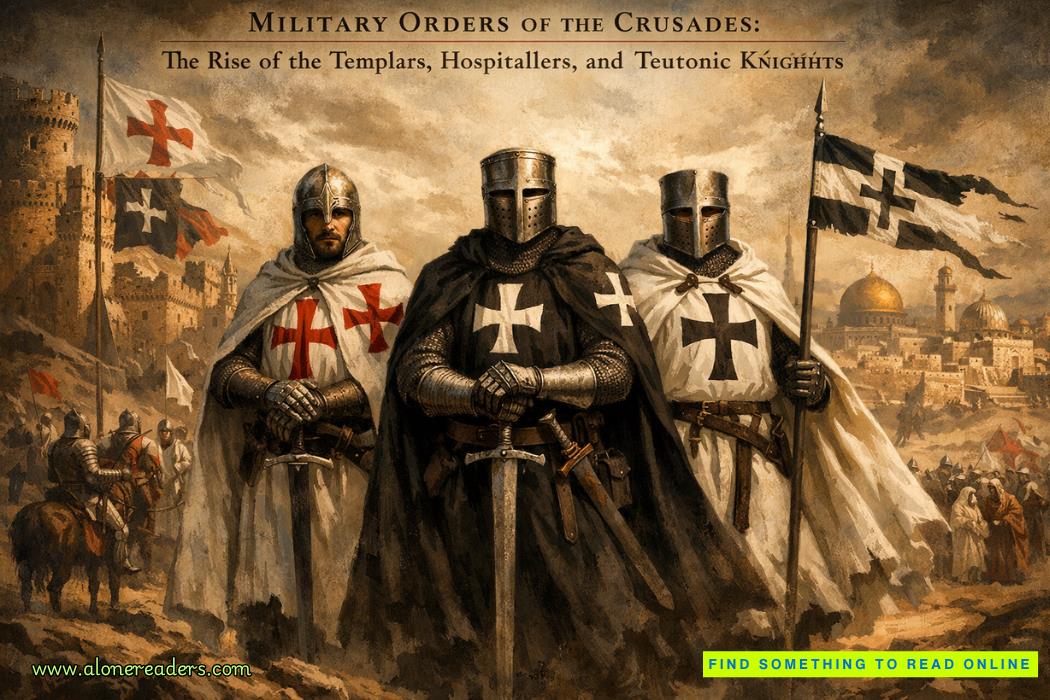
The Crusades were not merely wars between kingdoms; they were also shaped by the emergence of religious military institutions that combined monastic discipline with battlefield ferocity. Among the most influential of these institutions were the Knights Templar, the Knights Hospitaller, and the Teutonic Knights, organizations that transformed the nature of medieval warfare and religious service. These orders represented a new idea in Christian Europe: men who took vows similar to monks yet lived as professional soldiers dedicated to defending pilgrims, protecting sacred sites, and expanding Christian power in contested territories. Their rise marked one of the most remarkable institutional innovations of the medieval world, creating organizations that wielded immense economic, political, and military influence across Europe and the eastern Mediterranean.
Before the formation of these orders, the early Crusades were largely composed of feudal armies assembled temporarily by kings and nobles. Soldiers returned home once their vows were fulfilled, leaving the newly captured territories of the Levant vulnerable. The Kingdom of Jerusalem and other Crusader states required a permanent military presence capable of defending castles, escorting pilgrims, and confronting Muslim forces. Out of this need emerged the military orders—permanent, disciplined, and ideologically driven armies bound not by feudal obligation but by religious commitment.
The Knights Templar were the first of the great Crusading military orders and quickly became the most famous. Founded around 1119 by the French knight Hugh de Payens, the order began with a small group of knights who pledged themselves to protecting Christian pilgrims traveling between the port of Jaffa and Jerusalem. Their headquarters was established in the captured Al-Aqsa Mosque on the Temple Mount, which Crusaders believed stood on the site of the biblical Temple of Solomon. From this location came their name: the Poor Fellow-Soldiers of Christ and of the Temple of Solomon, later shortened to the Knights Templar.
The Templars quickly gained support from influential church leaders and European nobles. A decisive moment came in 1129 at the Council of Troyes, where the order received official recognition from the Church and a formal rule influenced by the monastic traditions of the Cistercians. The rule demanded poverty, chastity, and obedience, placing Templar knights under strict discipline. Unlike ordinary knights, who often pursued personal glory or wealth, Templars were expected to fight with collective purpose and religious devotion. Their white cloaks marked with a red cross symbolized purity and martyrdom, reinforcing their identity as warrior monks willing to die for Christendom.
Over time, the Templars developed into one of the most powerful organizations in medieval Europe. They established commanderies and estates across France, England, the Iberian Peninsula, Italy, and the German lands. Donations from nobles, kings, and pious believers allowed them to build a vast economic network. These estates produced agricultural goods, livestock, and income that supported their military activities in the Holy Land. The Templars effectively created a transcontinental system of finance and logistics that allowed them to move resources across vast distances.
Their financial expertise became particularly notable. Pilgrims traveling to Jerusalem could deposit money with Templar houses in Europe and withdraw it in the Levant, reducing the risk of robbery along the journey. This practice made the order one of the earliest institutions resembling a banking system. Kings and nobles also entrusted them with wealth, further strengthening their economic influence. By the thirteenth century, the Templars were not only soldiers but also bankers, administrators, and landowners.
On the battlefield, the Templars were known for their discipline and willingness to charge into the most dangerous situations. Their heavy cavalry units often formed the shock force of Crusader armies. However, their rigid code sometimes led them into devastating confrontations. Templar knights were forbidden from retreating unless directly ordered by their commander, a rule intended to prevent cowardice but which sometimes resulted in catastrophic losses. Despite these risks, their reputation for courage made them one of the most respected and feared forces in the medieval world.
While the Templars were rising in prominence, another order was developing a parallel but somewhat different mission. The Knights Hospitaller, also known as the Order of Saint John, originated earlier than the Templars but evolved gradually into a military force. The order began as a hospital established in Jerusalem around the eleventh century by merchants from the Italian city of Amalfi. Its original purpose was humanitarian: caring for sick and poor pilgrims visiting the Holy Land.
After the First Crusade captured Jerusalem in 1099, the hospital expanded under the leadership of Blessed Gerard, who organized the institution into a religious community dedicated to charity and medical care. Members of the order took monastic vows similar to those of other religious communities. Their primary responsibility was to provide shelter, treatment, and food to pilgrims, regardless of nationality or status. The hospital in Jerusalem became famous for its scale and organization, reflecting a remarkable level of medical administration for the medieval era.
However, as the Crusader states faced increasing military threats, the Hospitallers gradually adopted a martial role. By the mid-twelfth century, they were maintaining fortified castles and fielding professional soldiers alongside their charitable work. Their black cloak marked with a white cross became a symbol of both compassion and combat readiness. Unlike the Templars, whose identity was centered primarily on warfare, the Hospitallers retained a dual mission—defending Christian territories while also providing medical and humanitarian services.
The order became renowned for its fortified strongholds across the Levant. One of the most famous examples was Krak des Chevaliers, an immense castle in modern-day Syria that represented the pinnacle of medieval military architecture. From such fortresses, Hospitaller knights could control trade routes, defend territories, and launch military operations against enemy forces. These castles served not only as defensive structures but also as administrative centers managing the surrounding lands.
After the fall of the Crusader states in the late thirteenth century, the Hospitallers demonstrated remarkable adaptability. Rather than disappearing, they relocated first to Cyprus, then to the island of Rhodes, and eventually to Malta. From these bases they transformed into a powerful naval order fighting against Ottoman expansion in the Mediterranean. This transformation allowed them to survive long after the Crusades themselves had ended. Their legacy continues today in humanitarian organizations that trace their origins to the medieval order.
The third major military order, the Teutonic Knights, emerged somewhat later and followed a distinctive trajectory shaped by the politics of northern and eastern Europe. The order originated during the Third Crusade in 1190 when German crusaders established a hospital in the city of Acre to care for wounded soldiers. Like the Hospitallers, the institution initially focused on medical assistance and charitable service.
Soon, however, the organization developed into a military order dedicated specifically to German crusaders and settlers. Official recognition came in 1199 when the order adopted a rule similar to those of the Templars and Hospitallers. Members wore white cloaks bearing a black cross, a symbol that later became closely associated with German crusading traditions.
While the Templars and Hospitallers primarily operated in the eastern Mediterranean, the Teutonic Knights eventually shifted their focus toward the Baltic region. At the invitation of local rulers, the order launched campaigns against pagan tribes in what are now Poland, Lithuania, and the Baltic states. These campaigns were framed as crusades aimed at converting non-Christian populations and establishing Christian rule in the region.
In the early thirteenth century, the Teutonic Knights established a powerful state along the Baltic coast. They constructed formidable brick castles and founded cities that would later become major centers of trade and governance. Towns such as Königsberg and Marienburg became symbols of their expanding influence. The order governed these territories as a monastic military state, blending religious authority with administrative power.
Unlike the Templars, whose wealth came largely from donations and banking networks, the Teutonic Knights developed a territorial empire that generated revenue through agriculture, trade, and taxation. Their disciplined administration and military organization allowed them to dominate large portions of northeastern Europe for centuries. For a time, the order was among the most formidable political powers in the Baltic world.
Despite their successes, all three orders eventually faced significant challenges. The decline of the Crusader states weakened the original mission of defending Christian territories in the Holy Land. Changing political conditions in Europe also created tensions between monarchs and the increasingly wealthy military orders. Kings who had once supported these organizations began to see them as rivals for authority and resources.
The most dramatic downfall occurred with the Knights Templar in the early fourteenth century. King Philip IV of France, deeply indebted to the order, orchestrated a campaign accusing the Templars of heresy, corruption, and secret rituals. In 1307 many Templars were arrested, tortured, and forced to confess to fabricated crimes. The papacy eventually dissolved the order in 1312, and its properties were largely transferred to the Hospitallers. The dramatic suppression of the Templars remains one of the most controversial episodes in medieval history.
The Hospitallers and Teutonic Knights survived, though their influence gradually changed. The Hospitallers continued as a naval and humanitarian order in the Mediterranean, while the Teutonic Knights eventually lost much of their territorial power after military defeats and political transformations in the Baltic region. Yet both orders left enduring marks on European institutions, architecture, and cultural memory.
The military orders of the Crusades illustrate how deeply religion shaped medieval society. These organizations fused spiritual ideals with martial discipline, creating communities in which monks trained as elite warriors. Their members believed they were participating in a sacred struggle that promised spiritual reward and eternal salvation. This powerful ideology allowed them to attract recruits from across Europe and sustain their missions for centuries.
Beyond their military activities, the orders also played significant roles in administration, diplomacy, and cultural exchange. They built castles, hospitals, churches, and towns across multiple continents. Their estates and networks connected Europe with the eastern Mediterranean, facilitating trade and the movement of knowledge and resources. In many ways, they represented early forms of international institutions operating across political and cultural boundaries.
The legacy of these orders continues to fascinate historians and the public alike. The Templars remain surrounded by legends of hidden treasures and secret knowledge, while the Hospitallers are remembered for their enduring humanitarian traditions. The Teutonic Knights, meanwhile, shaped the political landscape of northern Europe and influenced the development of several modern states.
Taken together, the Templars, Hospitallers, and Teutonic Knights represent one of the most distinctive features of the Crusading era. They embodied the fusion of faith, warfare, and institutional power that defined much of medieval Christendom. Through their castles, battles, and networks of wealth and influence, these orders left a profound imprint on the history of Europe and the Middle East. Even centuries after the Crusades ended, their stories continue to illustrate how religious conviction, political ambition, and military organization could combine to create institutions of extraordinary power and lasting historical significance.



 The Hundred Days Offensive: How the Allies Defeated Germany in World War I
 The Second Battle of the Marne: The Turning Point of World War I in 1918
 The Spring Offensive of 1918: Germany's Final Gamble to Win World War I
 The Treaty of Brest-Litovsk: How Russia Left World War I
 The Russian Revolution and World War I: How War Brought Down the Tsar
 The Zimmermann Telegram Explained: Germany's Secret Offer to Mexico in World War I