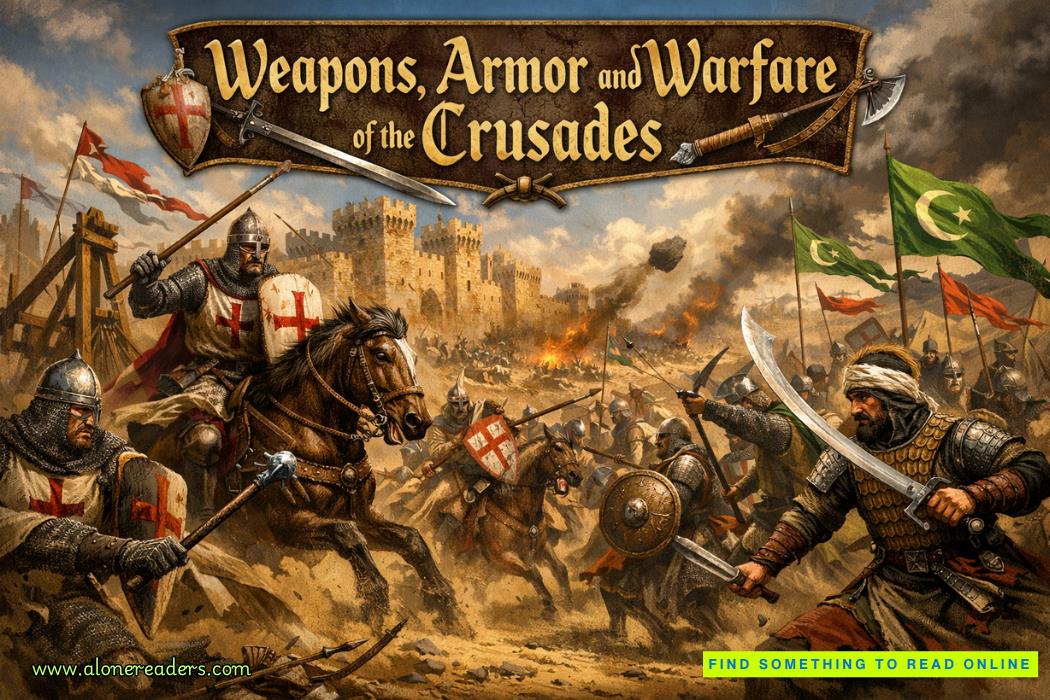
The wars known collectively as the Crusades were not only religious conflicts but also laboratories of military innovation. Between the late eleventh and thirteenth centuries, European crusaders and the Muslim armies of the Middle East confronted one another repeatedly across the landscapes of Anatolia, Syria, Palestine, and Egypt. Each side brought with it distinct military traditions, weapons technologies, and battlefield doctrines shaped by geography, culture, and centuries of warfare. The result was a prolonged military encounter in which armor, weapon design, cavalry tactics, and siege engineering evolved rapidly under the pressure of near-constant conflict.
At the heart of crusader warfare stood the knight, the elite heavy cavalry warrior who symbolized medieval European military power. Knights were defined by their equipment as much as by their social rank. The typical crusader knight wore a long chainmail garment known as a hauberk, which extended from shoulders to knees and often included integrated sleeves and a mail coif that protected the head and neck. Chainmail, constructed from thousands of interlinked iron rings, provided flexible protection capable of deflecting cuts from swords and glancing blows from axes. Though not entirely resistant to thrusting weapons or heavy impacts, it represented the most effective personal armor widely available in Europe during the early Crusades.
Over this armor knights typically wore a cloth garment known as a surcoat, often emblazoned with heraldic symbols or crosses identifying the crusader cause. Beneath the mail was a padded garment called a gambeson, which absorbed shock and prevented chafing. This layered defensive system was remarkably sophisticated for its time; the combination of padding and mail could significantly reduce the lethality of sword strikes and arrows.
Head protection was equally critical. Early crusaders commonly wore conical helmets with nasal guards, designed to protect the face while maintaining visibility and airflow in the hot climates of the Levant. By the late twelfth century, however, the development of the great helm marked a major shift in knightly armor. This cylindrical helmet enclosed the entire head with narrow eye slits and breathing holes, dramatically increasing protection against arrows and blows. Though heavy and somewhat restrictive, it symbolized the growing emphasis on full-body defense in medieval warfare.
Complementing the knight’s armor was the iconic kite shield, a long, tapered shield capable of covering the rider from shoulder to shin while mounted. Constructed from layered wood and covered with leather or canvas, the shield was light enough for cavalry maneuver while still capable of absorbing arrows and weapon strikes. Its distinctive shape allowed it to protect both the rider and the horse’s flank during a charge.
The primary offensive weapon of crusader knights was the lance, a long wooden spear used in devastating cavalry charges. The effectiveness of the lance lay not merely in its length but in the tactical doctrine that accompanied it. Knights formed tight formations and charged together, using the mass of horse and rider combined with the speed of the charge to deliver overwhelming impact. This method, often described as shock cavalry warfare, could break infantry lines or scatter lighter cavalry if executed with discipline.
Once the lance shattered or the battle devolved into close combat, knights relied on secondary weapons. The arming sword, typically a straight, double-edged blade around 70–80 centimeters long, served as the knight’s most versatile weapon. Balanced for both cutting and thrusting, it allowed skilled fighters to exploit weaknesses in an opponent’s armor. The sword also held profound symbolic meaning; it was associated with chivalry, Christian knighthood, and the notion of holy war.
Other weapons expanded the knight’s arsenal. The mace, a blunt weapon designed specifically to crush armor, was particularly effective against mail-clad opponents. Axes and war hammers appeared as well, capable of delivering powerful impacts capable of denting helmets or breaking bones beneath armor. Each weapon represented a response to the defensive technologies of the age, illustrating how medieval warfare was an ongoing contest between armor and weapon innovation.
Infantry formed the backbone of crusader armies despite the romantic focus on knights. Foot soldiers wielded spears, polearms, crossbows, and shields, providing essential support in battles and sieges. The spear remained one of the most widely used weapons in medieval warfare due to its reach, simplicity, and versatility. Infantry formations could present a wall of spear points that discouraged cavalry attacks and stabilized battle lines.
Among infantry weapons, the crossbow represented one of the most controversial yet effective innovations of the Crusading era. Unlike traditional bows, the crossbow used a mechanical trigger system that allowed a soldier to hold a drawn bolt indefinitely before firing. This increased accuracy and penetrating power, enabling crossbow bolts to punch through armor at relatively close range. The weapon was so effective that it provoked moral debates within Christian Europe, with some church authorities condemning its use against fellow Christians. On crusade battlefields, however, it became an indispensable tool for defending fortifications and harassing enemy formations.
While crusader armies emphasized heavy cavalry and armored combat, their Muslim adversaries relied on a somewhat different military tradition shaped by centuries of steppe and desert warfare. Muslim forces often fielded highly mobile cavalry skilled in archery, capable of striking from a distance and avoiding the crushing charge of European knights. The composite bow, constructed from layers of wood, horn, and sinew, allowed remarkable power and range relative to its size. Mounted archers could unleash volleys of arrows while riding, harassing crusader formations and gradually weakening them before close combat.
The curved scimitar, commonly associated with Middle Eastern warriors, was well suited for slashing attacks from horseback. Combined with the agility of lightly armored cavalry, it allowed Muslim fighters to exploit speed and maneuverability rather than brute force. Armor in Muslim armies often included lamellar or scale armor, composed of overlapping plates stitched together, providing solid protection while maintaining flexibility.
This contrast between crusader heavy cavalry and Muslim mobile archery created a dynamic tactical environment. European knights sought decisive engagements in which their shock charges could break the enemy. Muslim commanders frequently attempted to avoid such confrontations, instead employing skirmishing tactics, feigned retreats, and attritional warfare designed to exhaust and isolate crusader forces.
One of the most famous demonstrations of this strategic contrast occurred during campaigns led by the Kurdish commander Saladin, whose forces repeatedly used mobility and disciplined archery to wear down crusader armies. His victory at the Battle of Hattin in 1187 illustrated the effectiveness of combining terrain, maneuver, and missile fire to neutralize heavily armored knights.
Siege warfare played an equally critical role in the Crusades. The Levant was a landscape dotted with fortified cities and castles, and control of these strongholds often determined the outcome of campaigns. Both sides developed advanced siege technologies capable of breaching even formidable defenses.
Among the most powerful siege engines was the trebuchet, a massive counterweight-powered machine capable of launching large stones over great distances. Trebuchets could shatter walls, destroy towers, or hurl incendiary materials into besieged cities. The psychological impact of these machines was immense; defenders often endured weeks or months of bombardment before surrender.
Other siege equipment included battering rams, siege towers, and scaling ladders, each designed to overcome specific defensive obstacles. Siege towers allowed attackers to approach walls under protection while archers provided covering fire. Once positioned against the walls, troops could cross onto battlements and engage defenders directly.
Defenders, meanwhile, relied on their own arsenal of defensive tools. Boiling liquids, rocks, and arrows rained down upon attackers attempting to breach walls. Fortifications themselves evolved in response to these threats. Crusader castles such as Krak des Chevaliers incorporated thick concentric walls, defensive towers, and carefully designed killing zones that maximized the defensive advantage of the garrison.
Armor technology continued evolving throughout the Crusading period. While chainmail remained dominant during the early Crusades, by the thirteenth century elements of plate armor began appearing, particularly as reinforcement over vulnerable areas like the knees, elbows, and chest. These additions represented the early stages of the full plate armor that would dominate European battlefields in later centuries.
Climate and geography also shaped the equipment of crusading armies. European knights accustomed to cooler climates often struggled in the intense heat of the Middle East while wearing heavy armor. To mitigate this, they adopted lighter clothing layers and sometimes modified equipment for greater ventilation. Horses also required careful management, as the large warhorses used by knights were not ideally suited to desert conditions.
The logistical demands of crusading warfare further influenced military practices. Transporting weapons, armor, and siege equipment across thousands of kilometers required enormous resources. Crusader armies relied on supply lines from coastal ports, alliances with local rulers, and the establishment of fortified settlements to sustain prolonged campaigns.
Despite technological differences, warfare during the Crusades remained intensely personal and brutal. Battles were often decided in chaotic close combat where individual courage, discipline, and leadership played decisive roles. Knights, infantry, and archers fought amid clouds of dust, the clash of steel, and the thunder of hooves. Victory frequently hinged on morale as much as on weapons or armor.
Yet the Crusades were not merely destructive conflicts. The prolonged interaction between European and Middle Eastern societies facilitated the exchange of military knowledge, technology, and tactics. Europeans learned from Muslim expertise in cavalry maneuver and fortification design, while Muslim armies encountered the formidable shock power of western knights and adapted accordingly.
In this sense, the battlefields of the Crusades functioned as crucibles of military evolution. The encounter between two distinct martial cultures accelerated developments in armor construction, siege engineering, and battlefield tactics that would shape warfare across Eurasia for centuries. Weapons and armor were not merely tools of violence but reflections of broader social systems, technological capabilities, and strategic philosophies.
Ultimately, the warfare of the Crusades illustrates how medieval armies combined technology, discipline, and ideology in pursuit of victory. The clash between chainmail-clad knights and agile mounted archers, between towering castles and massive trebuchets, produced some of the most dramatic military encounters of the medieval world. These conflicts transformed not only the political map of the eastern Mediterranean but also the very nature of warfare itself, leaving a legacy that echoes throughout the later history of European and Middle Eastern military traditions.



 The Hundred Days Offensive: How the Allies Defeated Germany in World War I
 The Second Battle of the Marne: The Turning Point of World War I in 1918
 The Spring Offensive of 1918: Germany's Final Gamble to Win World War I
 The Treaty of Brest-Litovsk: How Russia Left World War I
 The Russian Revolution and World War I: How War Brought Down the Tsar
 The Zimmermann Telegram Explained: Germany's Secret Offer to Mexico in World War I










