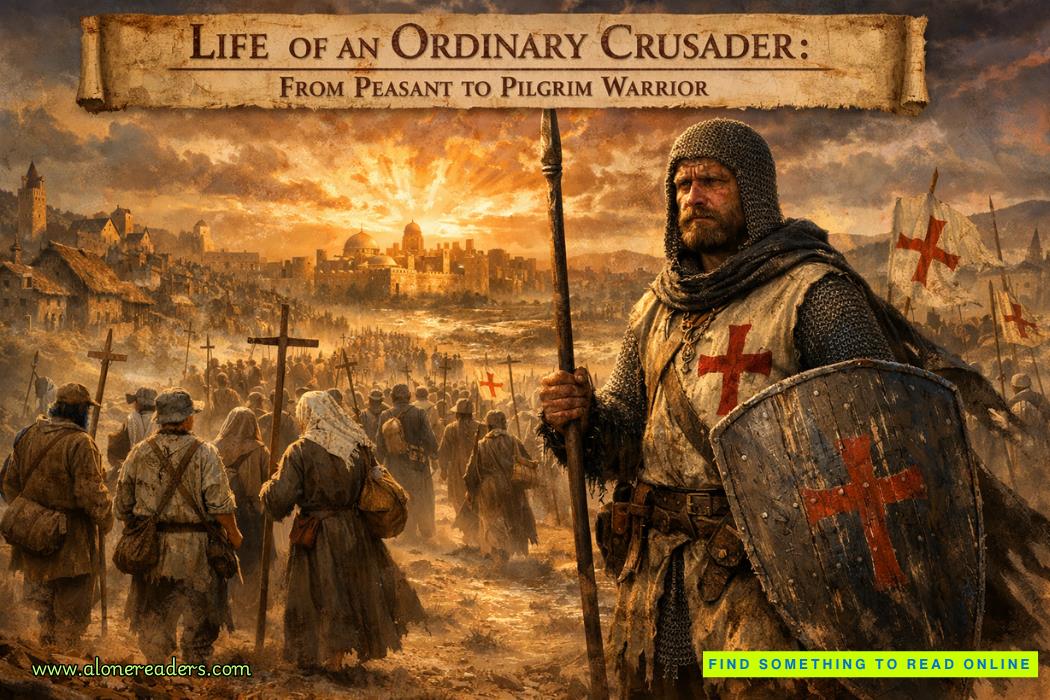
The popular imagination of the Crusades is dominated by images of armored knights, glittering banners, and powerful nobles leading armies across continents. Yet the vast majority of those who marched eastward toward the Holy Land were not noble warriors but ordinary people. Farmers, blacksmiths, carpenters, shepherds, and laborers—men who had never left their villages—suddenly found themselves part of one of the largest military and religious migrations of the medieval world. The story of the Crusades is therefore not only the story of kings and knights but also the story of thousands of anonymous individuals who transformed from peasants into pilgrim warriors. Their lives, struggles, and motivations reveal the true human dimension of this extraordinary historical movement.
In the late eleventh century, most Europeans lived lives defined by rigid feudal structures and economic hardship. A typical peasant lived in a small village, working land owned by a local lord and paying heavy rents or taxes in labor and crops. Life was dominated by agricultural cycles—plowing, sowing, harvesting—and survival often depended on the success of a single growing season. Food shortages, disease, and insecurity were common realities. Yet amid this hardship, medieval society was deeply shaped by religion. The Church was not merely a spiritual institution but the central organizing force of everyday life. The calendar followed religious festivals, moral authority came from priests, and the promise of salvation defined how people understood suffering and hope.
When the call for the First Crusade was issued in 1095, it resonated deeply among ordinary people because it combined two powerful forces: religious devotion and the promise of redemption. The message spread through sermons, traveling preachers, and word of mouth across villages and towns. The appeal was simple but profound. Christians were told that the Holy Land, including Jerusalem—the site of Christ’s crucifixion—had fallen under Muslim control. Pilgrims traveling there reportedly faced danger and humiliation. By taking up the cross and marching to liberate these sacred sites, believers could perform an act of extraordinary devotion.
For peasants who had spent their entire lives confined to a few miles around their village, the idea of traveling to Jerusalem held an almost mystical significance. Pilgrimage had long been considered a powerful spiritual act in medieval Christianity. Visiting holy places was believed to cleanse sins and bring believers closer to God. The Crusade was presented as something even greater: a pilgrimage armed with divine purpose. Participants were promised spiritual rewards, including the remission of sins—a concept that made the journey appear not only meaningful but salvific.
This promise transformed the Crusade from a distant political campaign into a deeply personal calling. Many peasants took vows, symbolized by sewing a cross onto their clothing, marking themselves as crusaders. Once this vow was taken, the journey became sacred. To abandon it was seen as a grave spiritual failure. The red cross on a cloak or tunic thus represented far more than a military emblem—it symbolized a spiritual contract between the individual and God.
Yet becoming a crusader required more than faith; it required abandoning the fragile stability of village life. A peasant preparing for the journey often faced painful decisions. Fields might need to be sold or entrusted to relatives. Livestock could be traded for travel supplies. Families were sometimes separated for years. Some crusaders never returned at all. The decision to leave was therefore an extraordinary leap into uncertainty.
Once the journey began, the romantic image of holy warfare quickly gave way to harsh reality. The path from Western Europe to the eastern Mediterranean stretched thousands of kilometers. Ordinary crusaders traveled mostly on foot, carrying basic supplies and weapons that were often improvised rather than professionally made. While knights possessed expensive armor and warhorses, peasants typically carried simple spears, axes, knives, or farming tools adapted for combat.
The journey itself was an ordeal of endurance. Crusader groups moved through unfamiliar lands, crossing mountains, forests, and rivers while struggling with hunger and disease. Medieval travel infrastructure was primitive. Roads were often little more than dirt tracks, and travelers depended on local markets or charity to obtain food. Entire groups sometimes faced starvation when supplies ran out or harvests failed in regions they passed through.
Despite these hardships, the journey had a powerful emotional and spiritual dimension. For many peasants, it was the first time they had encountered people from distant regions. They marched alongside villagers from other kingdoms, merchants from cities, and knights with retinues of soldiers. Languages, customs, and clothing varied widely, creating a unique sense of collective purpose among strangers united by faith.
This experience gradually reshaped the identity of ordinary crusaders. They were no longer merely villagers tied to a particular lord or land. Instead, they became part of a vast Christian movement that transcended regional boundaries. The journey fostered a new sense of belonging—a shared identity as warriors of faith marching toward a sacred goal.
Yet the hardships intensified as crusaders moved deeper into unfamiliar territories. Crossing into the Byzantine Empire introduced them to a sophisticated Christian civilization that differed culturally and politically from Western Europe. Many crusaders struggled to understand Byzantine customs and authority structures. Suspicion sometimes arose between the crusaders and their Byzantine hosts, highlighting how complex the Crusading movement truly was.
Eventually, after months or even years of travel, ordinary crusaders reached the eastern Mediterranean and encountered the realities of warfare. Most peasants had never experienced battle before. Medieval combat was brutal and chaotic. Armies clashed in close quarters with swords, spears, and shields. The sounds of battle—metal striking metal, war cries, and the cries of the wounded—created scenes of terrifying intensity.
For the ordinary crusader, the battlefield demanded courage born not from professional training but from conviction and desperation. Many fought with limited armor and minimal protection. Survival depended on staying close to fellow soldiers, following commanders, and maintaining discipline amid confusion.
The emotional experience of combat often transformed crusaders psychologically. The crusading ideology framed warfare as sacred duty rather than mere violence. Victory was interpreted as divine favor, while suffering and death were seen as sacrifices for a holy cause. This religious interpretation helped ordinary soldiers endure the horrors of battle by giving them a sense of cosmic significance.
Life in crusader camps between battles was equally demanding. Crusaders faced shortages of food and water, extreme heat in the Levantine climate, and outbreaks of disease. Many died not in combat but from illness or malnutrition. Yet camp life also fostered camaraderie. Soldiers shared stories, prayed together, and formed bonds that transcended social class.
For peasants accustomed to rigid feudal hierarchies, this environment sometimes created surprising social mobility. While knights still commanded authority, the shared hardships of the Crusade blurred some traditional boundaries. Acts of bravery could elevate an individual's reputation regardless of birth. In rare cases, ordinary soldiers gained recognition and improved their social standing through their service.
The climax of many crusaders’ journeys came with the approach to Jerusalem. For medieval Christians, Jerusalem represented the spiritual center of the world. The thought of seeing the city where Christ had lived and died filled crusaders with intense emotion. Contemporary accounts describe soldiers weeping, praying, and falling to their knees upon glimpsing the city's walls.
This moment represented the fulfillment of years of sacrifice. Peasants who had once lived quiet agricultural lives now stood at the threshold of a city that existed at the heart of their religious imagination. Their journey had transformed them profoundly—not only physically but spiritually and psychologically.
Yet even after reaching Jerusalem, life did not become easier. The establishment of crusader states in the eastern Mediterranean required constant defense against rival forces. Ordinary crusaders sometimes settled in these territories, becoming farmers, craftsmen, or soldiers in frontier communities. Others eventually returned to Europe, bringing with them stories and experiences that reshaped how their communities understood the wider world.
For those who returned home, the Crusade left lasting marks. Some brought relics, exotic goods, or new knowledge about distant cultures. Others carried scars—physical and emotional—from years of hardship and violence. The journey had expanded their horizons in ways unimaginable when they first left their villages.
The life of an ordinary crusader therefore reflects a profound transformation. A man who began as a peasant tied to a small patch of land could become a traveler, a soldier, and a participant in one of the most dramatic events of the medieval era. His story illustrates how the Crusades were not simply military campaigns but mass movements that reshaped individual lives and collective identities.
Understanding this perspective helps reveal the deeper human reality behind the Crusades. Beneath the banners of kings and the strategies of generals marched thousands of individuals driven by faith, hope, fear, and curiosity. They were not merely instruments of historical forces but active participants whose choices carried enormous personal consequences.
The ordinary crusader’s journey—from village fields to distant battlefields—embodies the powerful intersection of religion, society, and human ambition in medieval Europe. It reminds us that history is not only written by rulers and commanders but also by the countless unnamed individuals who dared to leave the familiar world behind in pursuit of something greater than themselves.



 The Hundred Days Offensive: How the Allies Defeated Germany in World War I
 The Second Battle of the Marne: The Turning Point of World War I in 1918
 The Spring Offensive of 1918: Germany's Final Gamble to Win World War I
 The Treaty of Brest-Litovsk: How Russia Left World War I
 The Russian Revolution and World War I: How War Brought Down the Tsar
 The Zimmermann Telegram Explained: Germany's Secret Offer to Mexico in World War I










