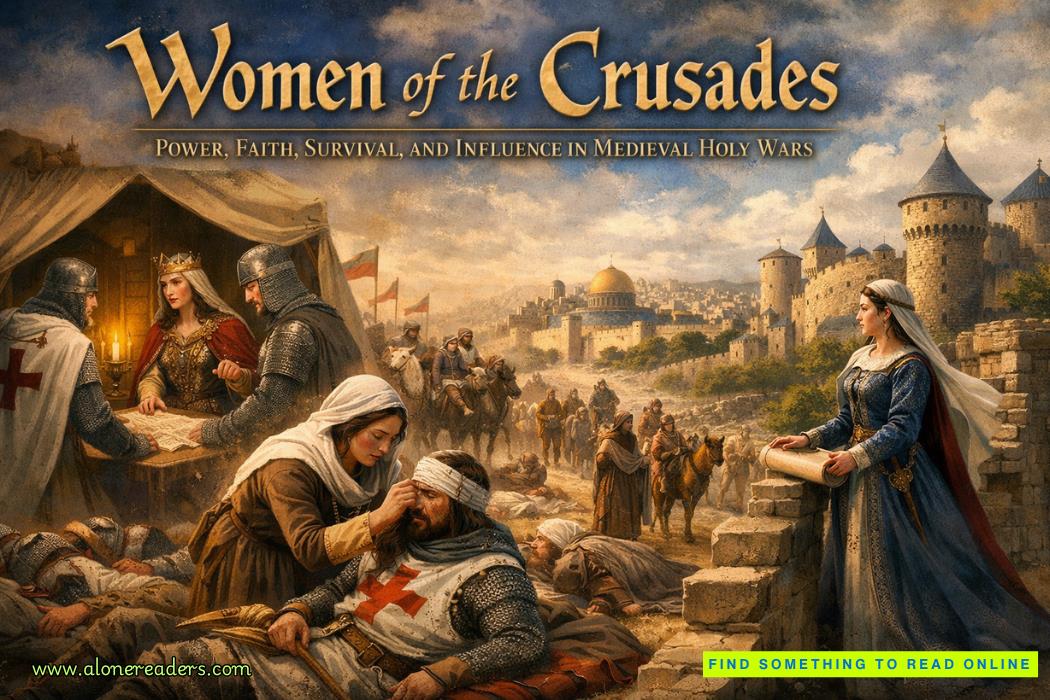
The Crusades are often remembered as a series of brutal medieval wars fought between Christian and Muslim powers over control of the Holy Land between the late eleventh and thirteenth centuries. Traditional narratives of these conflicts typically emphasize the exploits of kings, knights, and military orders such as the Templars and Hospitallers. Yet this perspective overlooks a crucial dimension of crusading society: the presence and influence of women. Although medieval Europe was largely patriarchal, women participated in the Crusades in ways that were both complex and consequential. They served as rulers, financiers, caretakers, pilgrims, diplomats, and sometimes even combatants. Their involvement reveals that the Crusades were not merely military expeditions but also vast social movements that reshaped medieval society.
The participation of women in the Crusades began almost immediately after the call to arms issued by Pope Urban II in 1095. The First Crusade mobilized tens of thousands of people from across Europe, and many women joined these movements alongside husbands, fathers, or brothers. Some accompanied the crusading armies as pilgrims, motivated by religious devotion and the promise of spiritual rewards similar to those offered to male crusaders. Others traveled because crusading expeditions required entire support communities to function. Armies on long journeys needed cooks, nurses, laundresses, and camp organizers, roles that women frequently filled. These contributions were rarely recorded in detail by chroniclers, yet without them the logistical survival of crusading forces would have been far more difficult.
At the same time, many noblewomen remained in Europe while their husbands departed for the Holy Land. These women assumed enormous responsibilities, effectively becoming the administrators of estates, castles, and political territories. In the absence of crusading lords, wives or daughters often acted as regents, managing finances, defending lands, and negotiating alliances. This temporary transfer of authority reveals how crusading warfare unexpectedly expanded the political roles of elite women. In many regions, noblewomen issued charters, collected taxes, oversaw agricultural production, and maintained legal authority over local populations. The Crusades thus created circumstances in which women exercised real political power, even within the constraints of medieval gender norms.
Some of the most remarkable female figures emerged directly within the crusader states established in the eastern Mediterranean after the First Crusade. These territories—including the Kingdom of Jerusalem, the County of Tripoli, the Principality of Antioch, and the County of Edessa—were fragile frontier societies where survival depended on political alliances and dynastic continuity. Women in these states often inherited or transmitted claims to power. In several cases, queens ruled in their own right or served as decisive political actors.
Among the most prominent examples was Queen Melisende of Jerusalem, who ruled during the mid-twelfth century. As the daughter of King Baldwin II, she inherited legitimate authority within the kingdom. When her husband, King Fulk of Anjou, attempted to sideline her politically, tensions erupted within the royal court. Ultimately, Melisende retained significant influence and governed as co-ruler, overseeing administration, diplomacy, and patronage of religious institutions. Her reign demonstrated that women in the crusader states could exercise sovereign authority when dynastic circumstances permitted it. Under her rule, Jerusalem experienced a period of relative stability and cultural flourishing, including the construction of churches and monasteries.
Another extraordinary figure was Eleanor of Aquitaine, one of the most powerful women in medieval Europe. Eleanor participated in the Second Crusade alongside her husband, King Louis VII of France. Unlike many noblewomen who remained in Europe, Eleanor traveled directly with the crusading army to the eastern Mediterranean. Her presence symbolized both devotion and political prestige, as she was the ruler of the wealthy Duchy of Aquitaine in her own right. Contemporary chroniclers sometimes criticized her involvement, portraying her as overly independent or politically ambitious. These criticisms reveal the discomfort medieval writers often felt toward women who operated beyond traditional gender expectations. Nevertheless, Eleanor’s participation demonstrated that elite women could become visible actors within crusading campaigns.
Women in the crusader states also played essential roles in diplomacy and dynastic marriage alliances. Marriages were powerful political tools, capable of forging alliances between European and local noble families. Through marriage arrangements, women helped stabilize fragile political networks across the eastern Mediterranean. Their bodies and marriages became instruments of geopolitical strategy, linking crusader rulers with European monarchies or neighboring powers. While this reality reflected the patriarchal structures of medieval society, it also meant that women stood at the center of political negotiations that shaped the fate of entire kingdoms.
Beyond queens and noblewomen, many ordinary women also traveled to the Holy Land as pilgrims. For medieval Christians, visiting sacred locations associated with the life of Jesus Christ was considered a profoundly meaningful spiritual act. Jerusalem, Bethlehem, and Nazareth were destinations that inspired deep religious devotion. Female pilgrims journeyed to these places both independently and alongside crusading armies. Some sought penance for sins, while others pursued religious fulfillment or personal transformation.
The presence of women among crusading pilgrims sometimes generated controversy among church authorities and chroniclers. Certain writers worried that mixed-gender armies could encourage moral disorder. Others argued that women were physically unsuited to endure the hardships of long military campaigns. Despite these criticisms, women continued to join crusading movements in significant numbers. Their determination reflected the broader religious enthusiasm that fueled the Crusades across medieval Europe.
Women who traveled with crusading armies frequently contributed to the care of wounded soldiers. Battles, sieges, and harsh travel conditions produced enormous numbers of injuries and illnesses. Women often served as informal nurses, tending wounds, preparing medicines, and providing basic care to exhausted fighters. In a period before professional military medicine developed, such care could determine whether wounded soldiers survived or died. These acts of caregiving constituted a quiet but vital dimension of crusading warfare.
In addition to caregiving roles, some women took part in defending cities and fortifications when crusader territories came under attack. Chronicles occasionally describe women helping to transport stones, water, or weapons during sieges. While such contributions might appear modest compared to battlefield combat, they were essential for sustaining defensive efforts in medieval warfare. In extreme circumstances, women even participated directly in combat, though such cases were relatively rare and often recorded with surprise by chroniclers.
One notable example appears during the defense of cities within the crusader states, where women reportedly joined defenders atop walls to repel attackers. They carried supplies, assisted wounded soldiers, and sometimes hurled projectiles at enemy forces. These accounts illustrate how warfare blurred traditional gender boundaries when survival was at stake. The frontier conditions of the crusader states forced entire communities—including women—to participate in defense.
Another dimension of women’s involvement emerged through religious institutions. Convents and monasteries across Europe played an important role in supporting crusading efforts. Women within religious orders prayed for the success of crusading armies, raised funds, and sometimes provided logistical support. Wealthy noblewomen donated land or money to religious institutions connected with crusading causes. Such donations helped finance expeditions, support pilgrims, and maintain churches in the Holy Land.
Spiritual motivations also shaped the experiences of women who participated in crusading culture. Medieval Christian theology portrayed the Crusades as acts of devotion capable of securing spiritual rewards such as indulgences. Women embraced this spiritual framework by supporting crusading relatives, sponsoring religious foundations, or undertaking pilgrimages themselves. In many ways, women helped sustain the ideological foundation of crusading enthusiasm across Europe.
Economic contributions also formed an important aspect of women’s roles. Financing crusading expeditions required enormous resources. Knights and nobles frequently mortgaged lands or borrowed money before departing for the Holy Land. Women—particularly widows or noble landholders—sometimes controlled significant financial assets. Their decisions to provide funding, release land rights, or approve loans could directly influence whether crusaders were able to participate in campaigns. In this sense, women functioned as crucial economic facilitators of crusading warfare.
Widowhood created additional opportunities for female influence within crusading society. The Crusades were extraordinarily dangerous, and many men never returned from campaigns in the Holy Land. When crusaders died abroad, their widows inherited estates, property rights, and legal authority. These women often became powerful landowners who continued to shape local politics in Europe. Some widows even sponsored additional crusading expeditions in memory of their deceased husbands.
The experience of women in the Crusades also reveals the profound hardships and suffering that accompanied medieval warfare. Traveling across thousands of kilometers exposed pilgrims and soldiers to disease, starvation, and violence. Women who joined crusading expeditions faced these dangers alongside men. Some perished during long journeys through Anatolia or during brutal sieges in the Levant. Others endured captivity or displacement when cities fell to enemy forces. The Crusades were not only campaigns of conquest but also human tragedies that affected entire families and communities.
Muslim and Eastern Christian women also experienced the consequences of the Crusades, although their perspectives appear less frequently in surviving sources. When crusader armies captured cities, local populations often suffered displacement, violence, or enslavement. Women within these communities faced the disruption of family life and social stability. Conversely, Muslim defenders sometimes relied on women within their own societies for logistical support and community resilience during sieges and invasions. The broader impact of crusading warfare therefore extended far beyond European crusaders themselves.
Over time, the cultural memory of women in the Crusades became shaped by legends and literary traditions. Medieval romances and later historical narratives sometimes portrayed crusading women as heroic figures driven by faith and loyalty. In other cases, writers depicted them as symbols of temptation or moral weakness. These conflicting portrayals reveal how gender expectations influenced the interpretation of women’s actions in medieval history. The reality was far more complex than these simplified narratives suggest.
Modern historical scholarship has increasingly recognized the diverse roles women played in crusading society. Rather than viewing the Crusades solely through the lens of male military leadership, historians now examine the broader social structures that sustained crusading movements. This perspective highlights the ways women contributed to governance, finance, religion, and community life within crusading contexts. It also reveals how crusading warfare temporarily reshaped gender dynamics across medieval Europe and the eastern Mediterranean.
The role of women during the Crusades ultimately demonstrates that these conflicts were not purely military enterprises but vast social mobilizations involving entire societies. Women participated in crusading culture as rulers, pilgrims, caretakers, financiers, and defenders. Their actions influenced political decisions, supported armies, and maintained communities during periods of upheaval. Without the contributions of women, the crusading movement would have looked dramatically different—and perhaps could not have been sustained at all.
Understanding the experiences of women in the Crusades allows modern readers to see medieval history in a more complete and human light. The Crusades were shaped not only by famous kings and knights but also by countless women whose work, devotion, and resilience helped define the era. Their stories reveal that even within the rigid hierarchies of medieval society, women found ways to exercise influence, shape political outcomes, and endure the turbulent realities of holy war.



 The Hundred Days Offensive: How the Allies Defeated Germany in World War I
 The Second Battle of the Marne: The Turning Point of World War I in 1918
 The Spring Offensive of 1918: Germany's Final Gamble to Win World War I
 The Treaty of Brest-Litovsk: How Russia Left World War I
 The Russian Revolution and World War I: How War Brought Down the Tsar
 The Zimmermann Telegram Explained: Germany's Secret Offer to Mexico in World War I