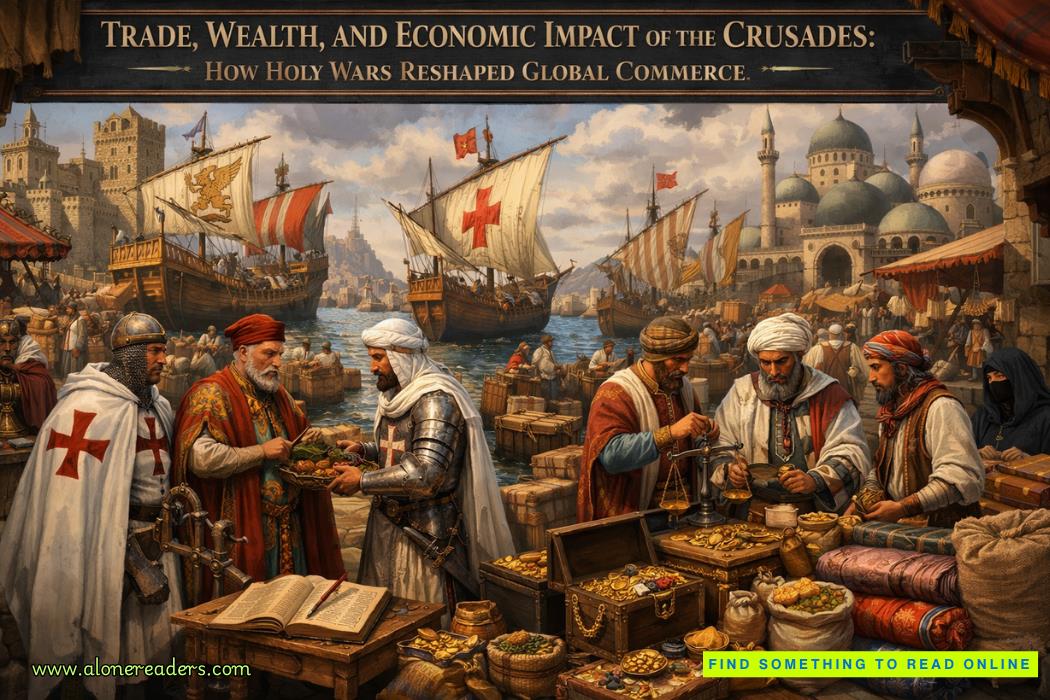
The Crusades are often remembered primarily as a sequence of religious wars driven by zeal, conquest, and territorial ambition, yet beneath the ideological and military narratives lay a profound economic transformation that reshaped both Europe and the Eastern Mediterranean. The intersection of warfare and commerce during these campaigns produced a dynamic system of trade expansion, wealth redistribution, and institutional innovation that would ultimately lay the groundwork for Europe’s transition into a more interconnected and commercially driven society. While the stated aim of the Crusades was the recovery of sacred lands, the unintended consequence was the emergence of a vibrant economic network that linked distant markets, accelerated urban growth, and redefined the very structure of medieval economies.
At the heart of this transformation was the Mediterranean, which evolved into a critical economic artery during the Crusading period. Before the late 11th century, much of Western Europe operated within relatively localized economies, with limited exposure to the luxury goods and advanced commercial systems of the East. However, the launch of the First Crusade in 1096 initiated a sustained movement of people, armies, and resources across vast distances, effectively reopening trade routes that had been dormant or underutilized. Italian maritime republics such as Venice, Genoa, and Pisa quickly recognized the economic opportunities embedded within these campaigns, positioning themselves as logistical intermediaries who could transport crusaders while simultaneously expanding their commercial reach. These city-states secured lucrative privileges in Crusader-held territories, including tax exemptions, port access, and autonomous trading quarters, thereby establishing a proto-colonial economic presence in key Levantine cities.
The commercial impact of these arrangements was immense. Venetian and Genoese merchants began importing large quantities of Eastern goods—spices, silk, sugar, precious metals, and fine textiles—into European markets, where demand for such luxuries grew rapidly among the nobility and emerging urban elites. The Crusades thus acted as a catalyst for consumer demand transformation, introducing European societies to commodities that were previously rare or unknown. This demand was not merely superficial; it triggered deeper structural changes in production, distribution, and trade networks. European merchants began to develop more sophisticated supply chains, integrating overland routes from Asia with maritime networks across the Mediterranean, effectively bridging the gap between the Silk Road and Western markets.
Equally significant was the role of the Crusades in stimulating the growth of financial systems and banking institutions. The logistical complexity of funding long-distance military campaigns necessitated new methods of managing capital, risk, and credit. Crusaders often needed to liquidate assets, secure loans, or transfer funds across borders, leading to the emergence of early financial instruments such as bills of exchange and letters of credit. Institutions like the Knights Templar evolved beyond their military function to become trusted custodians of wealth, offering services that resembled modern banking operations. Pilgrims and crusaders could deposit funds in one location and withdraw them in another, reducing the risks associated with carrying large sums of money. This innovation marked a crucial step toward the development of a more integrated and secure financial infrastructure in medieval Europe.
The redistribution of wealth during the Crusades further accelerated economic change. Many European nobles financed their participation in the campaigns by selling or mortgaging land, often to urban merchants or rising bourgeois classes. This process contributed to the gradual erosion of the feudal system, as land ownership became more fluid and economic power began shifting toward cities. The influx of wealth from trade, combined with increased monetization of the economy, fostered the growth of urban centers that would later become hubs of commerce and innovation. Cities such as Venice and Genoa accumulated immense wealth, not only through trade but also through their control of key maritime routes and their ability to negotiate favorable political arrangements in Crusader states.
The Crusades also facilitated a significant transfer of knowledge and technology between the Islamic world and Europe, which had direct economic implications. European merchants and scholars encountered advanced techniques in navigation, mathematics, agriculture, and manufacturing. Innovations such as improved ship designs, navigational instruments, and accounting methods enhanced the efficiency of trade and reduced operational risks. Agricultural products like sugar and rice were introduced to European markets, eventually leading to the establishment of new production systems in Mediterranean regions. This exchange was not a one-sided process but rather a complex interaction that enriched both sides, even amid ongoing conflict.
In the Eastern Mediterranean, the economic impact of the Crusades was equally profound, though often more volatile. The establishment of Crusader states created new commercial hubs that attracted merchants from across Europe and the Islamic world. Cities like Acre and Antioch became bustling centers of trade, where goods, currencies, and cultures intersected. However, this prosperity was frequently disrupted by warfare, shifting alliances, and political instability. The constant threat of conflict meant that economic activity in these regions was often precarious, dependent on the ability of Crusader states to maintain control over strategic territories and trade routes.
The relationship between warfare and commerce during the Crusades was inherently paradoxical. On one hand, the campaigns caused widespread destruction, disrupted existing trade networks, and imposed heavy financial burdens on participating societies. On the other hand, they created new opportunities for economic expansion and innovation. The need to sustain military operations over long distances drove advancements in logistics, transportation, and supply chain management. Merchants adapted to these challenges by developing more resilient and flexible trading systems, capable of operating in environments characterized by uncertainty and risk.
One of the most enduring economic consequences of the Crusades was the integration of Europe into a broader global trading system. By establishing direct connections with Eastern markets, European merchants reduced their reliance on intermediaries and gained access to a wider range of goods and resources. This integration laid the foundation for the later expansion of European trade networks during the Age of Exploration. The knowledge, experience, and capital accumulated during the Crusading period enabled European powers to pursue new trade routes and establish overseas empires, fundamentally altering the trajectory of global economic history.
The social implications of these economic changes were equally significant. The rise of merchant classes and the increasing importance of trade contributed to the emergence of a more complex and dynamic social structure. Wealth was no longer solely determined by land ownership but also by commercial success and financial acumen. This shift challenged traditional hierarchies and created new opportunities for social mobility. Urban centers became melting pots of cultures and ideas, fostering an environment conducive to intellectual and economic innovation.
Despite these transformative effects, it is important to recognize that the economic benefits of the Crusades were not evenly distributed. While Italian city-states and certain urban centers thrived, many regions in Europe experienced significant financial strain due to the costs of participation. The burden of taxation, combined with the loss of manpower, placed considerable pressure on rural communities and smaller economies. In the Eastern Mediterranean, the impact was even more uneven, with periods of prosperity often overshadowed by conflict and instability.
The long-term economic legacy of the Crusades can be understood as a process of structural transition, in which medieval Europe moved from a relatively insular and agrarian system toward a more interconnected and commercially oriented economy. This transition was not immediate or uniform but unfolded over several centuries, influenced by a combination of internal developments and external interactions. The Crusades served as a critical catalyst in this process, accelerating changes that might otherwise have taken much longer to materialize.
Ultimately, the Crusades illustrate how large-scale historical events can produce complex and often unintended economic outcomes. What began as a series of religiously motivated military campaigns evolved into a powerful engine of economic transformation, reshaping trade networks, redistributing wealth, and fostering innovation across multiple domains. The legacy of these changes is evident in the rise of European commercial power, the development of financial institutions, and the increasing interconnectedness of global economies.
The economic dimension of the Crusades, therefore, cannot be viewed in isolation from their broader historical context. It is a story of interaction, adaptation, and transformation, in which conflict and commerce were deeply intertwined. By examining these dynamics, one gains a more nuanced understanding of how the Crusades contributed not only to the political and religious landscape of the medieval world but also to the economic foundations of the modern era.



 The Hundred Days Offensive: How the Allies Defeated Germany in World War I
 The Second Battle of the Marne: The Turning Point of World War I in 1918
 The Spring Offensive of 1918: Germany's Final Gamble to Win World War I
 The Treaty of Brest-Litovsk: How Russia Left World War I
 The Russian Revolution and World War I: How War Brought Down the Tsar
 The Zimmermann Telegram Explained: Germany's Secret Offer to Mexico in World War I