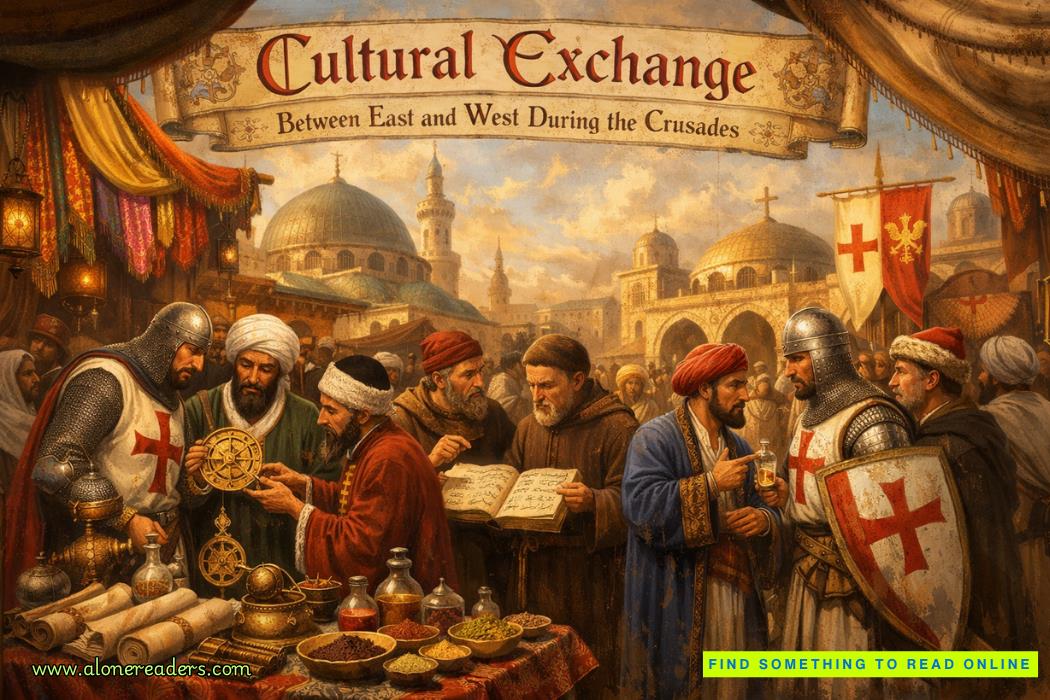
The Crusades are often framed narrowly as a series of violent religious wars between Christian Europe and the Islamic world, yet such a perspective obscures one of the most profound and enduring consequences of these encounters: a complex and transformative cultural exchange between East and West. While armies clashed on battlefields, merchants, scholars, artisans, and travelers facilitated an equally significant movement of ideas, technologies, goods, and intellectual traditions. This interaction reshaped medieval Europe in ways that extended far beyond the immediate political outcomes of the Crusades, laying critical groundwork for the later Renaissance and the broader trajectory of Western civilization.
At the heart of this exchange was the sustained contact between Western European crusaders and the advanced civilizations of the Eastern Mediterranean, particularly the Islamic caliphates and the Byzantine Empire. European crusaders, many of whom came from relatively isolated and underdeveloped regions, encountered societies that possessed sophisticated urban infrastructures, advanced scientific knowledge, and vibrant commercial networks. Cities such as Antioch, Damascus, and Jerusalem presented a stark contrast to the comparatively rudimentary towns of Western Europe. These urban centers featured paved streets, hospitals, libraries, public baths, and complex administrative systems, exposing Europeans to models of urban life that were both efficient and culturally rich.
One of the most significant areas of cultural exchange occurred in the realm of trade. The Crusades opened and intensified trade routes between Europe and the East, particularly through Italian maritime republics such as Venice, Genoa, and Pisa. These cities became critical intermediaries in the flow of Eastern goods into Europe, importing commodities that were previously rare or entirely unknown in the West. Spices such as pepper, cinnamon, and cloves revolutionized European cuisine and preservation methods, while luxury items like silk, glassware, carpets, and perfumes introduced new standards of wealth and refinement. This influx of goods not only transformed consumer habits but also stimulated economic growth, leading to the rise of merchant classes and the gradual decline of feudal economic structures.
Beyond material goods, the Crusades facilitated a profound intellectual exchange. The Islamic world, during this period, was a center of learning that had preserved and expanded upon the knowledge of ancient Greek, Persian, and Indian civilizations. European scholars encountered advanced works in mathematics, astronomy, medicine, and philosophy, many of which had been translated into Arabic and enriched through centuries of scholarly commentary. Through contact in places like Toledo, Sicily, and the Crusader states, these works began to be translated into Latin, making them accessible to Western audiences.
The introduction of Arabic numerals, including the concept of zero, represented a fundamental shift in European mathematical practice. These numerals were far more efficient than the cumbersome Roman system, enabling more complex calculations and fostering advancements in commerce, engineering, and science. Similarly, the works of scholars such as Avicenna and Averroes introduced European thinkers to sophisticated approaches in medicine and Aristotelian philosophy. Avicenna’s medical texts, in particular, became standard references in European universities for centuries, reflecting the deep integration of Islamic knowledge into Western education.
In the field of medicine, the contrast between East and West was especially pronounced. Islamic physicians operated within a framework that emphasized empirical observation, diagnosis, and treatment, often within institutional settings such as hospitals. Crusaders encountering these practices were exposed to systematic medical care, surgical techniques, and pharmacological knowledge that far surpassed the rudimentary and often superstition-based practices of medieval Europe. Concepts such as quarantine, hygiene, and the use of specific medicinal compounds gradually found their way into European medical traditions, contributing to a slow but meaningful evolution in healthcare.
Technological exchange also played a crucial role in shaping European development. The Crusades introduced Europeans to innovations such as the astrolabe, which improved navigation and astronomical observation, and advanced irrigation techniques that enhanced agricultural productivity. Paper, which had spread through the Islamic world from China, began to replace parchment in Europe, making written materials more accessible and contributing to the spread of literacy and record-keeping. The adoption of these technologies reflects a broader pattern of selective assimilation, where Europeans adapted and integrated Eastern innovations into their own contexts.
Art and architecture provide another lens through which to understand this cultural exchange. Exposure to Islamic and Byzantine artistic traditions influenced European aesthetics in subtle yet significant ways. Architectural features such as pointed arches, ribbed vaults, and intricate geometric designs found their way into Gothic architecture, one of the most iconic styles of medieval Europe. Decorative motifs, textile patterns, and metalwork techniques also reveal clear Eastern influences, demonstrating how artistic ideas transcended the boundaries of conflict. Even in the midst of warfare, there was an appreciation for the craftsmanship and beauty of foreign cultures.
Religious and philosophical exchange, while more complex and often contentious, also formed part of this broader interaction. Crusaders and pilgrims encountered Islamic theology, Jewish scholarship, and Eastern Christian traditions, leading to both confrontation and curiosity. While these encounters sometimes reinforced religious divisions, they also prompted intellectual engagement and comparative reflection. European scholars began to grapple with questions about faith, reason, and the nature of knowledge, influenced in part by their exposure to non-Christian perspectives.
The Crusader states themselves served as unique laboratories of cultural interaction. Established in regions such as the Levant, these states brought together diverse populations, including Latin Christians, Eastern Christians, Muslims, and Jews. Despite the underlying tensions, daily life in these regions often required cooperation and coexistence. Trade, diplomacy, and local governance necessitated pragmatic relationships across cultural and religious lines, leading to a degree of cultural blending that was rare in other parts of medieval Europe. Language, dress, cuisine, and even legal practices in these states reflected a hybridization of Eastern and Western elements.
It is important, however, to recognize that this cultural exchange was not a one-sided process. While Europe absorbed a vast array of knowledge and goods from the East, there were also influences flowing in the opposite direction. European military techniques, particularly in fortification and siege warfare, were observed and sometimes adopted by Eastern powers. Additionally, the presence of Crusader states introduced new political dynamics in the region, influencing local power structures and alliances. Nonetheless, the overall balance of exchange heavily favored the transmission of knowledge and innovation from East to West, given the relative levels of development at the time.
The long-term consequences of this exchange are difficult to overstate. By the end of the Crusades, Europe had undergone a subtle but significant transformation. The influx of knowledge and goods contributed to the gradual erosion of intellectual isolation, setting the stage for the Renaissance. Universities began to emerge as centers of learning, drawing upon translated texts and fostering new intellectual movements. The growth of trade networks and urban centers laid the foundation for the rise of capitalism and the modern economy. Even cultural attitudes began to shift, as exposure to different ways of life challenged traditional assumptions and expanded the horizons of European society.
At the same time, the legacy of the Crusades remains deeply ambivalent. While they facilitated cultural exchange, they were also marked by violence, exploitation, and religious intolerance. The very interactions that enabled the flow of ideas were often born out of conflict and conquest. This duality underscores the complexity of historical processes, where destruction and creation can occur simultaneously. The cultural exchange between East and West during the Crusades is therefore not a story of simple progress, but rather one of intricate and often contradictory dynamics.
In examining this period, it becomes clear that the Crusades cannot be understood solely through the lens of warfare or religious ideology. They were also a catalyst for one of the most significant cross-cultural interactions in medieval history, bridging worlds that had long developed in relative isolation. Through trade, scholarship, technology, and daily human contact, the boundaries between East and West became more permeable, allowing for the exchange of ideas that would shape the course of history.
Ultimately, the cultural exchange during the Crusades reveals a fundamental truth about human societies: even in times of conflict, there exists an enduring capacity for learning, adaptation, and transformation. The legacy of this exchange continues to resonate, reminding us that the intersections of cultures—however fraught—can give rise to profound and lasting change.



 The Hundred Days Offensive: How the Allies Defeated Germany in World War I
 The Second Battle of the Marne: The Turning Point of World War I in 1918
 The Spring Offensive of 1918: Germany's Final Gamble to Win World War I
 The Treaty of Brest-Litovsk: How Russia Left World War I
 The Russian Revolution and World War I: How War Brought Down the Tsar
 The Zimmermann Telegram Explained: Germany's Secret Offer to Mexico in World War I










