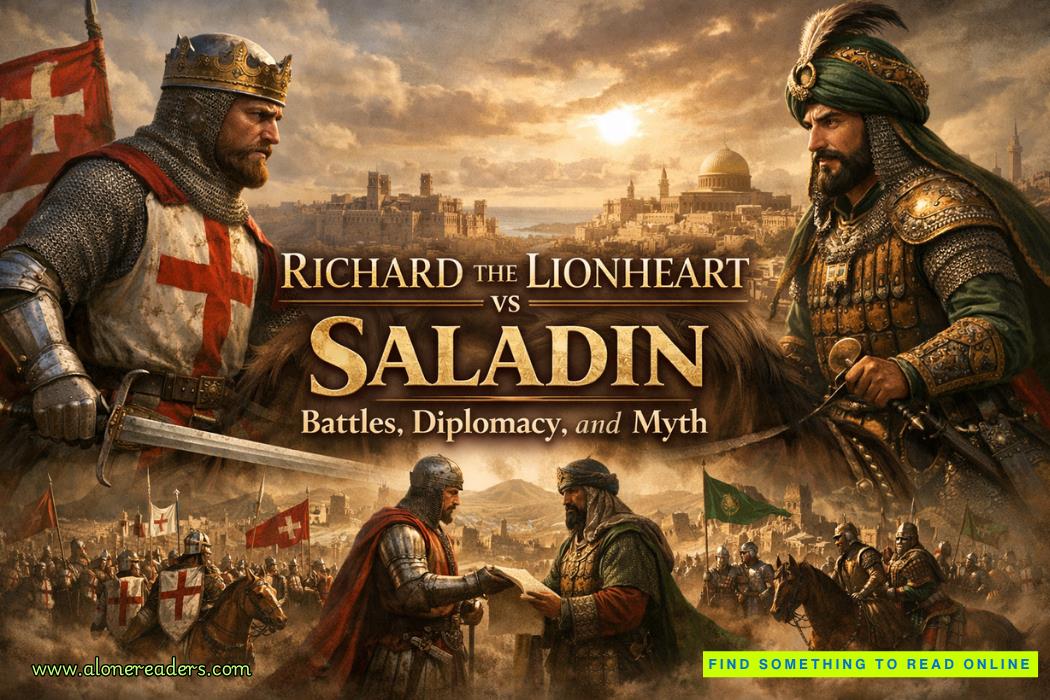
Richard the Lionheart and Saladin stand as two towering figures of the medieval world, not merely because they fought one another, but because their rivalry reshaped the meaning of leadership, warfare, and honor during the age of the Crusades. Their confrontation during the Third Crusade was not a simple clash between Christianity and Islam, nor a straightforward story of good versus evil. It was a prolonged struggle defined by military brilliance, strategic restraint, political necessity, and the gradual birth of myth that would outlive both men by centuries.
Richard I of England ascended to the throne in 1189 already carrying a reputation as a warrior prince. He had little interest in ruling England itself, viewing kingship primarily as a means to fund warfare and personal glory. To Richard, the crown was a weapon. His imagination was consumed by the crusading ideal, sharpened further by the catastrophic loss of Jerusalem to Saladin in 1187. For Western Christendom, the fall of the Holy City was more than a military defeat; it was a spiritual humiliation that demanded response. Richard embraced this call with near-religious intensity, seeing himself as the instrument through which divine justice would be restored.
Saladin, by contrast, emerged from a radically different path. Born into a Kurdish family and rising through military and administrative competence rather than royal lineage, he unified Egypt and Syria through calculated patience rather than raw force. Where Richard sought glory, Saladin sought stability. His capture of Jerusalem was not driven by spectacle but by long-term strategy—securing Muslim lands fractured by decades of political division. What made Saladin exceptional was not only that he conquered Jerusalem, but that he did so while deliberately avoiding massacre, allowing Christian civilians to ransom themselves and depart safely. This act alone began forging his reputation even among his enemies.
When the Third Crusade began, it was not destined to be a clean war. Richard’s journey east was delayed by political disputes, shipwrecks, and the violent conquest of Cyprus, which he seized not as a religious necessity but as a logistical prize. Cyprus became a vital supply hub for the crusading armies, revealing early on that Richard’s brilliance lay as much in strategic logistics as in battlefield ferocity. Saladin, observing from afar, understood that his opponent was not merely a knight-king but a commander capable of sustaining long campaigns.
The siege of Acre became the crucible where their rivalry first took physical form. The city had been under siege before Richard arrived, but its fall came shortly after his presence galvanized the crusaders. Acre was not simply a port; it was the economic artery of the Crusader states. Its capture reestablished Christian footing in the Levant, yet the victory was stained by brutality. When negotiations over prisoners collapsed, Richard ordered the execution of thousands of Muslim captives. This act shocked even his allies and hardened Saladin’s resolve. It marked a defining contrast between the two leaders—one ruled by impulse and pride, the other by calculated restraint.
From that point onward, the war transformed into a contest of maneuver rather than conquest. Saladin avoided direct confrontation unless conditions favored him, understanding that Richard’s strength lay in head-on engagements. Richard, meanwhile, struggled against terrain, climate, and fractured alliances. The crusader army was plagued by internal rivalries between French, English, and local nobles, while Saladin commanded a coalition bound not by fear but by loyalty to a unifying cause.
The Battle of Arsuf in 1191 became Richard’s greatest military triumph. Saladin attempted to harass and weaken the crusaders through relentless skirmishes as they marched south along the coast. For days, Richard maintained iron discipline, refusing to allow his knights to break formation. When the Hospitallers finally charged without orders, Richard responded instantly, launching a full counterattack. The result was a decisive victory that demonstrated his tactical genius. Yet even in defeat, Saladin preserved the core of his army, retreating in good order rather than collapsing into chaos. This ability to lose without losing everything would define his survival.
Despite Arsuf, Jerusalem remained elusive. Every advance toward the city revealed the same strategic dilemma. Richard could reach Jerusalem, but he could not hold it. Saladin could lose territory, but he could always reclaim it once the crusaders withdrew. Both men recognized this grim truth. Warfare gradually gave way to diplomacy—not because either lacked courage, but because both understood the limits of power.
It is within this space that one of history’s most fascinating dynamics emerged. Richard and Saladin never met face to face, yet they communicated frequently through envoys. These exchanges were not symbolic gestures but serious negotiations involving prisoner exchanges, ceasefires, medical aid, and territorial compromise. When Richard fell ill, Saladin famously sent his personal physician and fresh fruit—an act that resonated deeply in both cultures. Whether embellished or not, such stories endured because they reflected a broader reality: mutual respect between adversaries who recognized greatness in one another.
The diplomacy even reached surreal levels when marriage alliances were proposed, suggesting a union between Richard’s sister and Saladin’s brother to jointly rule Jerusalem. Though impractical, the proposal reveals how far both sides were willing to move beyond religious absolutism in pursuit of stability. This was not fanaticism; it was medieval realpolitik at its most sophisticated.
Ultimately, the Third Crusade concluded not with the recapture of Jerusalem but with the Treaty of Jaffa in 1192. Under its terms, Jerusalem remained under Muslim control, but Christian pilgrims were granted safe access. The coastal Crusader states survived, though reduced. Militarily, neither man could claim total victory. Politically, both achieved partial success. Historically, both emerged transformed.
Richard departed the Holy Land as a legend but also as a king who had neglected his realm. Within years, he would die from an infected wound during a minor siege in France—an unglorious end for a man defined by war. Saladin, exhausted by decades of campaigning, died shortly after, leaving behind little personal wealth despite ruling vast territories. His modest possessions were said to fit in a single chest, reinforcing the image of a ruler who fought not for riches but for duty.
Yet what truly immortalized both figures was not what they achieved, but how later generations chose to remember them. Medieval chroniclers in Europe elevated Richard into the archetype of the Christian warrior-king, emphasizing courage while minimizing cruelty. Islamic historians portrayed Saladin as the embodiment of justice, humility, and piety. Over time, these portrayals drifted further from reality and closer to myth.
The reality is far more complex and far more interesting. Richard was brave, charismatic, and militarily gifted, yet impulsive, politically careless, and capable of shocking brutality. Saladin was merciful, patient, and disciplined, yet ruthless when necessary and unwavering in his strategic objectives. Neither was a saint. Neither was a monster. Both were products of a violent age who mastered it in different ways.
Their rivalry symbolizes the evolution of medieval warfare from religious absolutism toward pragmatic coexistence. The Third Crusade demonstrated that even in an era dominated by faith-driven conflict, diplomacy could coexist with war, and respect could emerge between enemies sworn by belief to destroy one another.
What makes Richard and Saladin endure in modern memory is not who won or lost, but the rare balance they represent. One embodied the ferocity of crusading Europe, the other the consolidation of Islamic power in the Near East. Between them unfolded a conflict where swords clashed fiercely, yet words ultimately decided the outcome.
In this sense, their story transcends the Crusades themselves. It becomes a study of leadership under pressure, of how ideology collides with reality, and how myth is born when humanity glimpses honor amid destruction. Richard the Lionheart and Saladin did not merely fight history—they shaped how history remembers war itself.



 The Hundred Days Offensive: How the Allies Defeated Germany in World War I
 The Second Battle of the Marne: The Turning Point of World War I in 1918
 The Spring Offensive of 1918: Germany's Final Gamble to Win World War I
 The Treaty of Brest-Litovsk: How Russia Left World War I
 The Russian Revolution and World War I: How War Brought Down the Tsar
 The Zimmermann Telegram Explained: Germany's Secret Offer to Mexico in World War I










