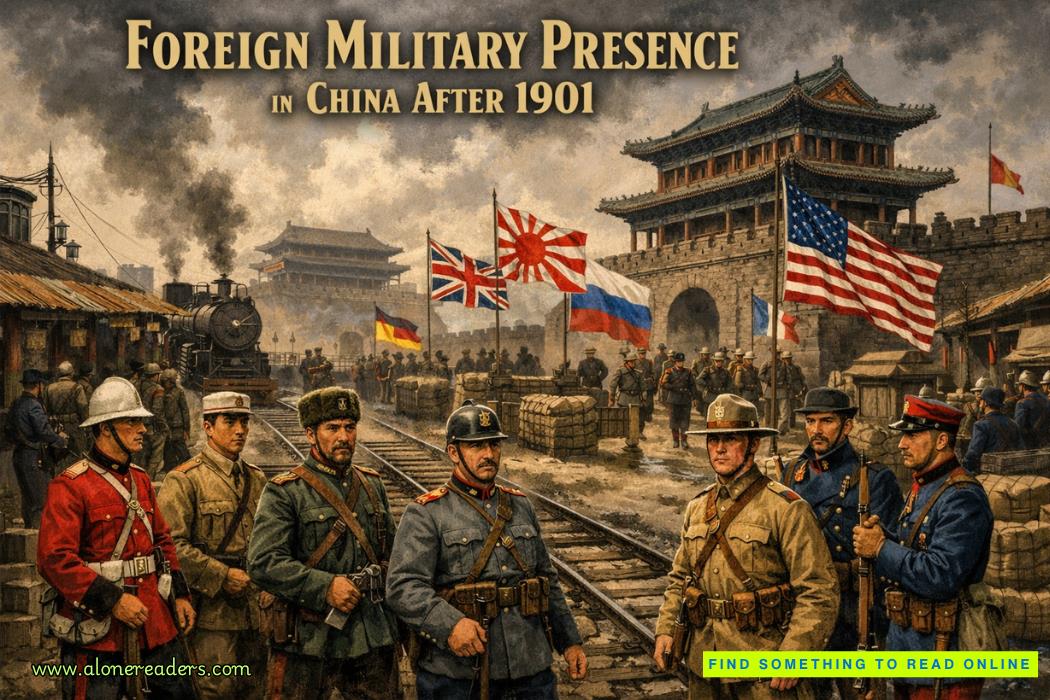
The year 1901 marked one of the darkest turning points in Chinese history. With the signing of the Boxer Protocol, China did not merely accept punishment for the uprising—it entered a prolonged era of foreign military intrusion embedded deep within its own territory. Unlike earlier treaty concessions that focused on trade or diplomacy, the post-1901 arrangement legalized something far more severe: the permanent stationing of foreign troops inside China’s capital and strategic corridors, effectively transforming parts of the empire into militarized zones beyond Chinese control.
What followed was not a temporary occupation but a carefully engineered system of domination. Under the terms imposed after the Boxer Rebellion, foreign powers gained the legal authority to deploy soldiers, fortify positions, patrol transport routes, and operate independently of Qing law. This presence reshaped China’s political geography, eroded imperial sovereignty, and left psychological scars that would influence Chinese nationalism for generations.
The most visible symbol of this new reality emerged in Beijing. The Legation Quarter, once merely a diplomatic enclave, was transformed into a fortified foreign city within the Chinese capital. High walls, guarded gates, machine-gun posts, and armed patrols made it clear that this space no longer answered to the Qing court. Chinese civilians were forbidden to live inside the area, and even imperial officials required permission to enter. The heart of China’s political universe now hosted an armed foreign occupation sanctioned by international treaty.
Foreign soldiers from Britain, Japan, Russia, Germany, France, the United States, Italy, Austria-Hungary, and others maintained constant garrisons in the capital. Their uniforms, flags, drills, and artillery stood in stark contrast to the weakening Qing banners. The presence was not symbolic; it was coercive. Any sign of unrest could be crushed instantly without consulting Chinese authorities.
Beyond Beijing, the most strategically devastating provision of the Boxer Protocol allowed foreign troops to be stationed along the railway line connecting the capital to the coast at Tianjin. This corridor was China’s political lifeline. Control over it meant control over the movement of emperors, officials, armies, and supplies. By granting foreign powers the right to occupy this route, China effectively surrendered its internal arteries to outside militaries.
Foreign guard posts appeared at major stations, bridges, tunnels, and junctions. These were not shared security arrangements. Each power controlled its own sector, flew its own flag, and enforced its own military rules. Chinese soldiers were excluded, turning their own land into a patchwork of foreign-controlled zones.
This system fundamentally altered China’s sovereignty. A state that cannot control troop movements within its borders ceases to function as a fully independent nation. Although the Qing dynasty remained formally in power, real authority over strategic security had slipped away.
Japan emerged as one of the most aggressive beneficiaries of this new order. While Western powers viewed the occupation largely as a safeguard for trade and diplomacy, Japan interpreted it as an opportunity for expansion. Japanese troops were particularly numerous and disciplined, and their presence in North China became a foundation for later military ambitions. Many Chinese observers later traced the path from the Boxer Protocol directly to Japan’s deeper incursions in the 1930s.
Russia, meanwhile, used the chaos to strengthen its hold over Manchuria. Under the pretext of protecting railways and citizens, Russian forces expanded far beyond what was initially agreed, establishing de facto military control over large territories. This eventually contributed to the Russo-Japanese War, fought largely on Chinese soil without Chinese consent—another bitter reminder of how foreign militarization turned China into a battlefield for others.
German forces entrenched themselves in Shandong, transforming Qingdao into a heavily fortified colonial port. British troops reinforced their dominance in Tianjin and along key commercial routes. French forces extended influence from Indochina into southern China. Each power pursued its own interests, yet collectively they created an environment in which China’s territory was treated as a shared strategic resource rather than a sovereign homeland.
The psychological impact on the Chinese population was immense. For ordinary citizens, foreign soldiers became a daily sight—marching through streets, guarding railways, occupying buildings, and enforcing boundaries. This constant visibility of armed outsiders created a deep sense of humiliation. It was not simply military defeat; it was existential subjugation.
Chinese intellectuals of the early twentieth century frequently described this era using words such as national shame, loss of dignity, and living under knives. These sentiments fueled the ideological movements that followed. The New Culture Movement, the May Fourth Movement, and later revolutionary ideologies all drew emotional energy from memories of this occupation.
The Qing government itself was paralyzed. Any attempt to reform the military or modernize defenses was constrained by the presence of foreign troops who could interpret such efforts as threats. The dynasty’s authority eroded not only because of internal weakness but because it governed under surveillance.
Even routine matters became sensitive. Large troop movements required foreign approval. Infrastructure projects risked interference. Policing near foreign zones was restricted. The state existed, but it did not fully command.
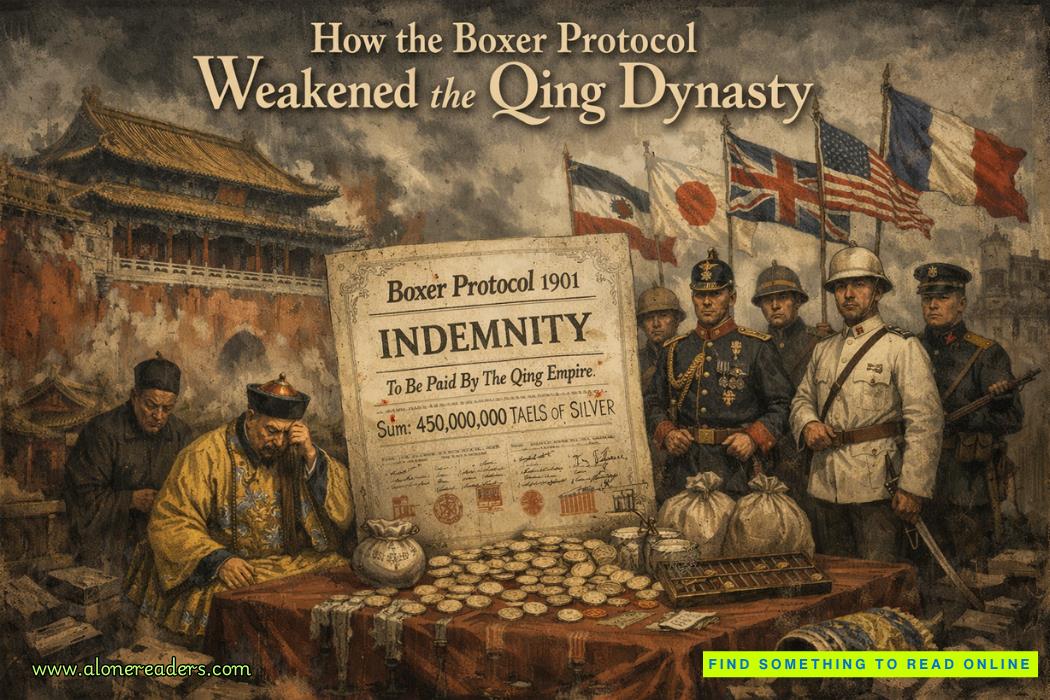
Economically, the military presence distorted development. Areas near foreign garrisons were reshaped to serve external interests—railways prioritized export routes, ports favored imperial trade, and security policy centered on protecting foreigners rather than Chinese communities. The cost of maintaining indemnity payments further drained resources that might have strengthened national defense.
Culturally, the occupation fostered resentment but also awareness. Chinese students studied abroad, absorbed political theory, and returned with a new understanding of sovereignty, nationalism, and statehood. Ironically, the humiliation imposed by foreign militaries helped generate the intellectual foundations of modern China.
The foreign presence was not entirely uniform or stable. Over time, some troops were reduced, redeployed, or withdrawn as global politics shifted. Yet the legal framework remained. The principle that foreign powers could station soldiers inside China without Chinese consent persisted well into the early twentieth century.
When the Qing dynasty collapsed in 1911, the new Republic inherited this burden. Revolutionary leaders discovered that political change did not immediately restore sovereignty. Foreign garrisons remained. Treaties remained. Railways remained guarded by outsiders. Independence on paper did not equal independence in reality.
Warlordism further complicated the situation. Competing Chinese factions often tolerated or negotiated with foreign forces for advantage, reinforcing the fragmentation of authority. China’s weakness was no longer just imposed—it was structurally entrenched.
Only in later decades, through prolonged struggle, diplomacy, war, and revolution, would China begin to dismantle the system created in 1901. The memory of foreign troops standing unchallenged in the capital became a defining lesson for future leaders. Never again became not merely a slogan but a guiding principle of national policy.
The legacy of the foreign military presence after 1901 thus extends far beyond barracks and railways. It reshaped Chinese political consciousness. It redefined the meaning of sovereignty. It transformed humiliation into motivation.
The Boxer Protocol did not simply punish rebellion. It institutionalized vulnerability. The foreign soldiers who remained behind were not peacekeepers; they were reminders—constant, visible, armed reminders—that China had lost control of its own destiny.
And it was precisely this reality that ensured such domination would never be forgotten.



 The Hundred Days Offensive: How the Allies Defeated Germany in World War I
 The Second Battle of the Marne: The Turning Point of World War I in 1918
 The Spring Offensive of 1918: Germany's Final Gamble to Win World War I
 The Treaty of Brest-Litovsk: How Russia Left World War I
 The Russian Revolution and World War I: How War Brought Down the Tsar
 The Zimmermann Telegram Explained: Germany's Secret Offer to Mexico in World War I