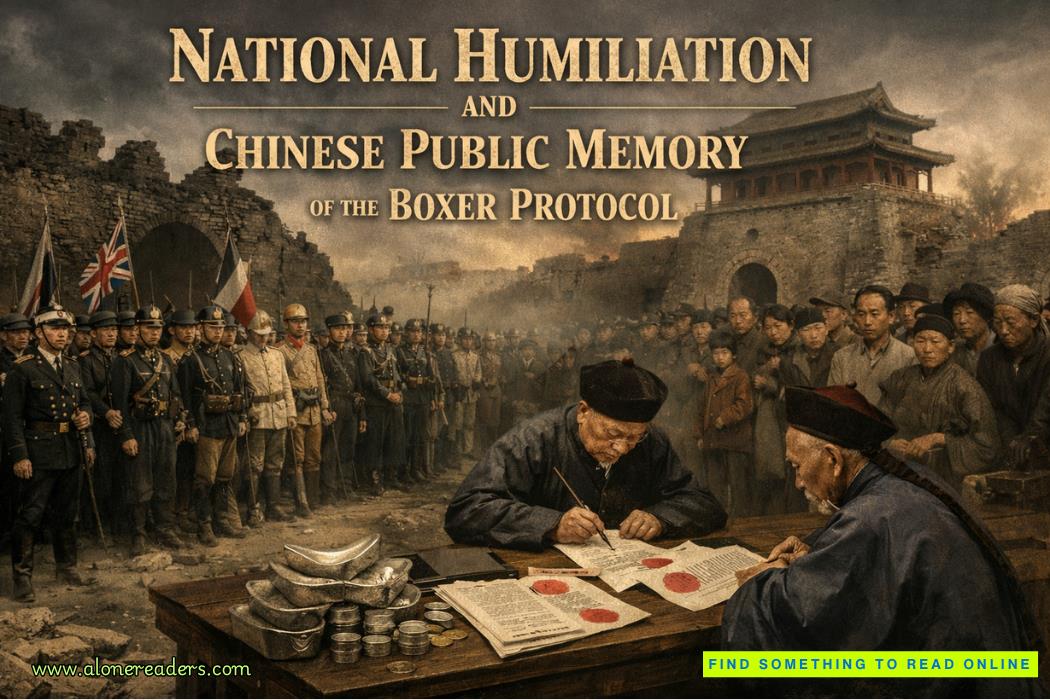
National humiliation occupies a central position in modern Chinese historical consciousness, and few events crystallize this sentiment more powerfully than the 1901 settlement commonly known as the Boxer Protocol. Signed on September 7, 1901, between the Qing court and the victorious foreign powers following the violent upheavals of the Boxer Uprising, the agreement imposed sweeping penalties on China. Over time, the document has transcended its immediate diplomatic context to become a symbolic cornerstone in the narrative of what Chinese discourse often calls the Century of Humiliation. The memory of this settlement has been shaped, reshaped, and mobilized across dynastic collapse, republican revolution, civil war, socialist transformation, and contemporary state-building.
To understand why the Boxer Protocol carries such enduring resonance, one must first situate it within the broader crisis of the late Qing dynasty. By the end of the nineteenth century, the Qing state had already suffered a series of humiliating defeats, including wars with Britain, France, and Japan, as well as unequal treaties that eroded sovereignty and opened treaty ports to foreign control. Yet the events surrounding the Boxer movement represented a particularly traumatic convergence of internal instability and foreign intervention. The Boxers, a loose network of anti-foreign and anti-Christian militias, emerged in northern China amid drought, economic dislocation, and rising resentment toward missionary activity. Their slogans fused xenophobia with spiritual martialism, promising divine protection against bullets and foreign domination.
The crisis escalated dramatically in 1900 when Boxers entered Beijing and violence engulfed the capital. The Qing court, under the influence of conservative factions around Empress Dowager Cixi, vacillated and ultimately aligned itself with the anti-foreign militants. In response, an international coalition of eight powers launched a military expedition, defeated Qing forces, and occupied Beijing. The occupation culminated in negotiations that produced the Boxer Protocol—an agreement that imposed financial, political, and symbolic penalties of extraordinary severity.
Among its most consequential provisions was the massive indemnity of 450 million taels of silver, payable over 39 years with interest. The total sum ultimately exceeded 980 million taels, placing a crushing burden on an already strained fiscal system. The Qing government was required to raise revenue through new taxes and customs duties, further entrenching foreign oversight over Chinese finances. The agreement also authorized foreign troops to be permanently stationed in Beijing’s Legation Quarter and along key routes to the sea, effectively institutionalizing foreign military presence in the heart of the empire.
Equally significant were the symbolic humiliations embedded in the text. Qing officials were compelled to execute or punish pro-Boxer leaders. The imperial court issued formal apologies to foreign governments. Fortifications were demolished. Civil service examinations were suspended in affected areas, striking at the core of Confucian bureaucratic culture. These measures signaled not only defeat but the visible erosion of imperial dignity.
In subsequent decades, Chinese intellectuals and political movements reframed the Boxer Protocol as evidence of systemic weakness. Reformers argued that the Qing dynasty’s failure to modernize had rendered the nation vulnerable. Revolutionaries cited the indemnity and foreign occupation as proof that the Manchu court had forfeited the Mandate of Heaven. Even after the fall of the dynasty in 1911, the memory of the settlement persisted as a cautionary tale about disunity and technological backwardness.
During the Republican period, public discourse increasingly integrated the Boxer Protocol into a broader chronology of humiliation that began with the Opium War and extended through foreign concessions, warlord fragmentation, and Japanese aggression. School textbooks, political speeches, and newspapers presented the 1901 agreement not as an isolated diplomatic episode but as a chapter in an unfolding national tragedy. The narrative emphasized the contrast between China’s civilizational pride and its contemporary subjugation, reinforcing the idea that recovery required modernization and national unity.
After 1949, the newly established People’s Republic of China institutionalized the language of humiliation within state historiography. The Boxer Protocol became emblematic of imperialist aggression and feudal decadence. Marxist interpretations portrayed the late Qing state as semi-colonial and semi-feudal, unable to resist capitalist encroachment. In this framing, the indemnity payments symbolized the extraction of surplus value by imperialist powers, while the foreign garrisons in Beijing epitomized the loss of sovereignty. The narrative reinforced the legitimacy of revolutionary transformation, positioning the Communist Party as the agent that had ended humiliation and restored dignity.
Yet public memory has never been static. Over the course of the twentieth century, interpretations of the Boxer movement itself shifted. Early nationalist historians sometimes condemned the Boxers as superstitious and counterproductive, arguing that their violence had invited foreign retaliation. Later accounts became more ambivalent, acknowledging both the destructive consequences of their actions and their expression of grassroots resistance. This ambivalence illustrates a key tension in Chinese historical memory: the need to reconcile popular anger with the costs of uncoordinated revolt.
The Boxer Protocol’s financial dimension also left a complex legacy. Ironically, portions of the indemnity were later remitted or redirected by certain powers to fund scholarships and educational initiatives. The establishment of institutions such as Tsinghua College, financed through returned indemnity funds, complicates the moral clarity of humiliation narratives. Nevertheless, within Chinese public consciousness, the overall image remains one of coercion and exploitation. The fact that education funds originated from punitive payments does not negate the underlying perception that China was compelled to pay tribute under duress.
In contemporary China, references to the Boxer Protocol frequently appear in museums, documentaries, and commemorative exhibits dedicated to the Century of Humiliation. Visual representations often highlight foreign troops in Beijing, the signing ceremony, and scenes of devastation. The emotional tone underscores collective suffering and indignation, reinforcing the idea that sovereignty must never again be compromised. Such portrayals serve pedagogical as well as political functions, reminding citizens of past weakness while legitimizing present strength.
This collective memory operates not merely as retrospective grievance but as a framework for interpreting current international relations. Official rhetoric occasionally invokes historical humiliation to contextualize disputes over territory, trade, or diplomacy. The Boxer Protocol, as a treaty that legalized foreign military presence and imposed economic penalties, offers a historical precedent against which contemporary policies are measured. The implicit lesson is clear: national rejuvenation requires vigilance against external pressure.
At the same time, Chinese scholarship has grown more nuanced in examining the internal dynamics that produced the crisis. Historians emphasize the environmental stresses, social fragmentation, and bureaucratic paralysis that facilitated the Boxer uprising. By acknowledging domestic causes alongside foreign intervention, recent analyses avoid reducing the episode to a simplistic morality play. Nevertheless, the broader public narrative continues to prioritize the theme of humiliation, because it resonates emotionally and politically.
The durability of this memory reveals how treaties can transcend their immediate legal content to become symbols of collective trauma. The Boxer Protocol was, in technical terms, a peace settlement designed to restore diplomatic relations after violence. In symbolic terms, it became a marker of subordination. Its clauses—indemnity, occupation, punishment—encoded a hierarchy in which China was compelled to concede authority to foreign powers. Over generations, this hierarchy was internalized as a cautionary memory.
The language of humiliation is powerful precisely because it fuses emotion with policy. It frames the past not as a distant era but as a living reference point. In public commemorations, the 1901 agreement stands alongside other unequal treaties as evidence of vulnerability. In official discourse, overcoming that vulnerability is cast as a central mission of national development. The concept of humiliation thus links late Qing defeat to contemporary aspirations of rejuvenation.
Understanding Chinese public memory of the Boxer Protocol requires recognizing that historical narratives are not neutral repositories of fact. They are structured by present concerns. The memory of 1901 is filtered through the experiences of revolution, invasion, civil war, and reform. Each era has reinterpreted the settlement to address its own anxieties and ambitions. What remains constant is the perception that the protocol represented a nadir of sovereignty and dignity.
In sum, the Boxer Protocol occupies a singular position in Chinese historical consciousness because it crystallizes multiple dimensions of loss: territorial integrity, fiscal autonomy, cultural pride, and political legitimacy. Its legacy endures not simply because of the indemnity or the foreign garrisons, but because it symbolizes the broader experience of coerced modernization and external domination. Within Chinese public memory, it stands as both warning and motivation—a reminder of humiliation and a catalyst for renewal.



 The Hundred Days Offensive: How the Allies Defeated Germany in World War I
 The Second Battle of the Marne: The Turning Point of World War I in 1918
 The Spring Offensive of 1918: Germany's Final Gamble to Win World War I
 The Treaty of Brest-Litovsk: How Russia Left World War I
 The Russian Revolution and World War I: How War Brought Down the Tsar
 The Zimmermann Telegram Explained: Germany's Secret Offer to Mexico in World War I