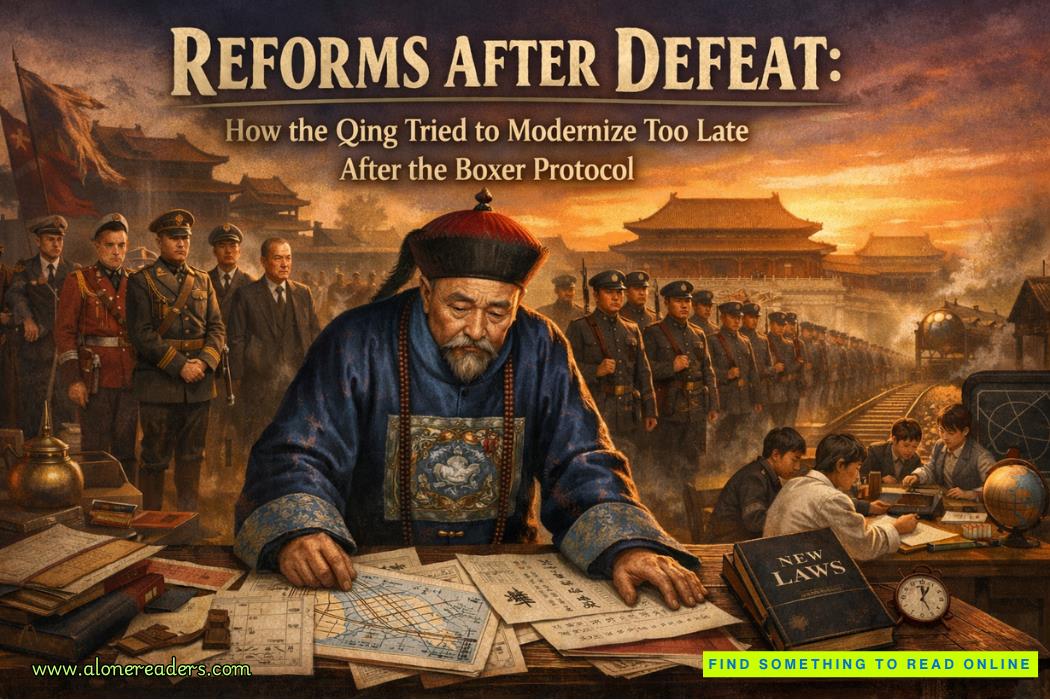
The Boxer Uprising of 1900 was not merely a failed anti-foreign rebellion; it was the final, catastrophic shock that forced the Qing dynasty to confront its own obsolescence. When the Eight-Nation Alliance marched into Beijing and imposed the Boxer Protocol in 1901, the dynasty faced not only crushing indemnities and foreign occupation but also the undeniable exposure of its institutional weakness. What followed was one of the most intense periods of reform in imperial Chinese history. Yet these reforms—ambitious, sweeping, and in many ways transformative—came too late to save the dynasty. They were undertaken not from strength but from humiliation, and that distinction would define their ultimate failure.
The Boxer Protocol imposed staggering terms: a massive indemnity payable over decades, foreign troops stationed in Beijing, and severe restrictions on Chinese sovereignty. The psychological impact was as damaging as the financial burden. For many within the Qing court, particularly reform-minded officials, the lesson was clear: China could no longer survive without structural transformation. The traditional Confucian state apparatus—built on agrarian assumptions and moral governance—had proven incapable of managing industrialized warfare, global finance, or imperial diplomacy.
At the center of this post-defeat transformation stood Empress Dowager Cixi. Long portrayed as a conservative obstructionist, Cixi made a dramatic pivot after 1901. Having fled Beijing during the Boxer crisis and returned under foreign pressure, she recognized that survival required adaptation. The resulting program, known as the “New Policies” or Xinzheng, represented a comprehensive attempt to modernize state, society, and military within a remarkably short timeframe.
One of the most consequential reforms was the abolition of the imperial examination system in 1905. For over a millennium, this examination structure had defined elite mobility and administrative recruitment. Rooted in Confucian classics, it reinforced intellectual continuity but discouraged scientific and technical innovation. By eliminating it, the Qing dismantled the ideological backbone of imperial governance. In its place emerged a modern educational system modeled partially on Japan and Western powers. New schools were established nationwide, students were sent abroad, and curricula began incorporating mathematics, engineering, law, and political science. This shift signaled a profound acknowledgment: moral cultivation alone could no longer sustain state power.
Military reform was equally urgent. The Qing army had been exposed as fragmented, technologically inferior, and poorly coordinated during both the Sino-Japanese War and the Boxer crisis. Reformers reorganized forces into the New Army, emphasizing centralized command, standardized training, and modern weaponry. Western drill methods were introduced, arsenals expanded, and officers increasingly trained abroad. The modernization of the military, however, carried unintended consequences. The New Army fostered professional officers whose loyalties were not exclusively tied to the Manchu court. Among these ranks emerged revolutionary sympathizers who would later support anti-dynastic movements.
Legal reform followed. Recognizing that extraterritoriality—the right of foreign nationals to be tried in their own consular courts—was justified by Western claims of Chinese legal backwardness, the Qing undertook a systematic overhaul of its legal code. Commissions studied European and Japanese law, leading to the drafting of modern penal and civil codes. Torture practices were curtailed, judicial procedures formalized, and ministries restructured. These measures aimed not only at domestic modernization but also at regaining sovereignty by meeting international legal standards.
Economic and infrastructural reforms attempted to strengthen the fiscal base of the state. Railways expanded, mining ventures increased, and industrial enterprises multiplied. However, many of these projects required foreign capital and expertise, entangling China further in global dependency. Provincial elites increasingly controlled railway ventures, and disputes over railway nationalization would later ignite widespread protest. The Qing court’s effort to centralize economic modernization inadvertently inflamed regional tensions.
Political reform proved the most delicate and ultimately insufficient domain. In 1908, the Qing court announced a constitutional roadmap promising eventual parliamentary government. Provincial assemblies were established in 1909, and a national consultative assembly convened in 1910. Yet these institutions possessed limited authority. The court maintained ultimate control, and the timeline for constitutional implementation extended several years into the future. To reform-minded elites, this pace appeared evasive; to conservative Manchu nobles, it seemed dangerously radical. The Qing found itself squeezed between incompatible expectations.
The reforms also suffered from structural contradictions. The Qing dynasty was a Manchu ruling house governing a predominantly Han population. Efforts to modernize risked empowering Han elites who already resented ethnic privilege within the banner system. By expanding education and political participation, the court unintentionally created new public spheres where anti-Manchu nationalism flourished. Modern schools and print media disseminated revolutionary ideas, many influenced by global republicanism and social Darwinism.
Financial strain compounded political fragility. The Boxer indemnity consumed a significant portion of state revenue, limiting the funds available for reform implementation. Modernization required investment in railways, armaments, schools, and bureaucratic restructuring—yet the dynasty was simultaneously servicing enormous debt obligations. Thus, reforms were ambitious on paper but constrained in practice.
Another critical limitation was temporal compression. The Qing attempted within a decade what had taken Japan’s Meiji state several decades to consolidate. Institutional change requires not only edicts but cultural absorption. While the Meiji Restoration had unified political will after internal consolidation, the Qing operated in an atmosphere of crisis, factionalism, and eroding legitimacy. Reform was reactive rather than visionary.
The deaths of Empress Dowager Cixi and Guangxu Emperor in 1908 further destabilized continuity. The enthronement of the child emperor Puyi placed real authority in the hands of regents with limited political capital. Momentum slowed. Confidence waned. Reform without charismatic leadership became administrative routine rather than national mobilization.
Ironically, the Qing reforms modernized the very instruments that would dismantle the dynasty. The New Army’s professionalization enabled coordinated military revolt. The spread of political assemblies cultivated expectations of representation. The expansion of education generated a politically conscious intelligentsia. When the Wuchang Uprising erupted in 1911, it was not a spontaneous peasant rebellion but a coordinated military and political movement rooted in institutions shaped by late Qing reform.
Thus, the New Policies were not trivial gestures. They reshaped Chinese society profoundly. The abolition of the examination system ended one civilizational era. Constitutional discourse normalized ideas of citizenship and national sovereignty. Legal codification aligned China with global jurisprudence. Yet reform cannot compensate for lost legitimacy. By 1911, the dynasty faced an educated elite demanding constitutional immediacy, a military leadership increasingly autonomous, and provincial assemblies unwilling to defer indefinitely.
The tragedy of late Qing modernization lies in its paradox. The reforms were genuine, substantive, and in many respects forward-looking. But they were born from defeat rather than strategic foresight. They attempted to preserve imperial authority while simultaneously diffusing power. They sought to strengthen centralization while empowering provinces. They aimed to modernize without surrendering dynastic supremacy. These internal contradictions rendered reform unstable.
In retrospect, the Qing dynasty’s final decade appears less as stagnation and more as frenetic transformation under existential pressure. The Boxer Protocol served as the catalyst that shattered illusions of insulation from global forces. The dynasty responded with remarkable speed and breadth of reform. Yet modernization requires legitimacy, coherence, and time—resources the Qing no longer possessed.
When revolution came in 1911, it did not erase the reform legacy. Many institutional innovations of the late Qing were inherited by the Republic of China and later regimes. The educational reforms endured. Legal codification evolved. Military modernization continued under new banners. In this sense, the Qing reforms were not futile; they were foundational—but not salvational.
The ultimate lesson of the Qing’s late modernization is stark. Reform imposed by defeat is inherently defensive. It seeks to correct weaknesses already exposed rather than to anticipate future challenges. By the time the Qing embraced systemic transformation, its moral authority had been irreparably damaged. Sovereignty had been compromised. Public confidence had eroded.
The Boxer Protocol humiliated the dynasty. The New Policies attempted redemption. But redemption requires more than structural change—it requires renewed belief. The Qing dynasty modernized institutions but failed to restore faith. And in the absence of legitimacy, even the most ambitious reforms could not prevent the fall of a dynasty that had ruled China for over two and a half centuries.
In that final decade between 1901 and 1911, China stood at the threshold between empire and republic. The Qing court tried to cross that threshold cautiously, hoping to carry imperial authority into a constitutional age. History, however, moved faster than the dynasty’s calculations. The reforms after defeat were bold—but they were also belated. And in the unforgiving calculus of state survival, belated reform is often indistinguishable from surrender.



 The Hundred Days Offensive: How the Allies Defeated Germany in World War I
 The Second Battle of the Marne: The Turning Point of World War I in 1918
 The Spring Offensive of 1918: Germany's Final Gamble to Win World War I
 The Treaty of Brest-Litovsk: How Russia Left World War I
 The Russian Revolution and World War I: How War Brought Down the Tsar
 The Zimmermann Telegram Explained: Germany's Secret Offer to Mexico in World War I