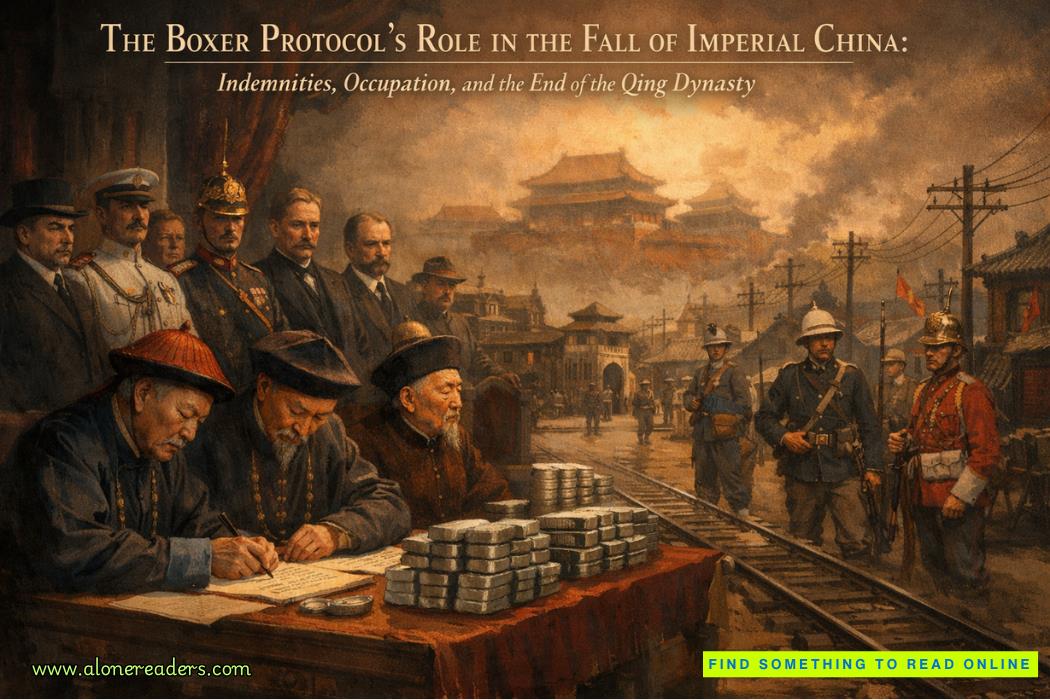
The signing of the Boxer Protocol on September 7, 1901, marked far more than the conclusion of the Boxer Rebellion; it represented a decisive turning point in the unraveling of the Qing dynasty. While imperial China had faced military defeats and unequal treaties throughout the nineteenth century, the Boxer Protocol imposed a scale of humiliation, financial burden, and structural intrusion that profoundly destabilized the imperial state. Its consequences reverberated through fiscal policy, political reform, military restructuring, and revolutionary mobilization, ultimately accelerating the collapse of imperial rule in 1911. To understand the fall of the Qing dynasty, one must examine not merely the uprising of the Boxers, but the systemic shock delivered by the settlement that followed.
The Boxer Rebellion itself emerged from a volatile convergence of anti-foreign sentiment, economic distress, and religious hostility in northern China. The movement known as the “Righteous and Harmonious Fists” attacked Christian missionaries, Chinese converts, and symbols of foreign presence. Within the Qing court, divisions deepened between conservative factions who viewed the Boxers as potential allies against foreign encroachment and reformist officials wary of their extremism. The decision by influential conservatives, including the Empress Dowager Cixi, to tacitly support or tolerate Boxer militancy resulted in open conflict with foreign powers. When an international coalition of eight nations marched on Beijing and relieved the besieged Legation Quarter, the Qing state suffered a catastrophic loss of credibility.
The Boxer Protocol institutionalized that defeat. Its most punishing clause was the indemnity: 450 million taels of silver, payable over 39 years at 4 percent interest. With accrued interest, the total exceeded 900 million taels—an astronomical figure that dwarfed the annual revenue of the Qing treasury. The indemnity was not a one-time penalty but a long-term fiscal siphon that restructured China’s economy around debt servicing. Customs revenues, salt taxes, and other critical income streams were pledged as guarantees. In effect, the empire’s financial arteries were redirected toward foreign creditors.
This indemnity had profound structural implications. First, it weakened the central government’s fiscal autonomy. Revenue previously used for administrative reform, military modernization, and infrastructure development was diverted to foreign powers. Second, it intensified tax burdens on the populace, particularly in already impoverished rural regions. The Qing state, in order to meet indemnity payments, had to squeeze greater revenue from provincial administrations, which in turn increased levies on local communities. This fiscal pressure eroded popular loyalty and deepened resentment against both foreign powers and the Manchu-led court.
Equally destabilizing were the political and military provisions of the treaty. The Protocol authorized foreign powers to station troops permanently in Beijing and along the route to the sea, particularly to protect the Legation Quarter. This provision effectively carved out zones of extraterritorial control within the imperial capital itself. The presence of foreign garrisons in Beijing symbolized the erosion of sovereignty at the heart of the empire. No previous treaty had embedded foreign military authority so visibly and so centrally within the Qing political sphere.
The destruction of key defensive fortifications, including the Dagu forts, further exposed China’s vulnerability. The Qing state was compelled to dismantle its own strategic assets while foreign powers consolidated theirs. This asymmetry in military capability highlighted the obsolescence of traditional imperial forces and exposed the inadequacy of prior self-strengthening efforts. Reformist officials increasingly recognized that incremental modernization was insufficient; systemic transformation was required.
Paradoxically, the Boxer Protocol also catalyzed reform. The humiliating defeat convinced many Qing elites that survival demanded institutional restructuring. In the years following 1901, the court initiated what became known as the “New Policies” reforms. These included the abolition of the traditional civil service examination system in 1905, the establishment of modern schools, the reorganization of the military along Western lines, and tentative steps toward constitutional governance. On the surface, these measures appeared progressive and adaptive. Yet they were reactive, implemented under the shadow of foreign coercion and domestic instability.
The abolition of the examination system was particularly consequential. For centuries, the Confucian examination structure had anchored the legitimacy of imperial governance. It provided a pathway for social mobility and reinforced ideological cohesion. Its removal disrupted the social contract between the state and the scholar-gentry class. While new educational institutions emerged, they produced graduates exposed to nationalist and revolutionary ideas, including republicanism and constitutionalism. The intellectual infrastructure of the empire was fundamentally transformed.
Moreover, the financial strain imposed by indemnity payments constrained the effectiveness of reform. Military modernization required capital; educational reform required investment; administrative restructuring required bureaucratic expansion. Yet the Qing treasury was tethered to foreign debt obligations. Provincial authorities, especially in economically dynamic regions like Guangdong and Hunan, gained greater fiscal autonomy as the central government struggled to coordinate revenue. This decentralization inadvertently strengthened provincial militarists and reformers who would later play pivotal roles in the 1911 Revolution.
Another long-term effect of the Boxer Protocol was the intensification of Chinese nationalism. The spectacle of foreign troops in Beijing, combined with the enormous indemnity burden, created a narrative of national humiliation. Newspapers, reformist societies, and overseas Chinese networks disseminated critiques of Manchu rule, portraying the Qing court as incapable of defending Chinese sovereignty. Revolutionary figures such as Sun Yat-sen capitalized on this sentiment, arguing that only the overthrow of the dynasty could restore national dignity. The Protocol thus became a symbol not merely of foreign aggression but of dynastic failure.
Interestingly, some indemnity funds were later redirected toward educational initiatives, particularly scholarships for Chinese students to study abroad. The United States, for example, remitted a portion of its indemnity share to support educational exchange programs. While this gesture mitigated certain aspects of the financial burden, it also contributed to the formation of a new generation of Chinese intellectuals educated in Western political thought. Many of these students returned with ideas that challenged imperial governance and promoted republican ideals. In this way, even partial relief efforts inadvertently undermined dynastic stability.
The Boxer Protocol also reshaped China’s geopolitical position. The settlement reaffirmed the “Open Door” framework favored by certain powers while consolidating foreign spheres of influence. Russia, Japan, Britain, Germany, France, and others maneuvered for strategic advantage in Manchuria and coastal regions. The Qing court found itself navigating an increasingly complex web of imperial rivalries. Its diplomatic capacity was constrained by treaty obligations and the perception of weakness. The Russo-Japanese War of 1904–1905, fought largely on Chinese soil, further demonstrated the erosion of Chinese sovereignty and intensified domestic calls for national regeneration.
Within the military sphere, reforms undertaken after 1901 produced unintended consequences. The creation of the New Army, trained and organized along modern lines, enhanced combat effectiveness but also fostered new centers of power. Officers exposed to nationalist ideology developed loyalties that were not exclusively tied to the Manchu throne. By 1911, segments of these modernized forces would side with revolutionaries. The very instruments designed to preserve the dynasty became vehicles of its dissolution.
It is important to recognize that the fall of the Qing dynasty cannot be attributed solely to the Boxer Protocol. Long-term structural weaknesses—including demographic pressures, bureaucratic corruption, ethnic tensions between Manchu rulers and Han majority populations, and earlier treaty defeats—had already eroded imperial resilience. Nevertheless, the Protocol acted as a catalyst. It compressed fiscal crisis, military humiliation, ideological transformation, and nationalist mobilization into a single, deeply symbolic event. Its provisions institutionalized dependency and exposed the limitations of dynastic adaptation.
By the time the Wuchang Uprising erupted in October 1911, the Qing state was fiscally strained, politically fragmented, and ideologically contested. Provincial assemblies established during constitutional experiments became platforms for dissent. Reform had raised expectations that the monarchy struggled to fulfill. The indemnity payments continued to drain resources, and foreign troops remained stationed in sensitive areas. The memory of 1901 lingered as a reminder of imperial impotence.
In retrospective analysis, the Boxer Protocol represents a moment when sovereignty, legitimacy, and reform intersected under conditions of extreme external pressure. It did not simply punish rebellion; it restructured the relationship between China and the global order. The indemnity burden entrenched financial dependency. The occupation clauses institutionalized foreign oversight. The reform impulse destabilized traditional authority. Nationalist consciousness intensified. Each of these dynamics contributed to the unraveling of imperial rule.
Thus, the Boxer Protocol’s role in the fall of imperial China was both direct and indirect. Directly, it imposed material constraints that weakened the Qing state. Indirectly, it accelerated ideological transformation and empowered forces that challenged dynastic legitimacy. It transformed humiliation into mobilization, reform into destabilization, and defeat into revolution. When the last emperor abdicated in early 1912, the roots of that abdication could be traced, in part, to the settlement imposed in 1901.
The Boxer Protocol stands, therefore, not merely as a diplomatic document but as a structural rupture in late imperial history. It marked the transition from a beleaguered empire struggling to reform to a collapsing monarchy overtaken by revolutionary nationalism. In the arc of Chinese history, it represents the moment when the cumulative pressures of the nineteenth century crystallized into irreversible decline.




 The Hundred Days Offensive: How the Allies Defeated Germany in World War I
 The Second Battle of the Marne: The Turning Point of World War I in 1918
 The Spring Offensive of 1918: Germany's Final Gamble to Win World War I
 The Treaty of Brest-Litovsk: How Russia Left World War I
 The Russian Revolution and World War I: How War Brought Down the Tsar
 The Zimmermann Telegram Explained: Germany's Secret Offer to Mexico in World War I