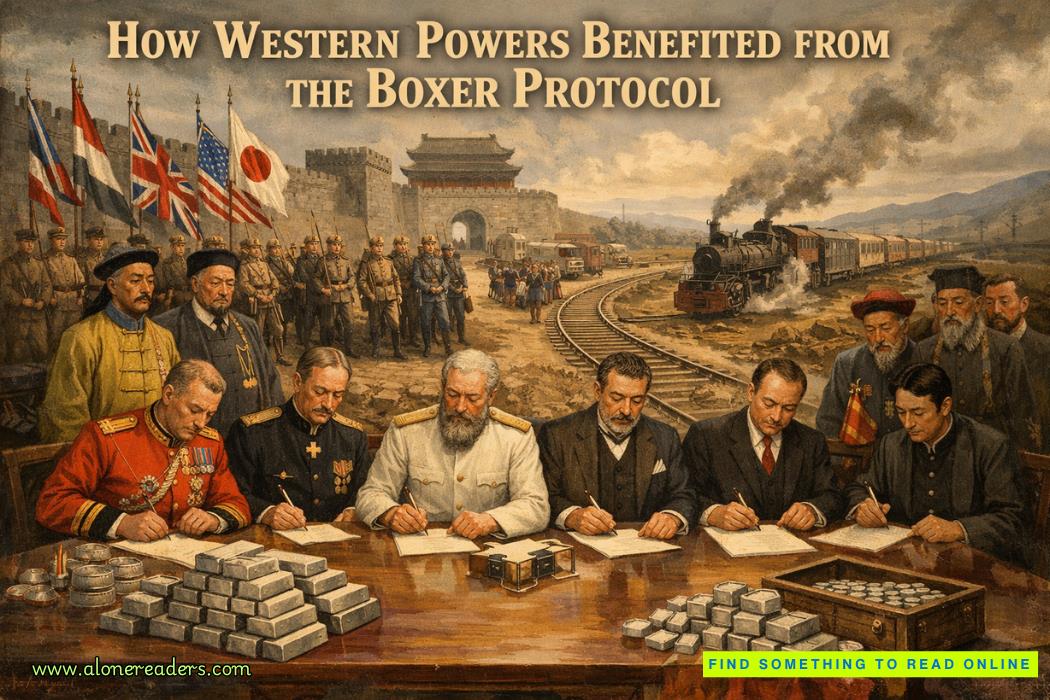
The signing of the Boxer Protocol in September 1901 marked one of the most consequential moments in the late Qing dynasty. Emerging from the violence of the Boxer Rebellion, the agreement formally ended hostilities between Qing China and the allied foreign powers that had intervened militarily to suppress the uprising. Yet beyond restoring diplomatic relations, the protocol fundamentally reshaped the balance of power in East Asia. It was not merely a punitive settlement; it was a calculated framework through which Western empires—and Japan—converted military victory into sustained financial gain, strategic footholds, and political leverage over a weakened Qing state.
The most immediate and visible benefit to foreign powers was financial. The protocol imposed a staggering indemnity of 450 million taels of silver, to be paid over 39 years with 4 percent annual interest. When compounded, this obligation amounted to nearly double the principal sum. In effect, China was compelled to transfer enormous portions of its fiscal capacity to foreign creditors well into the mid-20th century. For imperial governments such as the United Kingdom, Germany, France, Russia, the United States, and Japan, this indemnity functioned as both compensation and capital extraction.
The financial windfall did not simply reimburse wartime expenses. It became a mechanism for expanding influence. Indemnity payments were secured against Chinese maritime customs revenues, salt taxes, and other critical streams of state income. This meant that foreign control over Chinese fiscal institutions deepened dramatically. Customs administration, already influenced by foreign personnel, effectively became a guarantee system for foreign bondholders. The Qing state’s sovereignty over its own taxation was structurally compromised. Western bankers and financial institutions profited from arranging loans and managing indemnity bonds, embedding foreign capital more firmly into China’s economy.
Germany leveraged its indemnity share to expand naval facilities and colonial administration in Jiaozhou Bay. Russia used financial leverage to reinforce its strategic presence in Manchuria. Britain, already dominant in trade through Hong Kong and treaty ports, secured both monetary returns and strengthened legal privileges. The United States, while receiving a smaller share, reinvested part of its indemnity into educational initiatives such as scholarships that would later support Chinese students studying in American universities. Even this ostensibly benevolent use of funds served a strategic purpose: cultivating future elites who would be culturally and intellectually aligned with American institutions.
Military concessions embedded within the protocol provided another substantial advantage. The agreement permitted foreign powers to station troops along the route between Beijing and the sea, particularly to safeguard the Legation Quarter. This clause effectively legalized a permanent foreign military corridor through northern China. For the first time, foreign garrisons could operate openly in the capital’s vicinity without Qing oversight. The symbolic implications were immense. Beijing, the imperial heart of China, was no longer insulated from foreign arms.
The fortified Legation Quarter itself became an extraterritorial enclave. Within its boundaries, foreign laws and authorities prevailed. This space represented not only diplomatic immunity but also political insulation. Western representatives could operate with unprecedented autonomy, exerting pressure on Qing officials without fear of retaliation. The protocol also required the destruction of the Dagu forts and other defensive installations, weakening China’s coastal defenses and reducing its capacity to resist future incursions. Such disarmament ensured that the Qing government would struggle to contest foreign demands militarily.
Beyond finances and military presence, the Boxer Protocol reinforced the broader treaty port system that had emerged since the mid-19th century. Trade privileges were preserved and, in practice, expanded. Foreign merchants benefited from tariff limitations that restricted China’s ability to protect its domestic industries. The continued enforcement of low import duties meant that Western manufactured goods retained a competitive advantage in Chinese markets. Industrial powers could flood Chinese ports with textiles, machinery, and consumer products, consolidating economic dependency.
Railway and mining concessions further amplified these benefits. Following the suppression of the uprising, foreign investors accelerated infrastructure projects across northern China. Railways were not merely commercial ventures; they were instruments of strategic penetration. Control over rail lines enabled rapid troop movements, facilitated resource extraction, and opened inland markets to foreign trade. Mining rights granted to foreign companies ensured access to coal and other resources essential to industrial expansion. Thus, the protocol indirectly stimulated a new wave of concessionary agreements that tied China’s modernization efforts to foreign capital.
Diplomatically, the settlement elevated the status of the allied coalition. The coordinated intervention by eight powers demonstrated that imperial rivalries could be temporarily subordinated when shared economic interests were threatened. The suppression of the Boxers served as a collective assertion of global reach. It signaled to the world that Western empires could project force deep into Asia and compel compliance. For Japan, participation marked its arrival as a recognized imperial power capable of acting alongside European states. The protocol therefore reinforced existing hierarchies while reshaping others.
Politically within China, the indemnity burden exacerbated internal instability. To meet payment obligations, the Qing government increased taxes and sought new loans. These measures intensified popular resentment and weakened the dynasty’s legitimacy. For foreign powers, this instability was paradoxically advantageous. A fragile Qing regime was more susceptible to diplomatic pressure. Western diplomats could influence reforms, negotiate concessions, and shape policy outcomes in ways that would have been far more difficult with a confident and fiscally secure Chinese state.
The protocol also included clauses mandating the punishment of officials who had supported the Boxers. By compelling the Qing court to execute or exile certain figures, foreign governments directly intervened in China’s internal political sphere. This intrusion blurred the boundary between external diplomacy and domestic governance. It demonstrated that Western powers could dictate not only financial terms but also judicial outcomes within China.
Culturally and ideologically, the aftermath of the Boxer uprising provided Western nations with a narrative of civilizational superiority. The violence against missionaries and foreign residents was portrayed as evidence of Chinese backwardness and fanaticism. In European and American public discourse, the suppression of the uprising justified imperial expansion as a mission of order and modernization. Such rhetoric reinforced support for overseas ventures and framed economic exploitation as moral responsibility.
For global finance, the Boxer indemnity became one of the largest international debt arrangements of its era. Bond markets in London and Paris benefited from Chinese loan issuances tied to indemnity payments. Investors gained relatively secure returns backed by customs revenues. This integration of China into international capital flows expanded the reach of Western financial systems. China’s fiscal dependency became a pillar of global imperial finance.
Strategically, Russia and Japan maneuvered to capitalize on the post-Boxer environment in Manchuria. Russian occupation of parts of the region, justified in part by security concerns, laid groundwork for future conflict with Japan. While rivalry intensified, both powers benefited from China’s weakened bargaining position. The Boxer Protocol thus indirectly shaped the geopolitical contest that culminated in the Russo-Japanese War. Western European powers observed these developments while safeguarding their own spheres of influence.
The United States articulated its Open Door Policy within this context, advocating equal commercial access rather than territorial partition. Yet the policy did not challenge the fundamental premise of foreign privilege. Instead, it sought to ensure that American businesses would not be excluded from markets secured through collective coercion. Economic inclusivity among imperial powers did not translate into sovereignty for China.
Over the longer term, the indemnity payments influenced Chinese reform movements. Funds diverted abroad constrained investment in domestic modernization. Reformers within the Qing court initiated late reforms partly in response to the humiliation of 1901. Ironically, the same pressures that enriched Western powers contributed to revolutionary currents that would eventually topple the dynasty in 1911. However, during the intervening decade, foreign governments continued to reap benefits from a system designed to institutionalize Chinese weakness.
It is essential to recognize that the Boxer Protocol did not create Western dominance in China; rather, it consolidated and intensified preexisting structures of unequal treaties. What distinguished the 1901 settlement was its comprehensiveness. Financial extraction, military occupation, infrastructural penetration, and political interference were woven into a single framework. The treaty transformed a punitive peace into a durable instrument of imperial leverage.
Even the partial remission of indemnity payments by some powers later on served strategic objectives. By redirecting funds toward educational exchanges and development initiatives, governments cultivated influence among Chinese elites. Educational programs funded by indemnity remissions created networks of graduates familiar with Western institutions and languages. Such soft power initiatives complemented the harder instruments of control embedded in the treaty.
In economic terms, the indemnity effectively transferred wealth from a predominantly agrarian society to industrialized empires at the height of global expansion. Silver outflows and tax burdens constrained rural economies. Meanwhile, foreign industries and financiers absorbed capital that could be reinvested domestically. The asymmetry underscored the structural inequalities of the imperial world order at the dawn of the 20th century.
Ultimately, the benefits accrued by Western powers under the Boxer Protocol were multidimensional. They included direct financial compensation, secured revenue streams, expanded trade access, military positioning, political leverage, and ideological reinforcement of imperial authority. Each component reinforced the others, producing a cumulative effect far greater than the indemnity sum alone. The treaty stands as a case study in how military intervention can be converted into sustained economic and strategic advantage.
The legacy of the Boxer Protocol remains deeply embedded in Chinese historical memory as a symbol of humiliation and foreign exploitation. For Western powers at the time, however, it represented successful enforcement of imperial interests. By translating battlefield victory into long-term structural influence, the signatories ensured that their gains would persist well beyond the immediate crisis. The settlement illustrates how diplomacy, finance, and force intertwined in the age of high imperialism, reshaping East Asia and the global order in ways that reverberated for decades.



 The Hundred Days Offensive: How the Allies Defeated Germany in World War I
 The Second Battle of the Marne: The Turning Point of World War I in 1918
 The Spring Offensive of 1918: Germany's Final Gamble to Win World War I
 The Treaty of Brest-Litovsk: How Russia Left World War I
 The Russian Revolution and World War I: How War Brought Down the Tsar
 The Zimmermann Telegram Explained: Germany's Secret Offer to Mexico in World War I