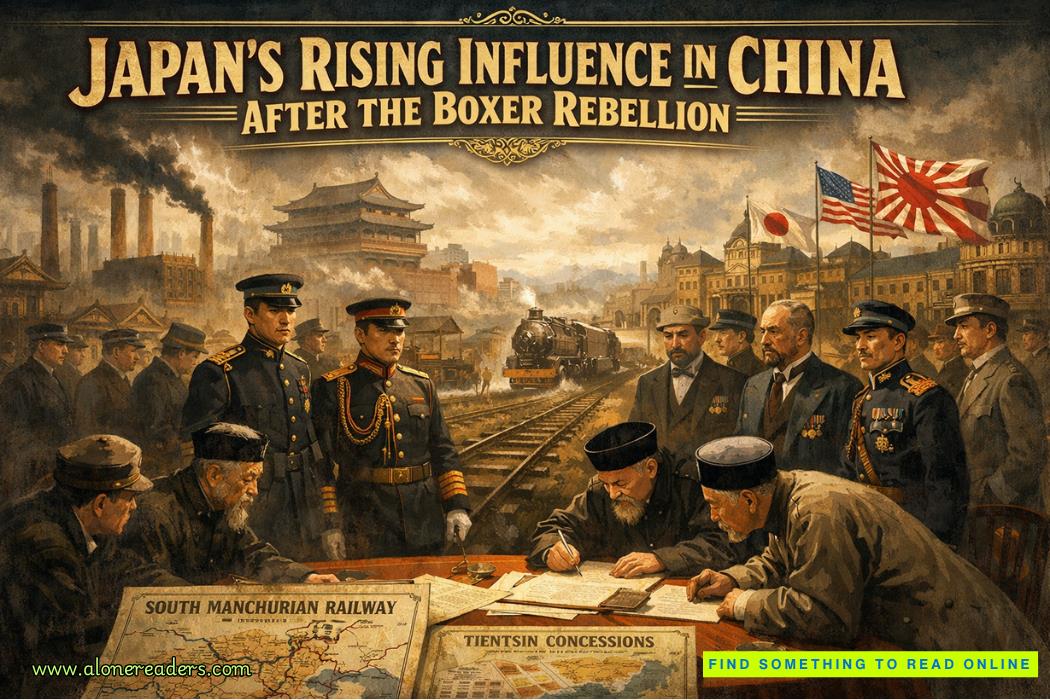
The suppression of the Boxer Uprising in 1900 marked a decisive rupture in Qing China’s sovereignty, but it also opened a transformative chapter in East Asian geopolitics. While multiple foreign powers imposed harsh terms under the Boxer Protocol of 1901, it was Japan that emerged as the most strategically advantaged Asian power in the post-Boxer settlement. Unlike the European empires, Japan combined geographical proximity, military credibility, and a rapidly modernizing state apparatus to translate treaty rights into enduring influence. The years following the rebellion witnessed a profound recalibration of power in North China and Manchuria, and at the center of that transformation stood Tokyo.
Japan’s role in suppressing the Boxers was not merely symbolic. It dispatched one of the largest contingents among the Eight-Nation Alliance. Japanese troops, hardened by the reforms of the Meiji Restoration and influenced by Western military doctrine, distinguished themselves during the march to relieve the foreign legations in Beijing. This military visibility was critical. Japan demonstrated that it was not a peripheral Asian state but a disciplined imperial power capable of projecting force on equal footing with Britain, Russia, Germany, and the United States. In the psychological landscape of diplomacy, that mattered as much as the battlefield outcome itself.
The Boxer Protocol imposed an enormous indemnity on China—450 million taels of silver, payable with interest over nearly four decades. Japan secured a significant share of this indemnity. Yet the financial compensation was only part of the equation. The protocol authorized foreign troops to be stationed permanently in key areas, including the route between Beijing and Tianjin. Japan used this clause strategically, consolidating military positions that would later support deeper incursions into northern China. The presence of Japanese garrisons normalized the idea of Japanese security interests on Chinese soil, a concept that would expand dramatically over the next three decades.
The broader context of Japan’s rise must be understood through its victory in the First Sino-Japanese War (1894–1895), which had already shattered the aura of Qing invincibility. That conflict resulted in the Treaty of Shimonoseki, granting Japan Taiwan and influence in Korea. However, the Triple Intervention—when Russia, Germany, and France forced Japan to relinquish the Liaodong Peninsula—had humiliated Tokyo and intensified its determination to prevent future diplomatic isolation. The Boxer crisis provided an opportunity for redemption. Japan re-entered North China not as a defeated claimant but as a recognized great power.
One of the most consequential arenas of Japanese expansion after the Boxer Rebellion was Manchuria. Although Russia initially dominated the region through the construction of the Chinese Eastern Railway and its military presence, tensions between Tokyo and St. Petersburg escalated rapidly. The Boxer aftermath had left Manchuria occupied by Russian forces under the pretext of restoring order. Japan perceived this as a strategic threat to its interests in Korea and northern China. The Russo-Japanese War of 1904–1905, fought largely over influence in Manchuria and Korea, became the next turning point.
Japan’s victory in that war profoundly altered the balance of power. Under the Treaty of Portsmouth, Russia ceded its leasehold rights in the Liaodong Peninsula and control of the southern section of the railway to Japan. This transfer effectively institutionalized Japanese authority in southern Manchuria. The South Manchurian Railway Company (SMR), established in 1906, was not merely a transportation enterprise; it functioned as a quasi-colonial administration. Through the SMR, Japan embedded economic penetration, intelligence networks, industrial development, and demographic expansion into the fabric of northeastern China.
Japanese influence in post-Boxer China was not confined to military installations or railway concessions. It extended into financial systems, education, and bureaucratic advisory roles. Japan capitalized on China’s search for reform models during the late Qing constitutional movement. Many Chinese reformers looked to Japan as an example of successful modernization without complete Westernization. Thousands of Chinese students traveled to Tokyo and Kyoto in the early 20th century. The intellectual crosscurrents were significant. Japan positioned itself simultaneously as imperial rival and developmental model, a paradox that complicated Chinese perceptions.
Economically, Japanese merchants and industrialists moved swiftly to exploit treaty port privileges. The expansion of textile exports into Chinese markets, investment in mining ventures, and establishment of banks strengthened Japan’s commercial foothold. Japanese capital often undercut European competitors due to lower transportation costs and state-backed coordination. In Tianjin and other northern cities, Japanese settlements grew in size and influence. Commercial expansion reinforced military leverage, creating a layered architecture of dominance.
The fragmentation of Qing authority further facilitated Japanese penetration. The Boxer catastrophe had discredited conservative factions at court and intensified calls for reform. However, the reforms implemented after 1901 were uneven and financially constrained by indemnity payments. Provincial militarization accelerated as regional leaders gained fiscal autonomy to meet indemnity obligations. This decentralization created opportunities for foreign powers to negotiate directly with local authorities. Japan proved adept at exploiting such fissures, cultivating ties with regional elites who could facilitate railway construction or commercial concessions.
When the Qing dynasty collapsed in 1911, Japan’s strategic calculus shifted again. The revolution introduced instability, but it also opened diplomatic space. Competing warlord regimes and a fragile central government in Beijing sought foreign recognition and loans. Japan extended financial credits that increased political leverage. The most notorious example came in 1915, when Tokyo presented the Twenty-One Demands to the Republic of China. Although partially diluted under international pressure, the demands sought to formalize Japan’s privileged position in Shandong, Manchuria, and Inner Mongolia. The roots of that assertiveness lay in the structural advantages secured after the Boxer Protocol.
Japan’s claim to Shandong merits particular attention. During the Boxer crisis, German interests in the province had been targeted, and Germany subsequently intensified its presence there. However, with the outbreak of the First World War in 1914, Japan seized German holdings in Shandong under the guise of alliance obligations to Britain. The postwar settlement at Versailles transferred these rights to Japan rather than returning them to China, igniting widespread outrage and fueling the May Fourth Movement. The trajectory from Boxer suppression to Shandong controversy illustrates a continuum. Each diplomatic episode layered new privileges atop earlier concessions.
Military doctrine also evolved in this period. Japanese strategists conceptualized Manchuria as a lifeline for national security and economic survival. The Kwantung Army, stationed in the leased territories inherited from Russia, developed increasing autonomy. Although formally subordinate to Tokyo, it operated with an aggressive frontier mentality. The 1931 Mukden Incident and subsequent establishment of Manchukuo can be traced to this institutional culture. While those events occurred decades after the Boxer Rebellion, the enabling infrastructure—railways, garrisons, treaty rights—originated in the immediate post-1900 settlement. The Boxer Protocol thus functioned as a legal and logistical foundation for later expansionist policies.
Chinese responses to Japan’s rising influence were complex and often ambivalent. Some reformers admired Japan’s constitutional monarchy and industrial growth, interpreting its ascent as proof that Asian societies could compete with the West. Others viewed Japanese encroachment as a betrayal of pan-Asian solidarity. The language of “Asia for Asians” rang hollow when accompanied by territorial demands. Intellectual debates in newspapers and political societies reflected this tension. Japan’s image oscillated between mentor and predator, shaping the ideological currents of early Republican China.
It is important to emphasize that Japan’s expansion was not inevitable solely because of the Boxer Rebellion. Rather, the rebellion created a permissive environment in which foreign military occupation and indemnity obligations weakened central control. Japan’s state apparatus, forged through decades of Meiji reforms, was uniquely prepared to exploit that environment. Efficient taxation, industrial coordination, naval modernization, and bureaucratic discipline enabled sustained overseas engagement. European powers, distracted by rivalries and colonial commitments elsewhere, often lacked the same regional focus. Japan’s comparative advantage lay in its concentration of effort within East Asia.
The indemnity payments themselves indirectly strengthened Japanese capital. As China serviced its obligations through customs revenues and foreign-supervised financial mechanisms, opportunities for loan syndicates and banking expansion multiplied. Japanese financial institutions integrated into these structures, facilitating trade flows and currency exchange. Economic entanglement became another vector of influence. Infrastructure projects, ostensibly commercial, doubled as strategic corridors.
The transformation of Tianjin after 1901 provides a microcosm of these dynamics. The city’s foreign concessions expanded, each administered under distinct legal regimes. Japan’s concession area grew in population and commercial vitality. Educational institutions, newspapers, and businesses reinforced a semi-autonomous enclave. Such enclaves were not mere expatriate communities; they were nodes of imperial governance embedded within Chinese urban space. Through these enclaves, sovereignty was incrementally diluted.
By the 1920s, Japanese industrial exports dominated certain sectors of the Chinese market. Cotton yarn and manufactured goods from Osaka competed aggressively against British and Indian imports. The economic interdependence that emerged was asymmetrical. While Chinese consumers benefited from lower prices, domestic industries struggled. Economic nationalism gained traction, but dismantling entrenched concessions proved politically arduous. The structural imbalance traced back to the legal regime imposed after the Boxer defeat.
In strategic retrospect, the Boxer Rebellion can be seen as a catalyst that accelerated Japan’s ascent from regional challenger to continental power. The Meiji state had already embarked on imperial expansion, yet the post-1900 environment legitimized a more assertive posture within China itself. What began as participation in a multinational punitive expedition evolved into a sustained project of influence-building that reshaped Northeast Asia.
The legacy of Japan’s rising influence after the Boxer Rebellion is inseparable from the turbulent decades that followed: revolution, warlordism, nationalist mobilization, and ultimately full-scale war in 1937. The initial framework of rights and privileges granted in 1901 provided both precedent and infrastructure. It normalized foreign troops on Chinese soil, institutionalized economic concessions, and eroded central sovereignty. Japan proved particularly adept at converting those permissions into durable strategic assets.
In evaluating this period, one must resist simplistic narratives of inevitability or singular causation. Yet it is unmistakable that the Boxer Protocol marked a structural inflection point, not only for Qing China’s decline but also for Japan’s imperial trajectory. From indemnities to railways, from concessions to constitutional emulation, the threads of influence intertwined. By the early twentieth century, Japan stood not merely as a participant in China’s crisis but as a principal architect of its new geopolitical landscape.



 The Hundred Days Offensive: How the Allies Defeated Germany in World War I
 The Second Battle of the Marne: The Turning Point of World War I in 1918
 The Spring Offensive of 1918: Germany's Final Gamble to Win World War I
 The Treaty of Brest-Litovsk: How Russia Left World War I
 The Russian Revolution and World War I: How War Brought Down the Tsar
 The Zimmermann Telegram Explained: Germany's Secret Offer to Mexico in World War I