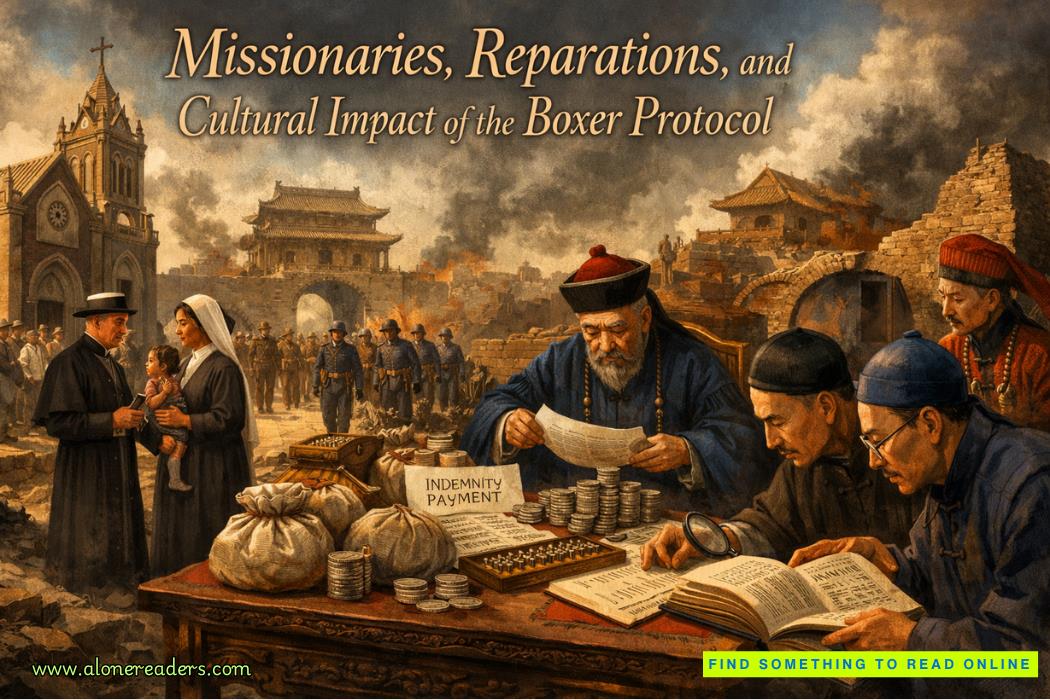
Missionaries, reparations, and the cultural aftershocks of the Boxer Protocol formed one of the most consequential intersections of religion, imperial finance, and national identity in modern Chinese history. The Boxer Protocol, signed in 1901 following the violent suppression of the Boxer Uprising, did far more than impose military restrictions and financial penalties on the Qing Empire. It reshaped the missionary presence in China, institutionalized massive indemnity payments to foreign powers, and accelerated profound cultural transformations that would reverberate through the final decade of Qing rule and into the Republican era. The treaty codified humiliation, yet paradoxically catalyzed reform, education, and nationalist awakening.
To understand the missionaries’ role in this drama, one must examine the volatile environment of late nineteenth-century China. Christian missionary activity had expanded significantly after earlier unequal treaties legalized their operations and granted them extraterritorial protections. By the 1890s, Protestant and Catholic missions had established churches, schools, hospitals, and printing presses throughout northern China. Missionaries often viewed themselves as agents of salvation and civilization. Yet many Chinese saw them as symbols of foreign intrusion, shielded by gunboat diplomacy and legal privileges that undermined local authority.
The Boxer movement, fueled by drought, economic distress, and resentment against foreign encroachment, targeted missionaries and Chinese converts with particular fury. Churches were burned, converts massacred, and foreign legations besieged in Beijing. The violence was not random. It expressed a potent belief that Christian institutions represented cultural subversion and political penetration. Converts were accused of abandoning ancestral rites and traditional hierarchies. Mission compounds, often protected by foreign troops, appeared to operate outside Qing jurisdiction, intensifying the perception that missionaries were instruments of imperial power.
When the Eight-Nation Alliance intervened militarily and crushed the uprising, the punitive settlement that followed institutionalized foreign dominance. The Boxer Protocol required the Qing government to pay an indemnity of 450 million taels of silver, payable over 39 years with interest. This staggering financial burden effectively mortgaged China’s fiscal future. The indemnity payments were allocated among powers including Britain, France, Germany, Russia, Japan, and the United States. The treaty also authorized the permanent stationing of foreign troops in Beijing and along key railway lines, reinforcing the sense of occupation.
Missionaries benefited materially and legally from the new order. Compensation for destroyed mission property and murdered missionaries was included within the broader indemnity framework. Furthermore, the Protocol reinforced earlier rights allowing missionaries to acquire property and rebuild churches. In practical terms, this meant that missionary institutions expanded in the very regions where anti-foreign violence had erupted. The suppression of the Boxers did not reduce missionary influence; it entrenched it.
Yet the story is not one-dimensional. Missionaries were not a monolith. Some adopted conciliatory postures, advocating educational outreach rather than aggressive proselytization. Others supported social services—hospitals, orphanages, and famine relief—that won local goodwill. In urban centers, missionary schools introduced Western science, medicine, and political thought to Chinese students who would later become reformers and revolutionaries. Ironically, Christian colleges and mission presses disseminated ideas about constitutionalism, rights, and civic participation that fed into anti-imperialist nationalism.
The indemnity payments themselves produced unexpected cultural consequences. While most powers used indemnity funds to service debts or bolster colonial budgets, the United States famously remitted a portion of its share to fund scholarships for Chinese students. This initiative led to the establishment of preparatory institutions that later evolved into major universities. Students educated abroad under these programs returned with exposure to Western science and governance models. Thus, an indemnity intended as punishment became an engine of intellectual modernization.
Nevertheless, the financial strain was severe. To meet indemnity obligations, the Qing government increased taxation and restructured customs revenues under foreign supervision. The perception that the dynasty was paying foreigners with Chinese resources deepened popular resentment. Reformers within the Qing court recognized that survival required systemic change. In the aftermath of the Protocol, the court launched the “New Policies” reforms, restructuring the military, education system, and administrative apparatus. Abolition of the imperial examination system in 1905—an institution that had defined elite culture for centuries—marked a revolutionary shift in Chinese intellectual life.
Missionaries operated within this fermenting environment. Christian schools increasingly offered curricula in mathematics, engineering, and medicine. Converts sometimes rose into new professional classes emerging from reformist institutions. At the same time, missionary presence continued to provoke suspicion. Anti-Christian riots did not vanish. Many Chinese intellectuals distinguished between Western science and Western religion, embracing the former while rejecting the latter as an alien imposition.
Culturally, the Boxer Protocol intensified a debate over identity. Was modernization synonymous with Westernization? Could China adopt technological and administrative innovations without surrendering civilizational autonomy? Missionaries often framed Christianity as a universal faith compatible with modern progress. Critics argued that conversion entailed loyalty shifts that fractured communal solidarity. The Protocol’s legal provisions, which allowed foreign powers to intervene diplomatically on behalf of missionaries and converts, reinforced fears that religion served as a Trojan horse for imperial control.
The presence of foreign troops in Beijing and the execution or exile of Qing officials deemed responsible for supporting the Boxers symbolized the erosion of sovereignty. Public humiliation ceremonies and memorial tablets commemorating slain diplomats institutionalized foreign narratives of victimhood and justification. For many Chinese observers, the Protocol represented not merely a treaty but a ritualized assertion of civilizational superiority. This symbolic dimension magnified its cultural impact beyond fiscal metrics.
At the grassroots level, missionary expansion reshaped local landscapes. Churches rebuilt after 1901 often stood as conspicuous markers of foreign influence. Architectural styles blended Gothic or Romanesque forms with Chinese decorative elements, visually embodying cultural hybridity. Mission compounds became nodes in transnational networks linking rural China to global religious institutions. Conversion sometimes provided social mobility or access to education otherwise unavailable. Yet it also exposed converts to social ostracism.
Reparations extended beyond financial compensation. Qing officials were compelled to issue edicts condemning anti-foreign violence and affirming protections for Christians. Such proclamations functioned as moral reparations, acknowledging wrongdoing in language crafted under foreign oversight. This compelled rhetoric reshaped state discourse about religion and governance. The dynasty had to publicly align itself with principles of protection for religious minorities—an articulation that anticipated modern legal frameworks of citizenship, albeit under coercive circumstances.
The longer-term cultural impact of the Boxer Protocol can be traced through revolutionary currents that culminated in the 1911 Revolution. Nationalist leaders cited the humiliations of 1901 as evidence of dynastic failure. Missionary institutions, paradoxically, educated some of the very figures who would later challenge foreign privilege. Exposure to Western political thought fueled demands for constitutional monarchy and eventually republicanism. The Protocol, intended to stabilize imperial influence, instead accelerated the collapse of imperial rule.
In assessing reparations, historians debate whether the indemnity crippled China irreparably or inadvertently stimulated reform. The burden undeniably constrained fiscal flexibility. Yet the infusion of foreign oversight into customs administration improved revenue collection efficiency. Infrastructure projects tied to foreign concessions introduced railways and telegraph systems that integrated regional economies. Cultural consequences were similarly ambivalent. Missionary education fostered literacy and scientific knowledge, but it also embedded a legacy of suspicion toward religious institutions perceived as externally aligned.
The psychological dimension of reparations is equally significant. Collective memory of the Boxer indemnity contributed to twentieth-century narratives of the “Century of Humiliation.” This phrase encapsulates a sequence of defeats and unequal treaties that reshaped Chinese national consciousness. Within this memory framework, missionaries often appear as ambiguous actors—sometimes benevolent educators, sometimes beneficiaries of coercive diplomacy. Contemporary reassessments strive to disentangle individual humanitarian contributions from structural imperial contexts.
Modern Chinese Christianity, which has grown substantially in the late twentieth and early twenty-first centuries, exists partly within the historical shadow of 1901. The tension between indigenous religious expression and foreign association remains sensitive. The Boxer Protocol thus occupies a dual symbolic space: it represents both repression and transformation, both coercion and unintended modernization.
Ultimately, the missionaries, reparations, and cultural shifts surrounding the Boxer Protocol illustrate the entangled nature of religion, empire, and reform. The treaty formalized foreign power through financial extraction and military presence. It expanded missionary rights and institutional reach. It strained Qing finances and catalyzed reformist urgency. It deepened nationalist resentment while disseminating modern ideas through educational networks. Its legacy cannot be reduced to humiliation alone; it is equally a story of adaptation, intellectual cross-pollination, and contested modernization.
In the final analysis, the Boxer Protocol stands as a pivotal juncture where spiritual missions intersected with geopolitical strategy and fiscal subjugation. The indemnity payments functioned as both punishment and conduit. Missionaries embodied both faith and foreignness. Cultural impact radiated through architecture, education, political discourse, and collective memory. To examine these dynamics is to confront the complexity of early twentieth-century China—a society grappling with the demands of global modernity under conditions not of its own choosing.



 The Hundred Days Offensive: How the Allies Defeated Germany in World War I
 The Second Battle of the Marne: The Turning Point of World War I in 1918
 The Spring Offensive of 1918: Germany's Final Gamble to Win World War I
 The Treaty of Brest-Litovsk: How Russia Left World War I
 The Russian Revolution and World War I: How War Brought Down the Tsar
 The Zimmermann Telegram Explained: Germany's Secret Offer to Mexico in World War I