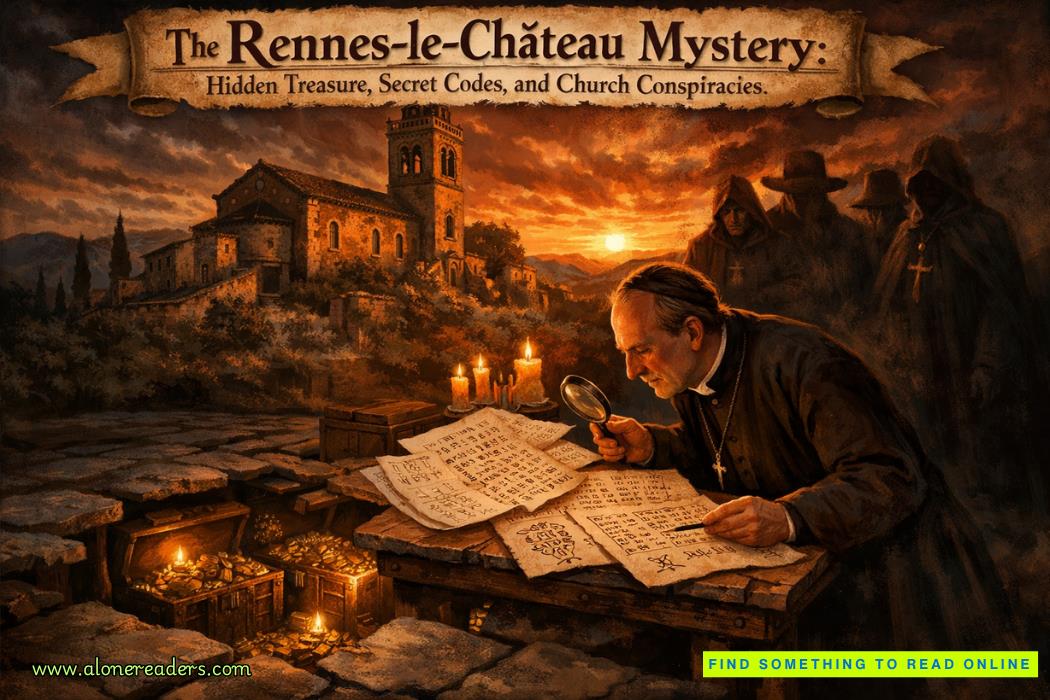
The quiet hilltop village of Rennes-le-Château in southern France appears, at first glance, to be an unremarkable rural settlement overlooking the valleys of the Languedoc region. Today it attracts thousands of curious visitors each year, drawn not by its size or beauty but by a mystery that has endured for more than a century. At the center of the enigma is a humble parish priest, Bérenger Saunière, whose sudden and unexplained wealth in the late nineteenth century gave birth to one of the most enduring conspiracy theories in modern history. The story combines elements of hidden treasure, coded documents, secret religious societies, and alleged Vatican cover-ups, transforming a small French village into a global symbol of historical intrigue.
The mystery began in 1885, when Bérenger Saunière was assigned as priest to the parish church of Saint-Mary Magdalene in Rennes-le-Château. At that time the church was in poor condition, and the village itself was struggling economically. Saunière’s salary was modest, and nothing about his early years suggested wealth or influence. However, while carrying out restoration work on the church during the 1890s, Saunière reportedly discovered something extraordinary. According to local accounts, he uncovered ancient parchments hidden within a hollow pillar of the altar. These documents, written in Latin and containing unusual patterns of letters and symbols, would later become central to the Rennes-le-Château legend.
Soon after this discovery, Saunière’s life changed dramatically. The previously poor priest began spending large sums of money on ambitious construction projects. He renovated the church in elaborate style, installed unusual decorations and inscriptions, and commissioned statues and artworks that many observers considered strangely symbolic. More strikingly, he constructed an entire estate beside the church, including the Villa Bethania, a luxurious residence, and the Tour Magdala, a neo-Gothic tower overlooking the surrounding countryside.
For a rural priest living in a remote village, such expenditures were astonishing. Records and local testimony indicate that Saunière spent the equivalent of millions of modern euros over the course of his life. He entertained wealthy guests, ordered expensive furnishings, and lived in a manner far beyond the means of an ordinary parish priest. Naturally, people began asking a question that still echoes today: where did the money come from?
Official explanations suggested that Saunière earned income through the sale of masses, a controversial but common practice at the time. However, critics argued that the scale of his spending far exceeded what such activities could generate. This discrepancy fueled speculation that Saunière had discovered a hidden treasure buried beneath the church or somewhere in the surrounding hills.
Over time, the story evolved into a much larger and more mysterious narrative. Some researchers proposed that Saunière had uncovered treasure linked to the medieval Knights Templar, the powerful military order that accumulated vast wealth during the Crusades before being suppressed in the fourteenth century. Others suggested the treasure might date back even further, perhaps belonging to the Visigothic kings, who ruled parts of southern France and Spain during the early Middle Ages and were rumored to have hidden riches during times of invasion.
Yet the mystery deepened further when attention returned to the coded parchments Saunière allegedly discovered. In the twentieth century, reproductions of these documents circulated among researchers and conspiracy theorists. The texts contained strange sequences of letters and seemingly random patterns that appeared to conceal hidden messages. Amateur cryptographers and historians attempted to decode them, claiming that the parchments referenced secret genealogies, ancient royal bloodlines, and hidden locations within the surrounding landscape.
These interpretations gave rise to one of the most controversial theories associated with Rennes-le-Château: the claim that Saunière had uncovered evidence of a secret lineage descending from Jesus Christ and Mary Magdalene. According to this theory, Mary Magdalene traveled to southern France after the crucifixion and founded a bloodline that continued through European royalty. The alleged discovery of documents revealing this lineage would have been explosive for the Catholic Church, potentially challenging traditional doctrines.
Supporters of this idea argued that Saunière’s sudden wealth was actually payment for silence from powerful church authorities. In this interpretation, the Vatican supposedly rewarded the priest financially to prevent him from revealing documents that could threaten established religious history. The unusual decorations Saunière installed in the church—including statues placed in unconventional positions and cryptic inscriptions—were interpreted as subtle clues pointing toward hidden knowledge.
While historians generally regard such claims with skepticism, the theories became widely popular in the twentieth century. Writers and researchers began connecting Rennes-le-Château with secret societies such as the Priory of Sion, an organization claimed to protect ancient secrets about royal bloodlines and hidden religious truths. According to the narrative promoted by some authors, this secret society had existed for centuries and included famous members such as Leonardo da Vinci and Isaac Newton.
In the 1960s and 1970s, books exploring these ideas transformed the Rennes-le-Château mystery from a local curiosity into an international sensation. Authors argued that the village concealed clues to a vast historical conspiracy involving hidden treasure, secret religious knowledge, and powerful institutions guarding dangerous truths. The story eventually inspired the famous book The Holy Blood and the Holy Grail, which popularized the theory that a secret bloodline of Jesus existed.
Decades later, these ideas influenced modern popular culture, most notably in Dan Brown’s novel The Da Vinci Code. Although fictional, the novel drew heavily on earlier theories about Rennes-le-Château, secret societies, and hidden religious history. As a result, the small French village became a pilgrimage destination for readers and conspiracy enthusiasts eager to explore the supposed center of the mystery.
Despite the excitement surrounding these theories, many historians argue that the truth is likely far more mundane. Investigations into church records and financial documents suggest that Saunière may indeed have earned large sums through controversial mass-selling practices. During that period, priests could accept donations to perform masses for the intentions of believers. Saunière reportedly solicited thousands of such donations from across France and even internationally.
If accurate, this practice could explain much of his wealth. However, church authorities eventually investigated Saunière and accused him of financial misconduct related to these activities. He was briefly suspended from his priestly duties and faced disciplinary actions. This official scrutiny suggests that the Church itself viewed his financial behavior as irregular, though not necessarily connected to hidden treasure or secret documents.
Another possibility is that local myths and later fabrications expanded the story over time. Some historians believe that the famous coded parchments circulated in the twentieth century may have been created long after Saunière’s death, possibly as part of elaborate hoaxes designed to promote the mystery. The alleged Priory of Sion itself was later exposed as a twentieth-century invention created by a French man named Pierre Plantard, who fabricated documents to support his claims of royal ancestry.
Yet even if many elements of the conspiracy theories were invented or exaggerated, the mystery remains compelling. Saunière’s renovations of the church still display unusual artistic choices that intrigue visitors. One statue shows the devil supporting a holy water basin, an unsettling image rarely found in Catholic churches. Other decorations include Latin inscriptions and symbolic imagery that some interpret as hidden messages.
The Tour Magdala, the tower Saunière built overlooking the valley, also contributes to the atmosphere of secrecy. From its windows one can see miles of rugged countryside dotted with ancient ruins, medieval castles, and mysterious caves. This landscape has inspired generations of treasure hunters who believe the hills surrounding Rennes-le-Château may still conceal undiscovered artifacts or riches.
Local legends further enhance the sense of mystery. Stories circulate about hidden tunnels beneath the church, lost gold from medieval wars, and secret maps pointing to buried treasure somewhere in the nearby mountains. Some treasure seekers have even conducted unofficial excavations, hoping to uncover the wealth that supposedly transformed Saunière’s life.
Whether or not any treasure truly exists, the Rennes-le-Château mystery demonstrates the powerful influence of storytelling, speculation, and historical curiosity. A combination of unexplained wealth, cryptic documents, unusual architecture, and imaginative theories created a narrative that captured global attention. The story blends history with mythology, fact with speculation, producing a mystery that continues to fascinate historians and conspiracy theorists alike.
Today, Rennes-le-Château has become a place where visitors explore not only a physical location but also an idea—the possibility that the past still hides secrets waiting to be discovered. Tourists wander through the restored church, climb the tower overlooking the valley, and examine symbols carved into stone more than a century ago. Each visitor arrives with the same lingering question that first emerged when a modest priest suddenly became wealthy: did Bérenger Saunière uncover a hidden treasure, or did he stumble upon a secret powerful enough to change history?
The answer remains uncertain. Some researchers continue to analyze the documents and symbols associated with the mystery, searching for patterns that might reveal hidden meanings. Others argue that the entire story illustrates how myths can grow from simple historical events when mystery and imagination combine. Yet regardless of the explanation, the legend of Rennes-le-Château endures as one of the most captivating historical conspiracy theories ever created.
More than a century after Saunière’s death in 1917, the small French village still stands quietly atop its hill, overlooking the same landscapes that once inspired speculation and intrigue. Beneath the peaceful surface lies a story that blends religion, treasure, secret codes, and centuries of speculation—a reminder that sometimes the most powerful mysteries are those that refuse to be solved.

October 25, 2023

January 02, 2025



 The Division Between Pagan and Christian Rome: Unity or Fragmentation Before the Fall of the Western Roman Empire
 Religious Conflicts and the Rise of Christianity in Late Rome: Faith, Power, and the Fall of the Western Roman Empire
 The Loss of North Africa: Rome’s Economic Lifeline Destroyed and the Road to the Fall of the Western Roman Empire
 The Collapse of Roman Britain: How Rome's Withdrawal Reshaped Western Europe
 Vinland and North America: Leif Erikson’s Journey to the New World Explained
 Erik the Red and the Discovery of Greenland: Norse Exploration and Colonization
 The Abu Ghraib Scandal, Iraq, 2004: A Human Rights Disaster That Shook the World
 The Disbanding of the CNRP, Cambodia, 2017: Hun Sen's Clampdown on Democracy and the Reshaping of Cambodian Politics
 The Firing of James Comey, United States, 2017: Trump's Controversial Decision Amid FBI Investigation
 The Rwandan Refugee Crisis, Central Africa, 1994: Aftermath of Genocide and the Humanitarian Catastrophe
 The Most Important Turning Points of the Battle of Hastings (1066)
 Why William Won the Battle of Hastings and Harold Lost: Strategy, Leadership and Fate in 1066
 How King Harold II Died: Facts, Myths, and Historical Debate
 The Battle of Hastings: A Complete Timeline of the Fighting
 High-End Talent Category A Work Permit China 2026: Complete Eligibility, Benefits, Application Process, and Expert Guide
 Cultural Activities Visa Japan 2026 Guide: Complete Eligibility, Requirements, Application Process, and Expert Tips