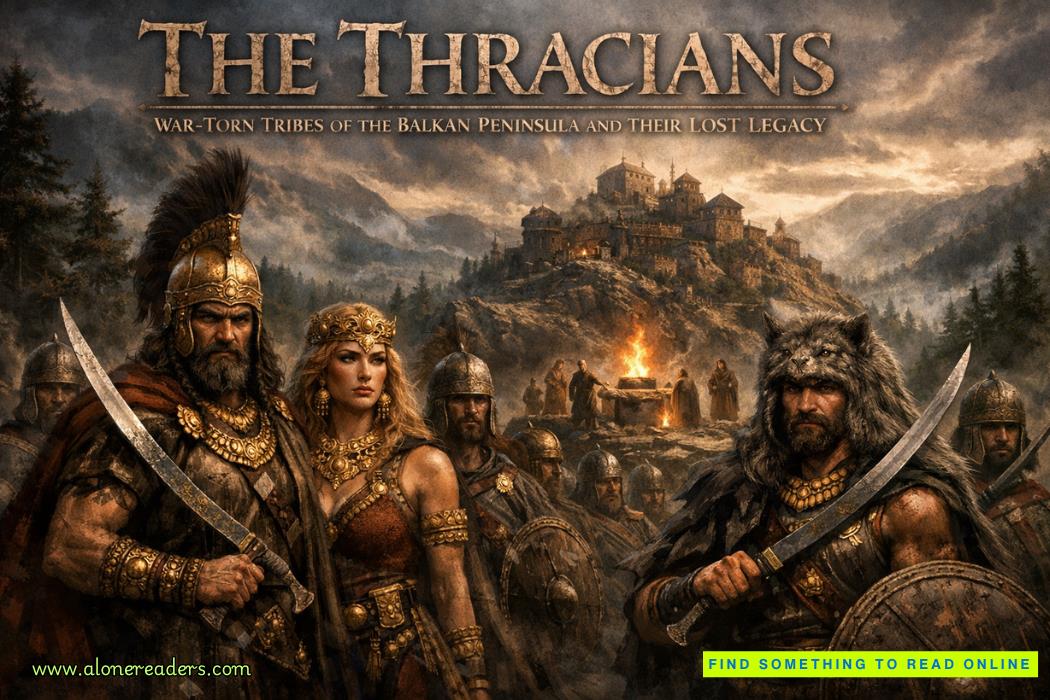
The Thracians remain one of the most enigmatic and underrepresented civilizations of the ancient world, occupying a vast and strategically significant region of southeastern Europe that included modern-day Bulgaria, parts of Greece, Turkey, and Romania. Despite their proximity to well-documented civilizations such as the Greeks and Romans, the Thracians left behind no unified written history of their own, forcing historians to reconstruct their identity from fragmented external accounts, archaeological discoveries, and cultural traces. This absence of self-recorded narratives has contributed to their reputation as a mysterious, war-driven society whose legacy has been overshadowed by more literate neighbors.
At the core of Thracian identity was their deeply fragmented tribal structure. Unlike centralized empires such as Persia or Rome, the Thracians were divided into dozens—if not hundreds—of tribes, each operating with its own leadership, customs, and military priorities. Prominent among these were the Odrysians, Bessi, Getae, and Triballi. While these tribes shared linguistic and cultural similarities, they often engaged in constant internal conflict, preventing long-term political unity. This fragmentation became one of the defining features of Thracian history and ultimately a major factor in their vulnerability to foreign domination.
The geography of Thrace played a crucial role in shaping their character. The region was a mosaic of mountain ranges, dense forests, fertile plains, and river systems, particularly the Danube and Maritsa. This terrain fostered both isolation and resilience. Tribes developed strong local identities and became adept at guerrilla-style warfare, using the rugged landscape to their advantage. However, this same geography also made large-scale political consolidation extremely difficult, reinforcing their decentralized structure.
Thracian society was deeply hierarchical, with a warrior elite dominating both political and cultural life. Kings and tribal chieftains wielded significant power, often legitimized through religious authority. Among the most notable rulers was King Sitalces of the Odrysian kingdom, who briefly managed to unify several tribes in the 5th century BCE, forming the most powerful Thracian state in recorded history. Under his leadership, Thrace demonstrated that it could rival neighboring powers, but such unity proved fleeting.
War was not merely a necessity for the Thracians—it was a defining cultural principle. Ancient sources consistently describe them as fierce, fearless, and often brutal warriors, traits that made them both feared enemies and highly sought-after mercenaries. Thracian soldiers were renowned for their use of distinctive weapons such as the rhomphaia, a long, curved blade capable of devastating strikes, and the sica, a shorter, inward-curving dagger associated with both combat and assassination. Their combat style emphasized aggression, mobility, and psychological intimidation, often involving loud war cries and dramatic displays.
One of the most striking aspects of Thracian warfare was their role in the wider Mediterranean world. They frequently served as mercenaries for Greek city-states, Persian armies, and later the Macedonians. This dual role—as both adversaries and allies—placed them at the center of major historical conflicts. During the Greco-Persian Wars, some Thracian tribes allied with the Persians, while others resisted foreign incursions. This lack of unified foreign policy once again highlighted their internal divisions.
The interaction between the Thracians and the Greeks was particularly influential. Greek colonies established along the Thracian coast facilitated trade, cultural exchange, and occasional conflict. Through these interactions, the Thracians became known for their extraordinary craftsmanship, especially in gold and silver. Archaeological discoveries, such as intricately designed gold masks, jewelry, and ceremonial vessels, reveal a society with a highly developed aesthetic sense and advanced metallurgical skills. These artifacts suggest that beneath their warlike exterior, the Thracians possessed a rich and sophisticated cultural life.
Religion played a central role in Thracian society, deeply intertwined with both governance and daily existence. Their spiritual beliefs were complex and often centered around concepts of immortality and the afterlife. The cult of Zalmoxis, a deity or semi-divine figure, exemplifies this worldview. According to ancient accounts, followers of Zalmoxis believed in the immortality of the soul and practiced rituals that reinforced this belief. This perspective may have contributed to their fearlessness in battle, as death was not seen as an end but as a transition.
Another prominent religious figure was Orpheus, a legendary musician and prophet often associated with Thrace. While mythological in nature, the association of Orpheus with the region underscores the deep spiritual and artistic traditions embedded within Thracian culture. Their rituals often involved music, dance, and possibly ecstatic practices, reflecting a belief system that was both mystical and experiential.
Despite their strengths, the Thracians faced increasing pressure from expanding powers. The rise of Macedon under Philip II and his son Alexander the Great marked a turning point. Philip systematically subdued Thracian tribes, incorporating their territories into his growing kingdom. While some tribes resisted fiercely, others were absorbed or allied with Macedon. Under Alexander, Thracian warriors became integral components of his army, participating in campaigns that stretched as far as India.
Following the decline of Macedonian power, the Thracians briefly regained a degree of autonomy, but this was short-lived. The expansion of the Roman Empire into the Balkans brought a new and more formidable challenge. Roman military organization, discipline, and administrative efficiency gradually overwhelmed the fragmented Thracian tribes. By the 1st century CE, Thrace had been fully incorporated into the Roman Empire as a province.
Roman rule brought significant changes to the region. Urbanization increased, infrastructure improved, and Roman culture began to permeate local traditions. However, this process also led to the gradual erosion of distinct Thracian identity. Over time, the Thracians were assimilated into the broader Greco-Roman world, their language and customs fading into obscurity. Unlike other conquered peoples who left behind extensive records, the Thracians effectively disappeared as a distinct cultural entity.
One of the most enduring legacies of the Thracians lies in their influence on neighboring cultures and historical figures. Perhaps the most famous individual of Thracian origin is Spartacus, the gladiator who led a major slave uprising against Rome. While his exact tribal affiliation remains debated, his story reflects the indomitable spirit and martial prowess associated with Thracian warriors.
Modern archaeology has played a crucial role in rediscovering the Thracians. Excavations across Bulgaria and surrounding regions have uncovered tombs, treasures, and settlements that provide invaluable insights into their world. The Thracian tomb of Kazanlak, with its vivid frescoes, and the Panagyurishte Treasure, a collection of exquisite gold vessels, stand as testaments to their artistic and cultural achievements. These discoveries challenge the traditional perception of the Thracians as merely barbaric warriors, revealing a civilization of considerable complexity and refinement.
What makes the Thracians particularly compelling is the contrast between their historical obscurity and their undeniable impact. They were a people who stood at the crossroads of major civilizations, interacting with Greeks, Persians, Macedonians, and Romans, yet never fully integrated into any of them on their own terms. Their story is one of potential unrealized due to fragmentation, a recurring theme that shaped their rise and fall.
The absence of a unified Thracian state for most of their history raises important questions about the nature of power and identity in the ancient world. While their tribal system allowed for flexibility and resilience, it also prevented the kind of coordinated response necessary to resist large-scale invasions. This structural weakness was exploited repeatedly by more centralized powers, ultimately leading to their absorption.
In many ways, the Thracians embody the concept of a “forgotten civilization”—not because they lacked significance, but because their legacy was not preserved through traditional historical channels. Their contributions survive in artifacts, myths, and the accounts of others, requiring modern scholars to piece together a narrative from scattered evidence. This process has gradually transformed our understanding of the Thracians from that of peripheral barbarians to a dynamic and influential culture with a distinct identity.
Today, the legacy of the Thracians continues to captivate historians, archaeologists, and enthusiasts alike. Their story serves as a reminder that history is not solely shaped by those who leave written records, but also by those whose lives and achievements must be reconstructed through other means. The Thracians, with their war-torn tribes, rich spiritual traditions, and remarkable craftsmanship, stand as a testament to the diversity and complexity of the ancient world.
Ultimately, the Thracians were neither purely savage nor fully civilized by classical standards—they existed in a space that defies such simple categorization. They were warriors and artists, mystics and mercenaries, fragmented yet culturally cohesive, a people whose identity was as complex as the landscape they inhabited. Their disappearance was not a sudden collapse but a gradual transformation, as their distinctiveness was absorbed into larger imperial systems.
In examining the Thracians, we are reminded of the countless other cultures that have faded from historical prominence, not because they lacked importance, but because their stories were not preserved in conventional ways. The Thracians challenge us to look beyond written history and to recognize the enduring value of archaeological and cultural evidence in reconstructing the past. Their legacy, though fragmented, remains a powerful testament to a civilization that once thrived in the shadow of empires yet left an indelible mark on the history of the Balkan Peninsula.



 The Hundred Days Offensive: How the Allies Defeated Germany in World War I
 The Second Battle of the Marne: The Turning Point of World War I in 1918
 The Spring Offensive of 1918: Germany's Final Gamble to Win World War I
 The Treaty of Brest-Litovsk: How Russia Left World War I
 The Russian Revolution and World War I: How War Brought Down the Tsar
 The Zimmermann Telegram Explained: Germany's Secret Offer to Mexico in World War I