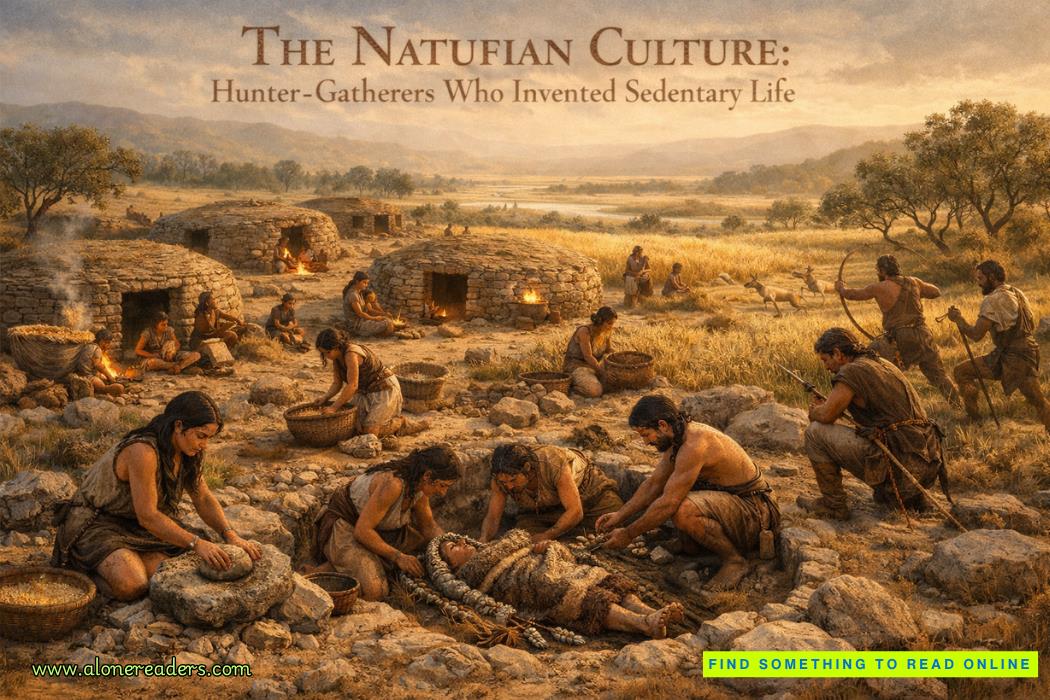
The Natufian culture represents one of the most transformative yet often overlooked chapters in human prehistory, a period when hunter-gatherers began to challenge the very foundations of mobility that had defined human existence for hundreds of thousands of years. Emerging in the Levant region around 12,500 BCE and lasting until approximately 9,500 BCE, the Natufians occupied territories that today include parts of modern-day Israel, Palestine, Jordan, Lebanon, and Syria. What makes them extraordinary is not merely their technological or cultural sophistication, but the fact that they were among the first human groups to adopt a semi-sedentary lifestyle long before the advent of agriculture. This inversion of the conventional narrative—where farming leads to settlement—marks the Natufians as pioneers of a radically different evolutionary trajectory.
The Natufian world developed during a climatically dynamic period at the end of the last Ice Age. The gradual warming known as the Bølling-Allerød interstadial created conditions favorable for the expansion of wild cereals such as wheat and barley across the Levantine corridor. Unlike earlier Paleolithic groups that followed migratory game herds, the Natufians anchored themselves to ecologically rich zones, particularly those offering reliable access to both plant and animal resources. Archaeological sites such as Ain Mallaha and Wadi Hammeh reveal permanent or semi-permanent settlements composed of circular, stone-built dwellings, often partially dug into the ground. These structures, with their carefully arranged floors and hearths, indicate not temporary camps but deliberate architectural planning and long-term habitation.
One of the most significant innovations associated with the Natufians is their intensive exploitation of wild cereals. Flint sickle blades bearing distinctive gloss—caused by repeated cutting of silica-rich grasses—provide compelling evidence of systematic harvesting. Grinding stones, mortars, and pestles found in abundance at Natufian sites further demonstrate that these communities were processing plant foods on a scale previously unseen. This development suggests that the conceptual shift toward food production began not with cultivation, but with intensified gathering and processing. In other words, the Natufians laid the behavioral and technological groundwork that would eventually culminate in agriculture.
Equally important is the Natufian approach to animal resources. While they continued to hunt a variety of species—including gazelle, deer, and small game—their hunting strategies appear to have been highly organized and regionally specialized. Faunal remains indicate seasonal hunting patterns, suggesting an intimate ecological knowledge and resource management system. This level of predictability in subsistence may have contributed to their ability to remain in one place for extended periods. Notably, there is also evidence suggesting early forms of animal domestication or at least close human-animal relationships, particularly with dogs. Burials containing humans and canines together imply not only companionship but also a symbolic or ritual significance attached to these animals.
The social implications of sedentism are perhaps even more profound than the economic ones. Permanent settlements require new forms of social organization, including mechanisms for resource distribution, conflict resolution, and communal cooperation. The Natufians appear to have developed increasingly complex social structures, as evidenced by their burial practices. Unlike earlier periods where burials were rare and often simple, Natufian graves are relatively common and sometimes elaborate. Individuals were interred beneath house floors or in designated cemeteries, often accompanied by grave goods such as shell beads, stone tools, and ornaments. These practices indicate a growing sense of identity, territoriality, and possibly social differentiation.
Particularly striking is the emergence of symbolic and artistic expression within Natufian culture. Personal adornments made from marine shells—sometimes transported over considerable distances—suggest not only aesthetic sensibilities but also the existence of trade or exchange networks. Carved bone objects and decorated tools further reflect a cultural richness that transcends mere survival. In some cases, skulls were deliberately removed, modified, or displayed, hinting at complex ritual behaviors or ancestor veneration. These elements collectively point to a society in which symbolism, memory, and social identity were becoming increasingly central.
However, the Natufian experiment with sedentism was not without challenges. Around 10,800 BCE, the onset of the Younger Dryas—a sudden return to colder and drier climatic conditions—disrupted the ecological stability that had supported their way of life. Wild cereal yields likely declined, and water sources became less reliable. In response, some Natufian groups appear to have reverted to more mobile lifestyles, while others intensified their subsistence strategies even further. It is within this context of environmental stress that the transition to true agriculture may have been accelerated. The need to secure reliable food sources in a fluctuating climate likely pushed communities toward the deliberate cultivation of plants and eventual domestication.
The legacy of the Natufian culture lies precisely in this transitional role. They occupy a critical threshold between the Paleolithic and Neolithic worlds, embodying a hybrid mode of existence that combined foraging with elements of sedentary life. This challenges earlier linear models of human development and suggests a more complex, iterative process in which cultural innovations emerge gradually and often under environmental pressure. The Natufians did not simply precede agriculture; they actively shaped the conditions that made agriculture possible.
Moreover, their story forces a reevaluation of what it means to be “civilized.” Sedentism, often associated with farming societies, is revealed here as a behavioral adaptation that can arise independently under the right ecological and social conditions. The Natufians demonstrate that permanence, community, and cultural complexity do not require full-scale agriculture as prerequisites. Instead, these traits can emerge within hunter-gatherer frameworks when resource availability and human ingenuity align.
From a broader anthropological perspective, the Natufian culture underscores the importance of regional diversity in human evolution. While other parts of the world continued to rely on highly mobile subsistence strategies, the Levant became a unique laboratory for early sedentism. This regional specificity highlights how local environmental factors and cultural choices interact to produce divergent developmental pathways. The Natufians were not an inevitable step toward agriculture, but rather one of several possible responses to changing conditions at the end of the Ice Age.
In conclusion, the Natufian culture stands as a pivotal yet underappreciated milestone in the human story. By establishing semi-permanent settlements, intensifying the use of wild plant resources, and developing complex social and symbolic systems, they effectively redefined the boundaries of hunter-gatherer life. Their innovations blurred the line between foraging and farming, setting the stage for one of the most consequential transformations in human history—the Agricultural Revolution. To understand the origins of sedentary civilization, one must look not only at the first farmers, but at the Natufians, the hunter-gatherers who dared to stay.




 The Hundred Days Offensive: How the Allies Defeated Germany in World War I
 The Second Battle of the Marne: The Turning Point of World War I in 1918
 The Spring Offensive of 1918: Germany's Final Gamble to Win World War I
 The Treaty of Brest-Litovsk: How Russia Left World War I
 The Russian Revolution and World War I: How War Brought Down the Tsar
 The Zimmermann Telegram Explained: Germany's Secret Offer to Mexico in World War I