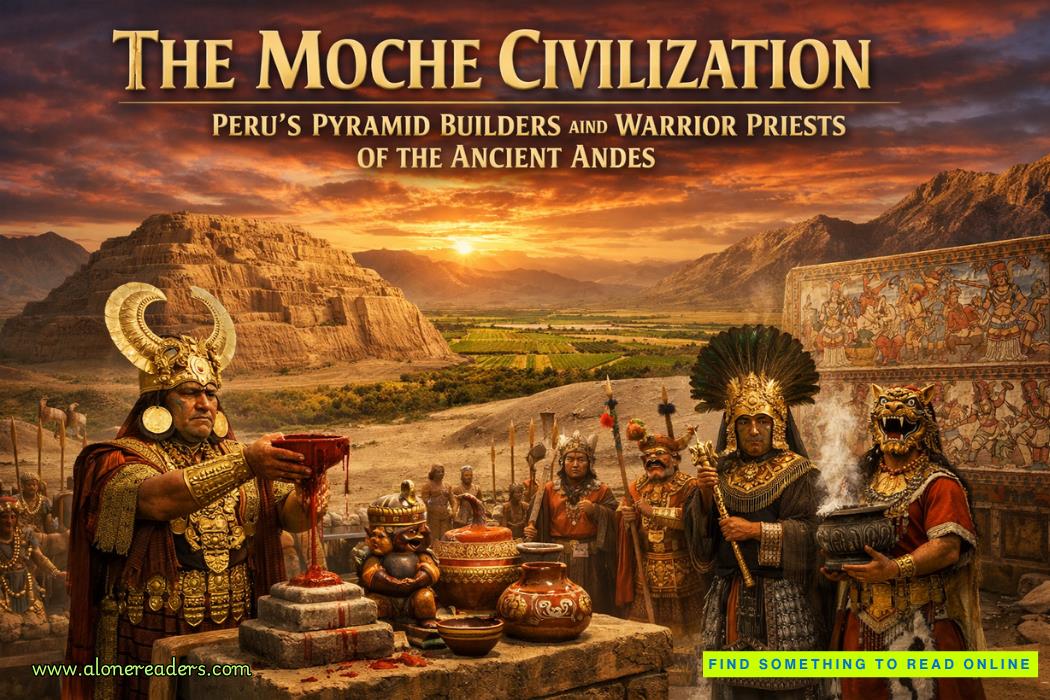
The Moche civilization stands as one of the most complex and visually striking cultures of pre-Columbian South America, flourishing along the arid northern coast of Peru between approximately 100 and 800 CE. Unlike later Andean empires that left behind extensive written or quipu-based administrative systems, the Moche communicated their worldview through material culture, producing an extraordinary archaeological record that allows modern scholars to reconstruct a society defined by ritual authority, hydraulic engineering, and militaristic ideology. Their legacy is preserved not in texts, but in monumental architecture, lifelike ceramics, and the haunting imagery of sacrifice and power.
At the heart of Moche society lay an intricate relationship with a harsh and unforgiving environment. The northern Peruvian coast is a desert punctuated by river valleys descending from the Andes. Rainfall is minimal, and survival depends on the precise control of water. The Moche responded with remarkable ingenuity, constructing extensive irrigation systems that diverted river water into agricultural fields. These canals, often stretching for kilometers, transformed barren land into fertile zones capable of sustaining maize, beans, squash, and cotton cultivation. This mastery of hydraulic engineering was not merely economic—it was political, as control over water resources reinforced elite authority and structured social hierarchy.
The Moche were not a unified empire in the centralized sense seen in later Andean states. Instead, they existed as a network of regional polities sharing cultural and religious practices but governed by local elites. These elites derived their legitimacy through ritual performance and military success, blending the roles of rulers, priests, and warriors into a single ideological framework. Power was theatrical, visible, and deeply symbolic, enacted through ceremonies that reinforced cosmic order and social dominance.
The most visible symbols of Moche authority are their monumental adobe pyramids, known as huacas. Among the most famous are Huaca del Sol and Huaca de la Luna, located in the Moche Valley. Constructed from millions of adobe bricks, these structures were not pyramids in the Egyptian sense but multi-tiered platforms used for administrative, ceremonial, and religious purposes. Huaca del Sol, likely the largest adobe structure in the Americas, functioned as a political center, while Huaca de la Luna served as a ritual complex adorned with vividly painted murals.
These murals offer a direct window into Moche cosmology. They depict deities, mythological creatures, and ritual scenes in striking detail, often featuring a recurring figure known as the “Decapitator” or “Ai Apaec,” a fanged deity associated with sacrifice and regeneration. The imagery is not abstract—it is narrative, illustrating sequences of ritual actions that scholars have correlated with archaeological findings. The consistency between artistic representation and physical evidence suggests that Moche art functioned as a form of visual documentation, encoding religious and political practices into durable media.
Among the most revealing aspects of Moche culture is their approach to warfare and ritual sacrifice. Unlike purely symbolic depictions, Moche ceramics and murals portray combat, capture, and execution with unsettling realism. Warriors are shown engaging in ritualized battles, capturing opponents who are subsequently stripped, bound, and presented in ceremonial contexts. Archaeological excavations at sites like Huaca de la Luna have uncovered the remains of sacrificed individuals, often young adult males, bearing signs of violent death consistent with these depictions.
This convergence of art and archaeology confirms that human sacrifice was a central component of Moche religion. The purpose of these rituals appears to have been multifaceted. On one level, they reinforced elite power by demonstrating the ability to control life and death. On another, they likely served a cosmological function, offering blood to deities in exchange for agricultural fertility and environmental stability. The presence of sacrificial remains in layers corresponding to periods of climatic stress suggests that these rituals intensified during times of ecological crisis, particularly during El Niño events that disrupted agricultural systems.
The role of the “warrior priest” emerges as a key figure within this framework. Moche elites are frequently depicted wearing elaborate regalia, including headdresses, backflaps, and jewelry made of gold, silver, and semi-precious stones. These individuals are shown participating in ritual ceremonies, often holding goblets believed to contain blood from sacrificial victims. The blending of martial and religious symbolism indicates that authority was both physical and spiritual, rooted in the ability to wage war and mediate between the human and divine realms.
Moche craftsmanship further reinforces this integration of ideology and daily life. Their ceramics are among the most sophisticated in the ancient world, characterized by stirrup-spout vessels and modeled forms that depict humans, animals, and supernatural beings with astonishing realism. Portrait vessels, in particular, stand out for their individualized features, suggesting that they may represent specific individuals rather than generic types. These objects functioned as more than utilitarian items—they were narrative devices, conveying stories, rituals, and social roles.
One of the most controversial aspects of Moche art is its explicit depiction of sexuality. Erotic ceramics, often portraying non-reproductive acts, have sparked extensive debate among scholars. Rather than being purely decorative or transgressive, these images are increasingly understood within a ritual and cosmological context. They may reflect beliefs about fertility, duality, and the cyclical nature of life and death. In this sense, Moche art challenges modern assumptions about the boundaries between the sacred and the profane, revealing a worldview in which all aspects of existence were interconnected.
Metallurgy also played a crucial role in Moche society. Artisans developed advanced techniques for working with gold, silver, and copper, including gilding, alloying, and repoussé. These metals were not valued primarily for their economic worth but for their symbolic associations. Gold, for instance, was linked to the sun, while silver was associated with the moon. Elite individuals adorned themselves with intricate metalwork, transforming their bodies into living representations of cosmic order. Material culture thus became a medium through which ideology was embodied and displayed.
Burial practices provide further insight into Moche social structure. Elite tombs, such as the famous burial of the “Lord of Sipán,” reveal a hierarchical society with stark distinctions between classes. The Lord of Sipán was interred with an array of grave goods, including gold ornaments, weapons, and sacrificial attendants. The presence of these attendants, often buried alongside the elite individual, underscores the extent to which social hierarchy extended into the afterlife. Death did not dissolve status—it perpetuated it, reinforcing the continuity of power beyond the mortal realm.
Despite their achievements, the Moche civilization ultimately declined around the 8th century CE. The reasons for this collapse remain a subject of ongoing research, but evidence points to a combination of environmental and social factors. Severe El Niño events likely caused flooding, crop failure, and infrastructural damage, undermining the agricultural base that sustained Moche society. At the same time, internal conflicts and shifts in political organization may have weakened elite authority. The very systems that enabled Moche success—centralized control of resources and ritual power—may have contributed to their vulnerability, as disruptions in one domain cascaded through the entire society.
What remains remarkable is not simply the rise and fall of the Moche, but the clarity with which their world has been preserved. Through their art, architecture, and archaeological remains, they have left behind a record that is both vivid and deeply human. Their society was not defined solely by violence or ritual, but by a complex interplay of innovation, belief, and adaptation. They were engineers of water, architects of earth, and interpreters of the divine, navigating a landscape that demanded both resilience and imagination.
In examining the Moche civilization, one is confronted with a culture that defies simplistic categorization. It was at once highly organized and regionally diverse, deeply spiritual yet grounded in material realities, artistically expressive yet politically strategic. Their pyramids rose from the desert not just as structures, but as statements of power and belief, anchoring a society that sought to impose order on both the natural and supernatural worlds.
Ultimately, the Moche remind us that ancient civilizations were not static or monolithic, but dynamic systems shaped by their environments and internal complexities. Their legacy challenges modern perspectives, inviting a reconsideration of how power, religion, and art intersect in the construction of human societies. In the silent adobe ruins and meticulously crafted vessels, the voice of the Moche endures—telling a story of ambition, ritual, and the enduring human quest to understand and control the forces of existence.



 The Hundred Days Offensive: How the Allies Defeated Germany in World War I
 The Second Battle of the Marne: The Turning Point of World War I in 1918
 The Spring Offensive of 1918: Germany's Final Gamble to Win World War I
 The Treaty of Brest-Litovsk: How Russia Left World War I
 The Russian Revolution and World War I: How War Brought Down the Tsar
 The Zimmermann Telegram Explained: Germany's Secret Offer to Mexico in World War I