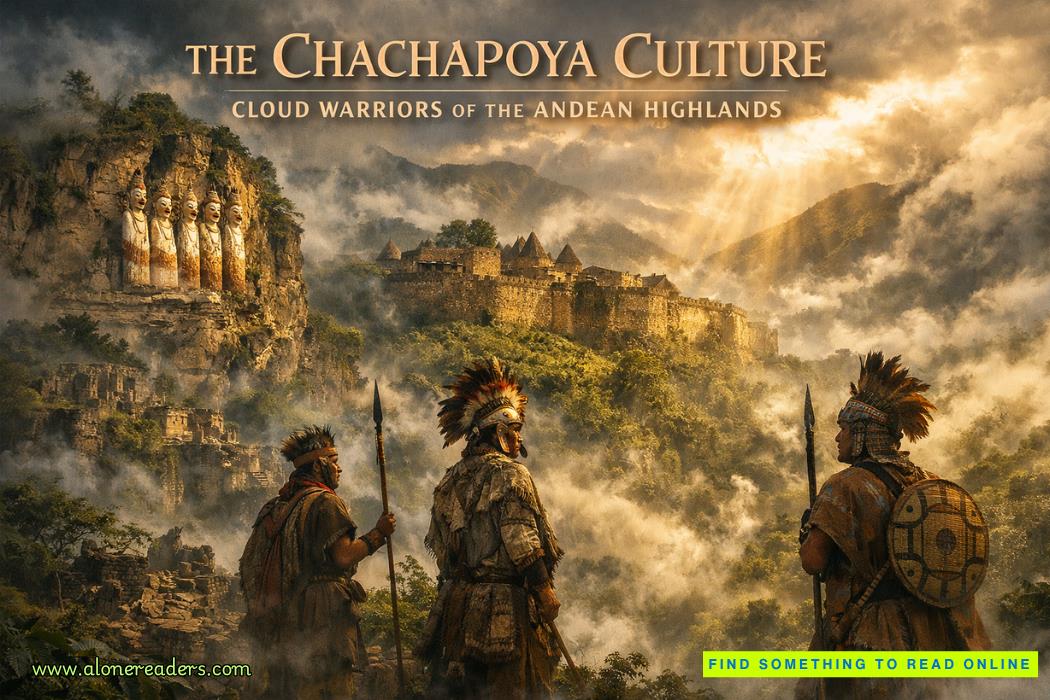
The Chachapoya culture, often referred to as the “Cloud Warriors,” stands as one of the most enigmatic civilizations of pre-Columbian South America. Flourishing in the northeastern Andes of present-day Peru between approximately the 9th and 15th centuries, the Chachapoya inhabited a region unlike any other major Andean culture—a dense, humid, cloud-enshrouded environment where towering mountains dissolve into Amazonian rainforest. This unique ecological niche profoundly shaped their society, architecture, warfare, and spiritual worldview. Unlike the imperial grandeur of the Inca or the urban sophistication of coastal civilizations, the Chachapoya developed a fragmented yet resilient highland culture that thrived in isolation, secrecy, and verticality.
The term “Chachapoya” itself is derived from Quechua, often translated as “people of the cloud forest.” This name, though applied later by outsiders, captures a defining truth: their lives were literally suspended between sky and earth. Their settlements clung to mountaintops and ridges, while their dead were placed on cliffs and precipices, as if bridging the mortal and the divine realms. This vertical spatial logic—living above, burying the dead even higher—suggests a cosmology deeply rooted in elevation, visibility, and proximity to the heavens.
Archaeological evidence indicates that the Chachapoya were not a centralized empire but rather a network of loosely connected communities. These communities shared cultural traits—distinctive architecture, burial practices, and artistic motifs—but operated independently. This decentralization likely made them both resilient and vulnerable: resilient in that no single conquest could collapse the entire culture, but vulnerable because they lacked unified political or military coordination against external threats.
One of the most striking aspects of Chachapoya civilization is their architectural ingenuity. Their most iconic site, Kuelap, is often described as a “fortress,” though its function was likely more complex than purely defensive. Perched at an altitude of over 3,000 meters, Kuelap consists of massive stone walls reaching up to 20 meters in height, enclosing a sprawling settlement of circular stone buildings. The sheer scale of the construction is staggering, particularly when considering the logistical challenges posed by the terrain. Transporting materials, organizing labor, and maintaining structural integrity in such an environment required advanced planning and engineering knowledge.
Within Kuelap, the predominance of circular dwellings distinguishes the Chachapoya from many other Andean cultures, which often favored rectangular or trapezoidal structures. The circular form may have had symbolic significance, possibly reflecting notions of continuity, community, or cosmological cycles. Many of these structures feature decorative friezes composed of zigzag and diamond patterns—motifs that may represent serpents or other symbolic elements tied to fertility, water, or the spiritual world.
Beyond Kuelap, the Chachapoya landscape is dotted with smaller settlements, agricultural terraces, and ritual sites. These locations reveal a society that mastered the art of adapting to steep and unstable terrain. Terracing allowed them to cultivate crops such as maize, potatoes, and quinoa, while also preventing soil erosion in a region prone to heavy rainfall. The integration of agriculture, architecture, and environment demonstrates a sophisticated understanding of ecological balance.
Perhaps even more haunting than their cities are the burial practices of the Chachapoya. Their funerary traditions are among the most visually dramatic in the ancient world. One of the most iconic forms is the cliffside sarcophagus, known as purunmachu. These anthropomorphic figures, often placed in inaccessible niches high above the ground, contain the remains of elite individuals. Painted in white and ochre, with stylized facial features, these sarcophagi appear almost as guardians watching over the valleys below. Their placement suggests not only a desire to protect the dead from disturbance but also a belief in elevation as a pathway to spiritual transcendence.
In addition to sarcophagi, the Chachapoya also constructed mausoleums—rectangular structures built into cliffs or caves, often adorned with geometric designs and pictographs. Inside, the dead were wrapped in textiles and accompanied by offerings, indicating a belief in an afterlife where such provisions would be necessary. The emphasis on collective burial spaces in some cases hints at a strong sense of lineage and ancestral identity.
Ethnohistorical accounts, particularly those recorded by early Spanish chroniclers, describe the Chachapoya as physically distinct from other Andean populations. They were noted for having lighter skin and, in some cases, lighter hair—descriptions that have fueled both fascination and speculation. While such accounts must be treated cautiously, they do suggest that the Chachapoya may have had unique genetic or cultural characteristics within the Andean mosaic.
Militarily, the Chachapoya earned a reputation as fierce warriors. Their rugged homeland provided natural defenses, and their familiarity with the terrain allowed them to conduct effective guerrilla-style resistance. When the expanding Inca Empire, under rulers such as Túpac Inca Yupanqui, sought to incorporate the Chachapoya into its domain in the late 15th century, it encountered significant resistance. The conquest was neither swift nor easy. Even after subjugation, the Chachapoya remained rebellious, frequently revolting against Inca authority.
The Inca response to this resistance was strategic and severe. They implemented a policy known as mitmaqkuna, forcibly relocating segments of the Chachapoya population to distant regions of the empire. This served a dual purpose: weakening local resistance and integrating the Chachapoya into the broader imperial system. However, this displacement also contributed to the erosion of their cultural cohesion and identity.
Ironically, the Chachapoya would later align with Spanish conquistadors during the early phases of European colonization. Viewing the Spanish as potential liberators from Inca domination, some Chachapoya groups provided support to the invaders. Yet this alliance proved to be a tragic miscalculation. The Spanish conquest brought not liberation but devastation—disease, forced labor, and cultural suppression. Within a relatively short period, the Chachapoya population declined dramatically, and their distinct cultural identity began to fade.
Despite this decline, the legacy of the Chachapoya endures in the archaeological record and in the cultural memory of the region. Sites like Kuelap, once hidden beneath dense vegetation, have been gradually rediscovered and studied, revealing new insights into their society. Advances in technologies such as LiDAR have begun to uncover previously unknown settlements, suggesting that the Chachapoya landscape was far more densely populated and interconnected than previously believed.
What makes the Chachapoya particularly compelling is the interplay between mystery and evidence. Unlike the Inca, who left behind extensive administrative records and monumental architecture, the Chachapoya left fewer direct narratives. Their story must be reconstructed from fragments—ruins, artifacts, and external accounts. This fragmentary nature invites both rigorous analysis and imaginative interpretation.
The Chachapoya challenge conventional narratives of ancient civilization. They were not empire builders in the traditional sense, nor were they isolated primitives. Instead, they represent a third category: a complex, adaptive society that thrived in one of the most challenging environments on Earth, developing unique solutions to the problems of survival, defense, and spiritual expression.
Their emphasis on elevation—living in the clouds, burying their dead on cliffs—can be read as both practical and symbolic. Practically, it offered security and preservation; symbolically, it positioned them closer to the divine. This duality reflects a worldview in which the physical and spiritual were deeply intertwined.
It was not a single catastrophic event but a series of pressures—Inca conquest, forced relocation, and European colonization—that gradually dismantled their society. This layered collapse underscores the vulnerability of even the most resilient cultures when faced with sustained external disruption.
Today, the Chachapoya are often overshadowed by more famous civilizations, yet their story is no less significant. They remind us that history is not only written by empires but also by those who lived on the margins—in the clouds, on the cliffs, and beyond the reach of easy understanding.
In the end, the Chachapoya culture stands as a testament to human adaptability, creativity, and resilience. Their cities may be in ruins, their voices largely lost, but their presence still lingers in the mist-covered mountains of Peru. To study them is not merely to uncover the past, but to confront the enduring question of how civilizations rise, adapt, and ultimately disappear.




 The Hundred Days Offensive: How the Allies Defeated Germany in World War I
 The Second Battle of the Marne: The Turning Point of World War I in 1918
 The Spring Offensive of 1918: Germany's Final Gamble to Win World War I
 The Treaty of Brest-Litovsk: How Russia Left World War I
 The Russian Revolution and World War I: How War Brought Down the Tsar
 The Zimmermann Telegram Explained: Germany's Secret Offer to Mexico in World War I








