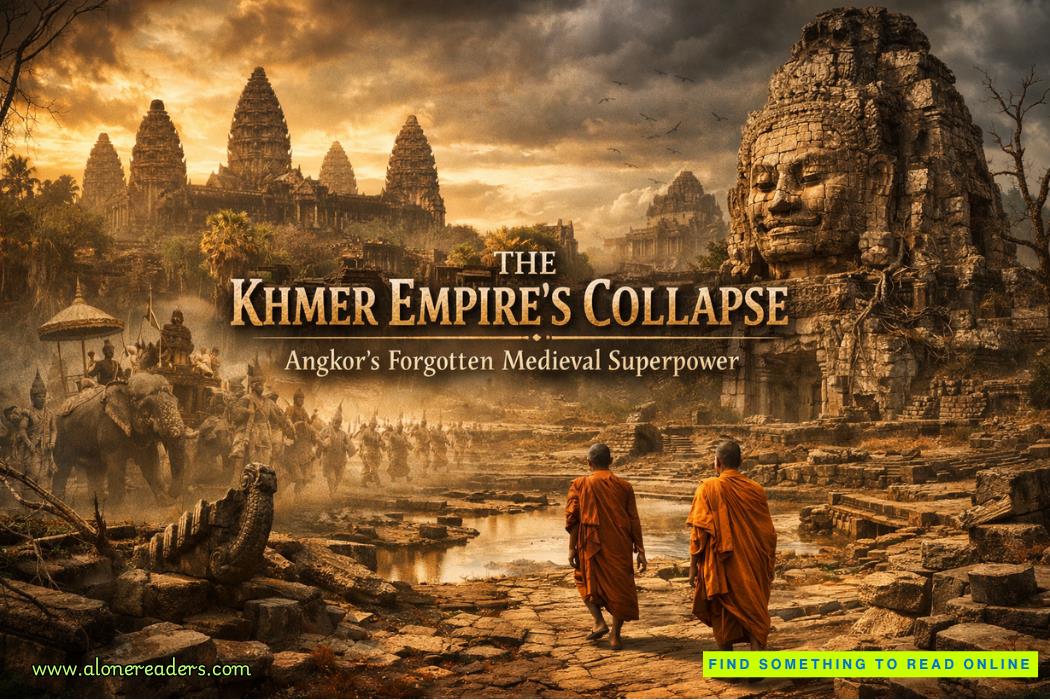
The story of the Khmer Empire is one of extraordinary ambition, engineering brilliance, and eventual unraveling—a civilization that, at its height, rivaled the great powers of the medieval world yet later slipped into relative obscurity. Centered in present-day Cambodia and anchored by the monumental city complex of Angkor Wat, the empire flourished between the 9th and 15th centuries, creating one of the most sophisticated urban and hydraulic systems of the premodern world. Its eventual collapse was neither sudden nor singular in cause, but rather a prolonged transformation shaped by environmental stress, infrastructural overreach, religious evolution, and geopolitical pressures.
At its zenith, the Khmer Empire was not merely a regional kingdom but a sprawling political and economic network extending across much of mainland Southeast Asia. Its capital, Angkor, was not a single city in the conventional sense but a vast, low-density urban sprawl covering hundreds of square kilometers. Recent archaeological and remote sensing studies have revealed that Angkor was perhaps the largest pre-industrial city in the world. This urban expanse was intricately tied together by an elaborate system of reservoirs, canals, embankments, and spillways—a hydraulic network so complex that it functioned as both infrastructure and the foundation of imperial power.
The Khmer kings, particularly rulers like Jayavarman VII, invested heavily in monumental construction and public works. Massive barays (artificial reservoirs) such as the West Baray served not only as water storage systems but also as symbols of divine kingship and cosmic order. These reservoirs regulated seasonal monsoon flows, ensuring stable rice production, which in turn supported a large population and a centralized administrative apparatus. The integration of religion, kingship, and environmental control created a system that appeared remarkably resilient—until it was not.
The seeds of Angkor’s collapse were embedded within the very systems that once sustained it. The hydraulic network, while innovative, required constant maintenance and precise management. Over time, sedimentation, structural degradation, and possibly administrative inefficiencies began to undermine its effectiveness. The scale of Angkor’s infrastructure meant that even minor disruptions could cascade into larger systemic failures.
Climate variability played a decisive role in exacerbating these vulnerabilities. Paleoclimatic data derived from tree rings and sediment cores indicate that the region experienced a series of prolonged droughts interspersed with intense monsoon events during the 14th and 15th centuries. These fluctuations placed immense stress on Angkor’s water management system. During drought periods, reservoirs would have struggled to maintain sufficient water levels, while sudden, intense rains likely caused breaches and erosion in canals and embankments. This alternating pattern of scarcity and excess overwhelmed a system designed for relative climatic stability.
Simultaneously, the empire faced internal transformations that altered its sociopolitical fabric. One of the most significant was the gradual shift from state-sponsored Hinduism and Mahayana Buddhism to Theravada Buddhism. This religious transition, which emphasized personal spirituality over divine kingship, subtly eroded the ideological foundation of centralized authority. The concept of the god-king (devaraja), which had legitimized monumental construction and labor mobilization, lost its cultural dominance. Without this ideological cohesion, the state’s ability to command large-scale projects and maintain infrastructure likely diminished.
Political fragmentation further compounded these challenges. The Khmer Empire had long relied on a network of regional elites and tributary states. As central authority weakened, these peripheral regions asserted greater autonomy. This decentralization reduced the empire’s capacity to coordinate large-scale maintenance of its hydraulic systems and defend its territories. In such an environment, local priorities began to diverge from imperial objectives, accelerating institutional decline.
External pressures also played a critical role. The rise of neighboring powers, particularly the Ayutthaya Kingdom in present-day Thailand, introduced new military and economic competition. By the 15th century, Ayutthaya had become a formidable force, capable of challenging Khmer dominance. Historical records suggest that Angkor was attacked and possibly sacked in 1431, an event often cited as a symbolic endpoint of the empire’s classical phase. However, this was less a sudden سقوط than the culmination of decades of gradual weakening.
Trade dynamics were shifting as well. The Khmer Empire had traditionally relied on overland trade routes and internal agricultural surplus. Yet, the increasing importance of maritime trade networks in Southeast Asia during this period favored coastal polities. Ports along the Gulf of Thailand and the South China Sea became hubs of economic activity, drawing resources and attention away from inland centers like Angkor. As trade routes reoriented toward maritime commerce, Angkor’s strategic relevance diminished.
Urban ecology also contributed to the city’s decline. Angkor’s vast urban footprint required extensive deforestation for agriculture, construction, and fuel. Over time, this environmental pressure likely contributed to soil degradation and increased vulnerability to erosion. Combined with climatic stress, these factors would have reduced agricultural productivity, undermining the economic base of the empire.
Despite these challenges, it is important to recognize that Angkor was not abruptly abandoned. Instead, there was a gradual relocation of political and economic centers toward the south, particularly to areas closer to the Mekong River and emerging trade routes. Phnom Penh and other downstream regions became focal points of Khmer activity. This transition reflects adaptation rather than total collapse—a reconfiguration of power in response to changing environmental and economic conditions.
Archaeological evidence supports this interpretation. While some areas of Angkor show signs of abandonment, others continued to be occupied and used for religious purposes. Temples like Angkor Wat remained active pilgrimage sites, even as the surrounding urban infrastructure declined. This continuity challenges the narrative of sudden disappearance and instead suggests a complex process of transformation.
What makes the Khmer Empire’s collapse particularly compelling is its relevance to broader discussions of resilience and sustainability. Angkor represents a case study in how advanced societies can become vulnerable when their infrastructural and environmental systems reach a tipping point. The very scale and sophistication that once enabled growth can, under certain conditions, amplify fragility.
Modern technologies such as LiDAR (Light Detection and Ranging) have revolutionized our understanding of Angkor’s urban landscape. These tools have revealed hidden networks of roads, canals, and habitation areas beneath dense forest cover, offering new insights into the scale and complexity of the city. They also underscore the extent to which Angkor was an engineered environment—one that required continuous human intervention to function effectively.
The decline of the Khmer Empire also invites reflection on the interplay between environmental change and human systems. While climate variability alone did not cause the collapse, it acted as a critical stress multiplier. Societies with flexible, decentralized systems may absorb such shocks more effectively, whereas highly centralized and infrastructure-dependent systems may struggle to adapt.
Another dimension worth considering is the cultural legacy of Angkor. Despite its political decline, the artistic and architectural achievements of the Khmer Empire continue to resonate. The intricate bas-reliefs of Angkor Wat, depicting scenes from Hindu epics and everyday life, provide invaluable insights into the worldview and social structure of the time. The serene stone faces of the Bayon temple, often interpreted as representations of Avalokiteshvara or the king himself, reflect a sophisticated synthesis of religious and political symbolism.
This enduring cultural presence contrasts sharply with the empire’s political disappearance, highlighting the distinction between civilizational continuity and state collapse. The Khmer people did not vanish; rather, they adapted, relocated, and transformed their society in response to new realities.
In reassessing Angkor’s fall, it becomes clear that simplistic explanations—whether focused solely on invasion, climate, or religious change—are insufficient. The collapse was the result of interacting systems under stress, where environmental, technological, political, and cultural factors converged. This multifactorial perspective aligns with contemporary approaches in historical and environmental analysis, which emphasize complexity and interdependence.
Ultimately, the Khmer Empire’s story is not merely one of decline but of transition. It challenges the notion of collapse as an endpoint and instead frames it as a process of reorganization. Angkor’s monumental ruins stand as both a testament to human ingenuity and a cautionary reminder of the limits of even the most advanced systems.
In the shadow of its towering temples and silent reservoirs, Angkor tells a story that remains profoundly relevant: that power, no matter how great, is always contingent—on environment, ideology, and the delicate balance between human ambition and ecological reality.






 The Hundred Days Offensive: How the Allies Defeated Germany in World War I
 The Second Battle of the Marne: The Turning Point of World War I in 1918
 The Spring Offensive of 1918: Germany's Final Gamble to Win World War I
 The Treaty of Brest-Litovsk: How Russia Left World War I
 The Russian Revolution and World War I: How War Brought Down the Tsar
 The Zimmermann Telegram Explained: Germany's Secret Offer to Mexico in World War I








