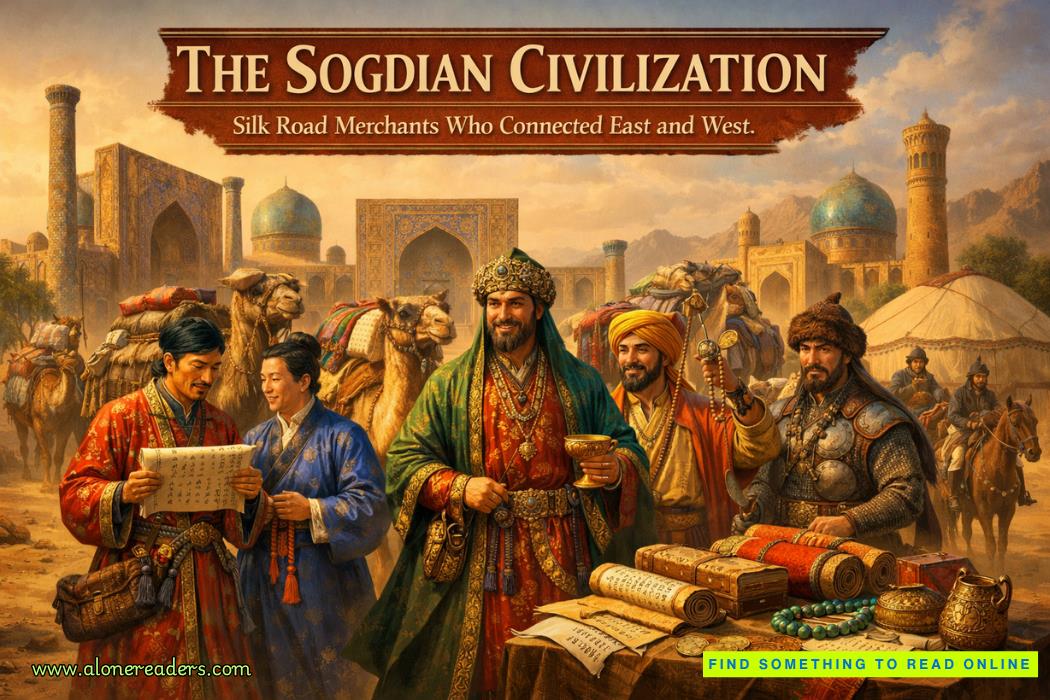
The Sogdian civilization stands as one of the most influential yet often overlooked forces in ancient Eurasian history. Flourishing between roughly the 5th century BCE and the 10th century CE, the Sogdians were not empire-builders in the traditional sense, nor were they conquerors driven by territorial ambition. Instead, they were masters of connectivity, acting as the vital human infrastructure of the Silk Road. Through commerce, diplomacy, and cultural mediation, they shaped interactions between powerful civilizations such as China, Persia, and the nomadic societies of the Eurasian steppe.
At the heart of Sogdian civilization lay the region of Sogdiana, centered in modern-day Uzbekistan and Tajikistan, with key urban hubs like Samarkand and Bukhara. These cities were not merely trade stops but dynamic cosmopolitan centers where languages, religions, and goods from across continents converged. Unlike many ancient societies defined by rigid political structures, the Sogdians operated through decentralized networks of merchant families, each extending their influence across vast distances.
What distinguished the Sogdians most profoundly was their unparalleled role as intermediaries. They did not simply transport goods; they facilitated relationships between distant cultures. Their caravans carried silk from China, silverware from Persia, glassware from the Mediterranean, and spices from India. Yet alongside these commodities traveled ideas, artistic motifs, and religious beliefs, making the Sogdians crucial agents of early globalization.
The Sogdian economy was fundamentally commercial, but its sophistication extended far beyond simple trade. Merchant families established colonies in foreign cities, particularly in Chinese urban centers such as Chang'an, where Sogdian communities thrived as influential diaspora networks. These expatriate merchants maintained strong ties to their homeland while integrating into local societies, often serving as translators, diplomats, and cultural brokers.
One of the most striking aspects of Sogdian society was its linguistic adaptability. The Sogdian language, an Eastern Iranian tongue, became a lingua franca of the Silk Road. Documents discovered in Central Asia and western China reveal contracts, letters, and religious texts written in Sogdian, underscoring its importance as a medium of communication across diverse populations. This linguistic flexibility was not merely practical; it was a strategic asset that enabled the Sogdians to operate effectively in multicultural environments.
Religion within Sogdian civilization was equally diverse, reflecting their exposure to a wide array of spiritual traditions. While many Sogdians adhered to Zoroastrianism, others embraced Buddhism, Manichaeism, and even Nestorian Christianity. This religious pluralism was not incidental but integral to their identity as intermediaries. By adopting and transmitting different belief systems, the Sogdians played a critical role in the spread of Buddhism into China and beyond. Their caravans were not only carriers of goods but also vehicles of spiritual transformation.
Art and material culture further illustrate the Sogdians’ unique position. Sogdian murals, particularly those found in Panjikent, depict lively scenes of banquets, mythological narratives, and diplomatic encounters. These artworks reveal a society that celebrated both its local traditions and its global connections. The visual language of Sogdian art blends Persian, Indian, and Chinese influences, creating a distinctive aesthetic that mirrors the cultural hybridity of the Silk Road itself.
Politically, the Sogdians operated within a landscape dominated by larger empires. They were often subject to powers such as the Achaemenids, the Kushans, and later the Sasanian Empire. However, their lack of centralized political authority proved to be an advantage rather than a weakness. Without the burden of maintaining a vast territorial state, Sogdian merchants could adapt quickly to changing geopolitical conditions. They negotiated with rulers, paid tribute when necessary, and leveraged their economic importance to secure favorable treatment.
The rise of the Tang Dynasty marked a golden age for Sogdian activity. During this period, trade routes flourished, and Sogdian merchants became deeply embedded in Chinese society. Many served as officials, military officers, and court entertainers. Sogdian music and dance gained popularity in the Tang court, reflecting a broader cultural exchange that enriched Chinese civilization. This era exemplifies how economic integration can lead to profound cultural transformation.
However, the Sogdian civilization was not immune to disruption. The expansion of Islamic power into Central Asia in the 7th and 8th centuries brought significant changes. The Arab conquests gradually diminished the autonomy of Sogdian cities, and the spread of Islam altered the religious landscape. While many Sogdians converted to Islam and continued to participate in trade, the distinct identity of the Sogdian civilization began to fade. Over time, their language disappeared, and their cultural practices were absorbed into the broader Islamic world.
Despite this decline, the legacy of the Sogdians endures in subtle but profound ways. The very concept of the Silk Road as a network of interconnected routes owes much to their efforts. They demonstrated that commerce could transcend political boundaries and that cultural exchange could flourish through mutual dependence. In many respects, the Sogdians anticipated the dynamics of modern globalization, where economic networks link distant societies in complex and often unexpected ways.
Archaeological discoveries continue to shed light on this remarkable civilization. Documents such as the “Ancient Letters,” found near Dunhuang, provide intimate glimpses into the lives of Sogdian merchants. These letters reveal concerns about family, business, and survival, reminding us that behind the grand narrative of trade and diplomacy were individuals navigating the uncertainties of long-distance commerce. Their voices, preserved across centuries, offer a rare human perspective on the ancient world.
The Sogdian contribution to cultural transmission is perhaps their most enduring achievement. They acted as conduits through which artistic styles, technological innovations, and religious ideas flowed across Eurasia. Without their efforts, the Silk Road would have been a far less dynamic and interconnected system. Their ability to bridge cultural divides was not merely a function of geography but a reflection of a deeply ingrained ethos of adaptability and openness.
It is also worth emphasizing the structural sophistication of Sogdian trade networks. These were not random or informal exchanges but highly organized systems involving credit, partnerships, and risk management. Merchant families often operated as multinational enterprises, with members stationed in different cities along the trade routes. This allowed for efficient coordination and the sharing of information, reducing the uncertainties inherent in long-distance trade. In this sense, the Sogdians can be seen as pioneers of early commercial capitalism.
The decline of the Sogdian civilization is better understood not as a collapse, but as a process of transformation. As they became integrated into the Islamic world and gradually absorbed into Turkic and Persian societies, their distinct identity faded, yet their influence did not disappear. Instead, it continued in more subtle ways, leaving enduring traces in the traditions of Central Asia, in linguistic developments, and in artistic expressions that still reflect their cultural legacy.
In the broader context of history, the Sogdians challenge conventional narratives that prioritize empires and conquests. They remind us that connectivity, rather than domination, can be a powerful driver of historical change. Their story underscores the importance of intermediaries—those who facilitate exchange and understanding between different worlds.
Ultimately, the Sogdian civilization exemplifies the transformative potential of trade and cultural interaction. They were not merely participants in the Silk Road; they were its architects, its lifeblood, and its most effective ambassadors. Their legacy invites us to reconsider the foundations of global history, highlighting the enduring impact of those who build bridges rather than walls.



 The Hundred Days Offensive: How the Allies Defeated Germany in World War I
 The Second Battle of the Marne: The Turning Point of World War I in 1918
 The Spring Offensive of 1918: Germany's Final Gamble to Win World War I
 The Treaty of Brest-Litovsk: How Russia Left World War I
 The Russian Revolution and World War I: How War Brought Down the Tsar
 The Zimmermann Telegram Explained: Germany's Secret Offer to Mexico in World War I










