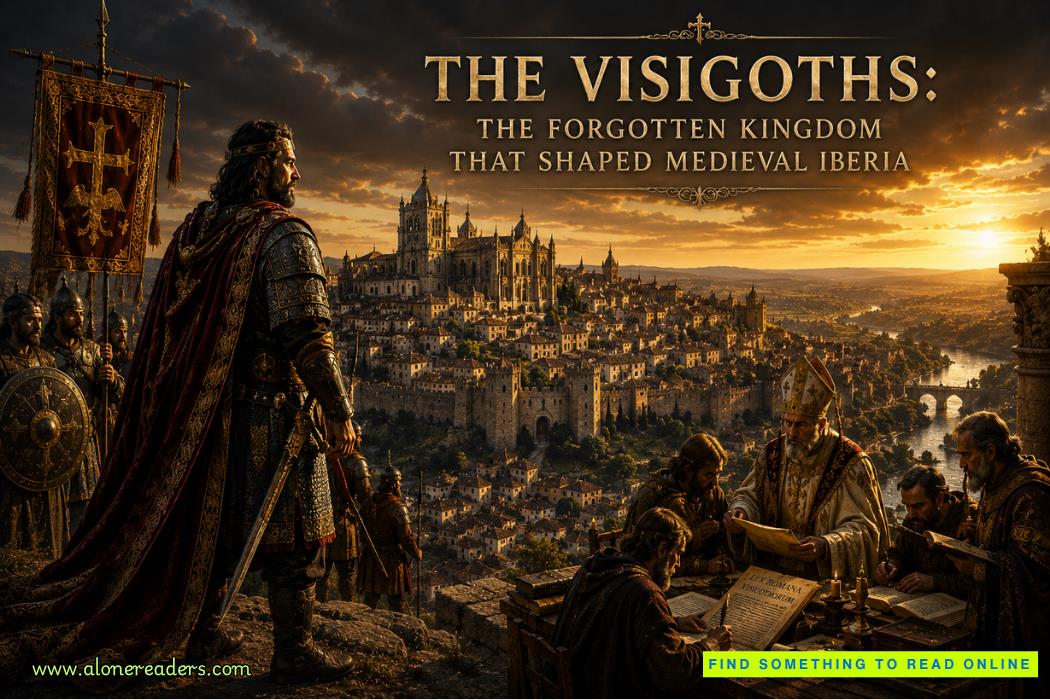
The collapse of the Western Roman Empire did not create an empty world. Across Europe, new kingdoms emerged from the ruins of imperial authority, each attempting to reshape Roman civilization according to its own traditions, ambitions, and political realities. Among these successor states, few have been as historically overlooked as the Visigothic Kingdom of Iberia. Overshadowed by the Franks in Gaul, the Byzantines in the East, and later by the Islamic conquest of Spain, the Visigoths are often remembered only briefly as wandering barbarians who sacked Rome in 410 CE under Alaric. Yet this narrow image conceals the extraordinary historical importance of the Visigothic state that later arose in Hispania. For nearly three centuries, the Visigoths governed much of the Iberian Peninsula, developed sophisticated legal institutions, strengthened Christian authority, and laid foundations that would profoundly influence medieval Spain.
The Visigoths began not as conquerors of Iberia but as displaced migrants navigating the chaos of the late Roman world. Originally part of the broader Gothic peoples who lived north of the Danube, they entered Roman territory during the fourth century amid the devastating expansion of the Huns into Eastern Europe. The Roman Empire initially permitted Gothic settlement within imperial borders, hoping to use them as federated allies. Instead, poor treatment, corruption, and starvation drove the Goths into rebellion. The catastrophic Roman defeat at the Battle of Adrianople in 378 CE demonstrated that imperial military supremacy was weakening rapidly. From that point onward, the Goths became central actors in the transformation of Europe.
Under Alaric, the Visigoths moved repeatedly through the Balkans and Italy, negotiating with emperors while simultaneously threatening Roman stability. Their sack of Rome in 410 shocked the ancient world because the Eternal City had long symbolized imperial permanence. Although the physical destruction was limited compared to later invasions, the psychological impact was immense. Roman writers interpreted the event as evidence that the old order was collapsing. Yet the Visigoths were not attempting to annihilate Roman civilization. In many ways, they sought inclusion within it. They desired land, military authority, and legitimacy inside the imperial system rather than its complete destruction.
After years of movement across the Western Empire, the Visigoths eventually established themselves in southern Gaul under a federate agreement with Rome. From there, they expanded their influence into Hispania. What began as military settlement gradually evolved into an independent kingdom as Roman authority deteriorated further during the fifth century. The decisive transformation occurred after the Visigoths suffered defeat against the Franks at the Battle of Vouillé in 507 CE. This defeat forced them to abandon much of Gaul and consolidate their power in Iberia. Toledo emerged as the political center of the Visigothic Kingdom, a city that would later become one of the most important capitals in medieval European history.
The establishment of the Visigothic Kingdom in Iberia represented far more than a military occupation. It marked the beginning of a remarkable experiment in political fusion between Roman provincial society and Germanic warrior aristocracy. Unlike the simplistic stereotype of barbarian destruction, Visigothic rulers inherited and adapted substantial elements of Roman governance. Latin remained the language of administration. Roman taxation systems survived in modified forms. Urban institutions persisted, although often weakened. Most importantly, Roman law continued to influence governance even as Gothic customs shaped military and aristocratic culture.
One of the greatest challenges facing the Visigothic Kingdom was the division between the Gothic ruling elite and the Hispano-Roman population. Religion intensified this divide. The Visigoths initially followed Arian Christianity, a theological doctrine considered heretical by the Catholic majority of Iberia. This religious separation created political instability because Catholic bishops remained deeply influential among the Roman population. Visigothic kings therefore faced a fundamental problem: they ruled a land where the majority of their subjects viewed the royal religion as illegitimate.
This situation changed dramatically during the reign of King Reccared I in the late sixth century. In 589 CE, Reccared publicly converted from Arian Christianity to Catholicism during the Third Council of Toledo. This moment became one of the most transformative events in Iberian history. The conversion unified the kingdom religiously and strengthened cooperation between the monarchy and the Catholic Church. Bishops gained enormous political influence within Visigothic society, while the monarchy acquired greater legitimacy among the Roman population. The fusion of royal authority and Catholic identity would later become one of the defining characteristics of medieval Spain.
The Councils of Toledo became powerful political institutions during this period. These assemblies were not merely religious gatherings. They functioned as centers of governance where bishops and nobles debated succession, law, taxation, and royal legitimacy. In many ways, they represented an early form of collaborative political administration in post-Roman Europe. The Church became deeply intertwined with the state, helping preserve literacy, legal traditions, and bureaucratic continuity during an age often portrayed as chaotic and fragmented.
The Visigothic legal system stands among the kingdom’s most enduring achievements. Early Visigothic rulers maintained separate legal codes for Goths and Romans, reflecting the divided nature of society. Over time, however, the monarchy pursued greater unification. This process culminated in the creation of the Liber Iudiciorum, also known as the Visigothic Code, during the seventh century. This legal compilation merged Roman legal principles with Germanic customs into a single framework applicable to all subjects regardless of ethnicity.
The importance of this legal development cannot be overstated. The Liber Iudiciorum influenced legal traditions in Iberia for centuries, surviving even after the Islamic conquest and continuing to shape Christian kingdoms during the Reconquista. The code addressed issues ranging from inheritance and marriage to property disputes and criminal punishment. Compared to many contemporary European legal systems, it demonstrated remarkable sophistication and administrative ambition. It also reflected the broader Visigothic goal of creating a unified kingdom rather than a temporary military occupation.
Visigothic society itself was highly stratified. At the top stood the king and the warrior aristocracy, whose power depended heavily on military loyalty and landownership. Below them existed a complex hierarchy of nobles, clergy, free peasants, artisans, and slaves. Land ownership became increasingly concentrated among aristocratic families and the Church, contributing to the development of social structures that anticipated medieval feudalism. Rural estates grew in importance as urban economic life declined in many regions following the collapse of Roman trade networks.
Yet Iberia under the Visigoths was not culturally stagnant. Toledo became a major intellectual center where scholars, bishops, and scribes preserved classical learning while developing Christian theology and historical writing. One of the most important intellectual figures of the period was Isidore of Seville, whose encyclopedic work, the Etymologiae, attempted to compile and preserve the knowledge of the ancient world. Isidore’s writings became foundational educational texts throughout medieval Europe. His work demonstrates that the Visigothic Kingdom was not an isolated barbarian state but an active participant in the preservation and transmission of classical civilization.
Art and architecture during the Visigothic period also reveal a sophisticated cultural synthesis. Churches built under Visigothic rule combined Roman engineering traditions with distinctive Germanic artistic motifs. Horseshoe arches, intricate stone carvings, and decorative metalwork became characteristic features of Visigothic artistic expression. Although many structures were later modified or destroyed during subsequent Islamic and Christian periods, surviving examples still demonstrate the creativity of Visigothic craftsmanship. The kingdom served as a cultural bridge between the Roman world and medieval Christian Europe.
Despite these achievements, the Visigothic Kingdom faced chronic political instability. One of its greatest weaknesses was the absence of a stable system of royal succession. Kings were often chosen through aristocratic election rather than strict hereditary inheritance. While this system theoretically allowed capable rulers to emerge, in practice it encouraged conspiracies, coups, and assassinations. Noble factions constantly competed for influence, undermining political unity and weakening royal authority.
Military power remained central to Visigothic politics. Kings relied heavily on aristocratic support and military loyalty, making them vulnerable to rebellion whenever elite factions became dissatisfied. Several Visigothic monarchs were deposed or killed through internal conspiracies. This instability limited the monarchy’s ability to establish lasting dynastic continuity and created deep fractures within the ruling class.
At the same time, the kingdom faced external pressures. Byzantine forces briefly controlled parts of southern Iberia during the sixth century as Emperor Justinian attempted to restore Roman imperial authority in the West. Although the Visigoths eventually expelled Byzantine influence, these conflicts exposed the kingdom’s vulnerabilities. Basque resistance in northern regions also challenged royal authority, while tensions among regional elites persisted throughout the kingdom’s history.
Nevertheless, by the early eighth century, the Visigothic Kingdom remained one of the most significant powers in Western Europe. Its rulers governed a large territory, maintained legal institutions, supported ecclesiastical authority, and controlled strategic trade routes. Yet beneath this appearance of stability, internal divisions were intensifying dangerously.
The crisis erupted following the death of King Wittiza. Rival factions supported competing claimants to the throne, particularly King Roderic and the supporters of Achila II. These internal disputes fragmented the kingdom precisely when a new external force was emerging across the Strait of Gibraltar. In 711 CE, Muslim armies composed largely of Berber troops under Tariq ibn Ziyad crossed into Iberia from North Africa. The Visigothic response was weakened by civil war and aristocratic disunity.
The decisive Battle of Guadalete resulted in catastrophic defeat for King Roderic. Although historical details remain debated, the consequences were undeniable. Within only a few years, much of the Visigothic Kingdom collapsed under the rapid expansion of Islamic forces. Major cities surrendered or were captured, and Visigothic political authority disintegrated across most of Iberia.
The speed of the conquest has often led historians to portray the Visigothic Kingdom as fragile and decaying. Yet this interpretation oversimplifies a far more complex reality. The Muslim conquest succeeded not merely because of Visigothic weakness but also because of extraordinary military momentum, internal political fragmentation, and the ability of Islamic commanders to negotiate alliances with local elites. In many areas, existing administrative structures continued functioning under new rulers. The transition was therefore not a simple story of destruction but a profound political transformation.
Importantly, the Visigothic legacy did not disappear after 711. Christian communities in northern Iberia preserved memories of the Visigothic monarchy and increasingly viewed themselves as heirs to the lost kingdom. During the Reconquista, rulers of Asturias, León, Castile, and other Christian states invoked Visigothic continuity to legitimize their authority and territorial ambitions. The idea that Christian kingdoms were restoring the old Visigothic order became a powerful ideological narrative throughout medieval Spanish history.
Visigothic law also survived remarkably long after the kingdom itself vanished. The Liber Iudiciorum continued influencing legal traditions in Christian Iberia for centuries. Ecclesiastical structures established during the Visigothic period similarly endured, shaping the relationship between monarchy and Church in medieval Spain. Even architectural and artistic traditions displayed traces of Visigothic influence long after the Islamic conquest transformed much of Iberian culture.
Modern historical memory, however, has often marginalized the Visigoths. Popular narratives tend to jump directly from Roman Hispania to Islamic Al-Andalus, overlooking the crucial centuries in between. This omission distorts the historical development of Iberia. The Visigothic Kingdom was not merely an interlude between empires. It was a formative civilization that shaped the political, legal, religious, and cultural foundations of medieval Spain.
In many respects, the Visigoths created one of the earliest unified kingdoms in Western Europe after the fall of Rome. They attempted to integrate diverse populations under a common legal and religious framework. They preserved elements of Roman administration while adapting them to new political realities. They strengthened the role of Christianity within governance and contributed to the intellectual preservation of classical knowledge during a period of immense transformation.
Their history also challenges simplistic assumptions about the so-called “barbarian kingdoms” of post-Roman Europe. The Visigoths were neither mere destroyers nor passive inheritors of Roman civilization. They were active political architects shaping a new medieval order from the remnants of imperial collapse. Their kingdom became a laboratory where Roman traditions, Christian authority, and Germanic political culture merged into something entirely new.
The story of the Visigoths is therefore not simply the story of a vanished people. It is the story of how Europe transformed after Rome’s fall. In the cities of Toledo and Seville, in the councils of bishops and kings, in the pages of Visigothic law codes, and in the memory of later Spanish kingdoms, the Visigoths helped define the emerging medieval world. Though often forgotten in popular history, their influence endured long after their kingdom disappeared, shaping the identity of Iberia and leaving a legacy woven deeply into the foundations of medieval Europe.



 The Hundred Days Offensive: How the Allies Defeated Germany in World War I
 The Second Battle of the Marne: The Turning Point of World War I in 1918
 The Spring Offensive of 1918: Germany's Final Gamble to Win World War I
 The Treaty of Brest-Litovsk: How Russia Left World War I
 The Russian Revolution and World War I: How War Brought Down the Tsar
 The Zimmermann Telegram Explained: Germany's Secret Offer to Mexico in World War I