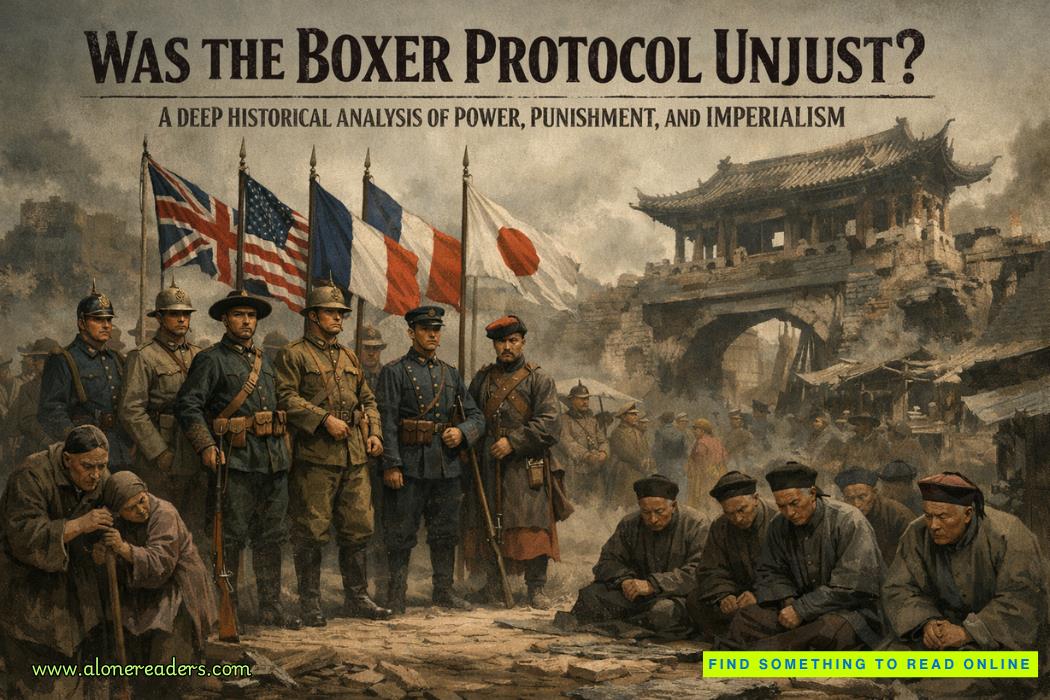
The question of whether the Boxer Protocol was unjust is not merely a matter of moral judgment but a complex historiographical debate shaped by competing interpretations of imperialism, sovereignty, and international law at the turn of the twentieth century. Signed in 1901 after the violent suppression of the Boxer Rebellion, the agreement imposed sweeping penalties on Qing China, including massive indemnities, foreign troop deployments, and significant political concessions. To understand whether it was unjust, one must interrogate not only the terms of the treaty itself but also the context in which it emerged, the motivations of the foreign powers involved, and the broader structure of global power relations that framed it.
At its core, the Boxer Protocol must be situated within the logic of late nineteenth-century imperialism. By 1900, Qing China had already been weakened by a series of “unequal treaties” following conflicts such as the Opium Wars and the Sino-Japanese War. These treaties had systematically eroded Chinese sovereignty, granting extraterritorial rights to foreigners, opening treaty ports, and imposing economic concessions. The Boxer Rebellion, which began as a grassroots anti-foreign movement fueled by economic distress, cultural tensions, and resentment toward missionary activity, was as much a reaction to these cumulative humiliations as it was a violent uprising. When the Qing court, under the influence of conservative factions, aligned itself with the Boxers, the conflict escalated into a full-scale confrontation with an eight-nation alliance.
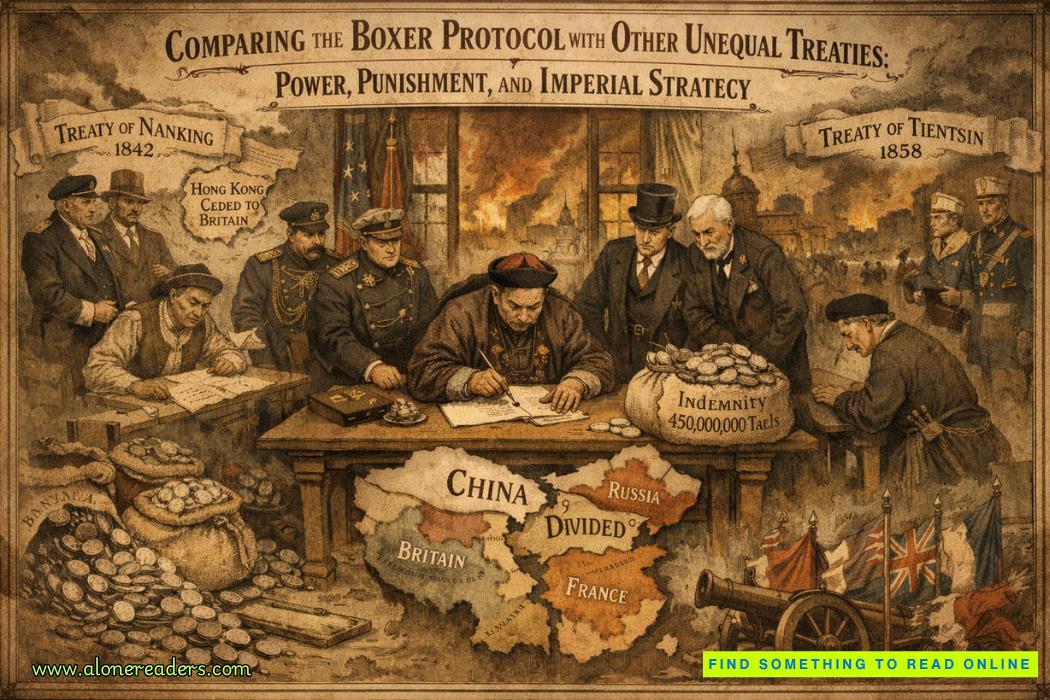
From the perspective of the foreign powers, the Boxer Protocol represented a justified response to what they viewed as a breakdown of order and a direct threat to their nationals and interests. Foreign diplomats, missionaries, and civilians had been killed during the uprising, and the siege of the foreign legations in Beijing was interpreted as an egregious violation of diplomatic norms. Within this framework, the punitive measures imposed on China—most notably the indemnity of 450 million taels of silver, payable over 39 years with interest—were framed as compensation for losses and as a deterrent against future anti-foreign violence. Supporters of this view argue that the protocol was consistent with the prevailing norms of international relations at the time, where military victory often translated into legal and financial concessions.
However, this interpretation becomes increasingly problematic when examined through a critical lens. The scale of the indemnity alone raises serious questions about proportionality. The total repayment amount, when interest is included, effectively doubled, placing an enormous financial burden on an already fragile state. This was not merely compensation; it was a mechanism of long-term economic subjugation. The Qing government was forced to divert substantial revenue streams, including customs duties and salt taxes, to service this debt. The consequences were profound, exacerbating fiscal instability and limiting the state’s capacity to implement reforms at a critical moment in its history.
Moreover, the protocol’s provisions went far beyond financial penalties. The right granted to foreign powers to station troops in Beijing and along key routes to the sea represented a direct infringement on Chinese sovereignty. These military presences were not temporary safeguards but institutionalized forms of control that allowed foreign powers to exert ongoing influence over Chinese political affairs. In addition, the requirement that China execute or punish officials deemed responsible for supporting the Boxers introduced an external dimension to internal governance. The Qing state was effectively compelled to discipline itself according to the demands of foreign powers, undermining its autonomy and legitimacy.
A crucial dimension of the debate centers on the concept of “unequal treaties.” The Boxer Protocol is often cited as one of the most egregious examples of such agreements, characterized by coercion and asymmetry. Unlike treaties negotiated between sovereign equals, this agreement was imposed under conditions of military occupation and political duress. The Qing delegation had little room for negotiation; refusal would have likely resulted in further military action and possibly territorial dismemberment. From this perspective, the protocol can be understood as a product of coercive diplomacy rather than genuine consent, challenging its legitimacy under modern interpretations of international law.
Chinese historiography has overwhelmingly characterized the Boxer Protocol as unjust, framing it as a symbol of national humiliation during what is often referred to as the “Century of Humiliation.” In this narrative, the treaty is not merely a diplomatic document but a representation of the systemic exploitation of China by imperial powers. The indemnity payments, which continued into the early Republican period, are seen as draining resources that could have been used for modernization and development. Furthermore, the presence of foreign troops in Beijing is remembered as a stark reminder of lost sovereignty. This perspective emphasizes the structural inequality embedded in the global order of the time, where Western powers and Japan operated with impunity while non-Western states were subjected to punitive interventions.
Western historiography, however, has evolved over time. Earlier interpretations tended to justify the protocol as a necessary response to violence and instability, often portraying the Boxers as irrational and xenophobic. In these accounts, the treaty was seen as a civilizing intervention aimed at restoring order and protecting international interests. Yet more recent scholarship has adopted a more critical stance, acknowledging the imperialist motivations behind the intervention and questioning the fairness of the imposed terms. Historians now increasingly recognize that the Boxer Rebellion itself was rooted in legitimate grievances, including economic dislocation, environmental crises, and cultural tensions exacerbated by foreign intrusion.
An additional layer of complexity arises when considering the internal dynamics of the Qing state. The decision of the Qing court to support the Boxers was not universally accepted within the government. Reformist officials, many of whom had advocated for modernization and engagement with foreign powers, were sidelined or punished. The aftermath of the rebellion and the imposition of the protocol further weakened the central government, contributing to the eventual collapse of the Qing dynasty in 1911. In this sense, the protocol not only reflected external pressures but also intensified internal fractures, accelerating the decline of imperial rule.
It is also important to examine the role of individual foreign powers within the alliance. While they acted collectively, their motivations were not identical. Japan, for instance, sought to assert itself as a major power, while European nations and the United States were primarily concerned with protecting commercial and missionary interests. The distribution of indemnity payments among these powers further illustrates the economic incentives underlying the intervention. Some countries even used their share of the indemnity to fund educational programs for Chinese students abroad, a gesture that complicates the narrative but does not fundamentally alter the coercive nature of the agreement.
From a legal standpoint, the Boxer Protocol occupies an ambiguous position. At the time, international law was heavily influenced by European norms and often excluded non-Western states from equal participation. The concept of sovereignty itself was applied unevenly, with “civilized” nations enjoying full rights while others were subjected to intervention. Within this framework, the protocol may have been considered lawful. However, under contemporary standards, which emphasize self-determination and the prohibition of coercion, it would likely be deemed illegitimate. This temporal disjunction highlights the evolving nature of legal and moral standards in international relations.
The question of justice also intersects with the issue of collective punishment. The protocol imposed penalties on the Qing state as a whole, rather than targeting specific individuals or groups responsible for the violence. This raises ethical concerns about the fairness of holding an entire nation accountable for the actions of a segment of its population, particularly in a context where the central government’s control was already limited. The executions and punishments mandated by the treaty further underscore this point, as they were often carried out under external pressure rather than through independent judicial processes.
Yet, to dismiss the protocol entirely as unjust without acknowledging the violence of the Boxer Rebellion would be an oversimplification. The uprising did involve attacks on civilians and diplomatic personnel, actions that cannot be easily justified. The challenge lies in balancing this recognition with an understanding of the broader structural conditions that produced the rebellion. Justice, in this context, cannot be reduced to a binary judgment but must account for both the immediate causes and the systemic inequalities at play.
Ultimately, the Boxer Protocol can be seen as a manifestation of a deeply unequal international system, where power dictated terms and justice was often subordinated to strategic interests. Its provisions reflected not only a desire for retribution but also an intent to consolidate influence over China. The long-term consequences of the treaty—economic strain, political instability, and intensified anti-foreign sentiment—suggest that it may have been counterproductive as well as unjust.
In contemporary discourse, the legacy of the Boxer Protocol continues to shape perceptions of international relations and historical memory in China. It serves as a reminder of a period when sovereignty was compromised and external powers wielded disproportionate influence. At the same time, it invites reflection on how concepts of justice, responsibility, and legitimacy have evolved over time. The enduring relevance of this debate lies in its capacity to illuminate the intersections of power and morality in global history, challenging us to reconsider the standards by which we evaluate past actions.
In conclusion, whether the Boxer Protocol was unjust depends largely on the framework through which it is assessed. From the standpoint of imperial powers operating within the norms of their time, it may have appeared justified. However, when viewed through a modern lens that emphasizes equity, sovereignty, and proportionality, the treaty reveals itself as a profoundly imbalanced and coercive agreement. It stands as a stark example of how power can shape notions of justice, often to the detriment of those who lack it.



 The Hundred Days Offensive: How the Allies Defeated Germany in World War I
 The Second Battle of the Marne: The Turning Point of World War I in 1918
 The Spring Offensive of 1918: Germany's Final Gamble to Win World War I
 The Treaty of Brest-Litovsk: How Russia Left World War I
 The Russian Revolution and World War I: How War Brought Down the Tsar
 The Zimmermann Telegram Explained: Germany's Secret Offer to Mexico in World War I