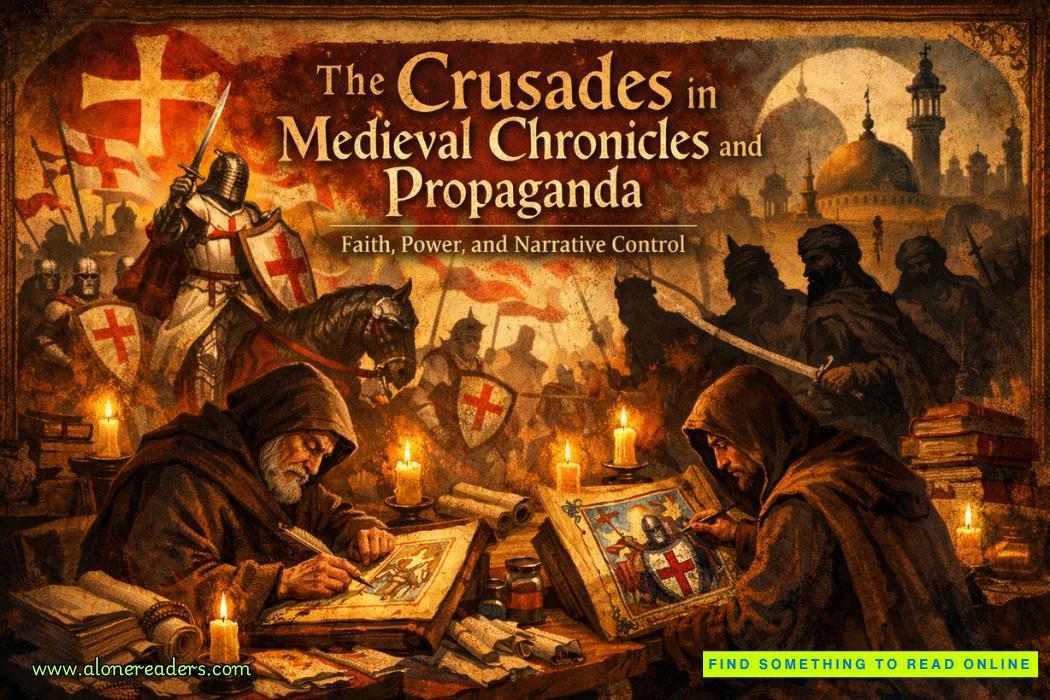
The Crusades, spanning from the late eleventh to the late thirteenth centuries, were not only military campaigns but also profoundly constructed narratives shaped by those who recorded them. Medieval chronicles served as the primary medium through which these events were documented, interpreted, and disseminated. Yet these texts were far from neutral records; they functioned as instruments of ideological persuasion, embedding within them layers of religious fervor, political justification, and cultural bias. To understand the Crusades through medieval chronicles is to engage not with objective history, but with a carefully curated worldview in which faith and power intersected with narrative control.
At the heart of this phenomenon lies the medieval chronicler, often a cleric or monk, whose role extended beyond documentation into interpretation. These individuals operated within ecclesiastical and political structures that influenced their perspectives. Their accounts frequently framed the Crusades as a divinely sanctioned endeavor, portraying crusaders as instruments of God’s will. The language employed in these texts is saturated with moral absolutism, presenting the conflict as a binary struggle between righteousness and infidelity. Such framing was not incidental; it was central to legitimizing the immense human and material costs associated with the campaigns.
The First Crusade, in particular, demonstrates how chronicles functioned as propaganda. Narratives describing the capture of Jerusalem in 1099 often emphasize miraculous elements, divine intervention, and the moral superiority of the crusaders. Descriptions of the city’s conquest are infused with imagery of purification and redemption, even when recounting acts of extreme violence. The juxtaposition of brutality with sanctity reveals a deliberate rhetorical strategy, one that sought to reconcile the ethical contradictions inherent in holy war. By presenting violence as both necessary and divinely ordained, chroniclers effectively transformed conquest into a sacred duty.
Equally significant is the selective omission or distortion of events. Medieval chronicles rarely provide a balanced account of interactions between crusaders and local populations. Complex political alliances, instances of cooperation, and cultural exchanges are often minimized or ignored altogether. Instead, narratives tend to highlight conflict, reinforcing a perception of irreconcilable difference. This selective storytelling contributed to the construction of a monolithic “other,” characterized by hostility and moral inferiority. Such depictions were instrumental in sustaining the ideological momentum of the Crusades, ensuring continued support from both the nobility and the broader populace.
Propaganda during the Crusades was not limited to written chronicles; it extended into sermons, letters, and visual representations. However, chronicles played a unique role due to their perceived authority and permanence. Once recorded, these texts became reference points for subsequent generations, shaping collective memory and historical understanding. The repetition of certain themes—divine approval, heroic sacrifice, and righteous violence—created a narrative consistency that reinforced their credibility. Over time, these elements became embedded within the cultural fabric of medieval Europe, influencing not only perceptions of the Crusades but also broader attitudes toward warfare and religious identity.
The interplay between chronicles and propaganda is particularly evident in the portrayal of key figures. Leaders of the Crusades were often depicted in idealized terms, their actions framed as exemplars of Christian virtue. Failures and controversies were either downplayed or reinterpreted to align with the overarching narrative. This process of selective glorification served to construct a heroic archetype, one that could inspire future participation and reinforce the legitimacy of the crusading movement. Conversely, opposing leaders were frequently depicted through a lens of demonization, their motivations reduced to malice or heresy.
It is important to recognize that this narrative construction was not solely imposed from above; it also resonated with the expectations and beliefs of the audience. Medieval society was deeply religious, and the idea of a holy war held significant appeal. Chronicles, therefore, operated within a feedback loop, both shaping and reflecting contemporary attitudes. The effectiveness of crusading propaganda lay in its ability to align ideological messaging with existing cultural frameworks, thereby ensuring its acceptance and dissemination.
The Second and Third Crusades further illustrate the evolution of propagandistic techniques within chronicles. As the initial fervor of the First Crusade gave way to more complex political realities, chroniclers adapted their narratives accordingly. Emphasis shifted toward themes of perseverance, martyrdom, and divine testing. Failures were reinterpreted as trials of faith rather than strategic shortcomings. This reframing allowed the crusading ideal to persist despite setbacks, maintaining its relevance and appeal. The resilience of the narrative underscores the adaptability of medieval propaganda, capable of absorbing and reconfiguring unfavorable outcomes.
Another critical dimension of crusading chronicles is their role in shaping perceptions of geography and culture. Descriptions of the Eastern Mediterranean often blend factual observation with imaginative embellishment. Cities are depicted as both exotic and threatening, their portrayal reinforcing the sense of a distant and dangerous frontier. Cultural practices are frequently misunderstood or misrepresented, contributing to a distorted image of the region and its inhabitants. This construction of an unfamiliar and hostile landscape served to justify the presence and actions of crusading forces, framing their campaigns as both necessary and heroic.
The language of chronicles also reveals a sophisticated use of symbolism and metaphor. Religious imagery is pervasive, with references to biblical events and figures used to contextualize contemporary actions. Crusaders are often compared to warriors of the Old Testament, and their struggles are presented as continuations of sacred history. This intertextual approach not only strengthened the moral authority of these narratives but also provided audiences with a familiar framework through which to interpret events. By placing the Crusades within a broader theological context, chroniclers elevated them from mere historical events to expressions of divine will.
Despite their propagandistic nature, medieval chronicles are invaluable historical sources. They offer insights into the mindset of the period, revealing how individuals and institutions sought to understand and justify their actions. However, engaging with these texts requires a critical approach, one that acknowledges their biases and limitations. Modern historiography has increasingly emphasized the need to contextualize chronicles within their social, political, and cultural environments. This involves comparing multiple accounts, examining inconsistencies, and considering alternative perspectives.
The role of translation and transmission further complicates the interpretation of crusading chronicles. Many texts were copied and circulated across different regions, often undergoing modifications in the process. These variations can reflect shifting priorities and perspectives, as well as the influence of different audiences. The fluidity of these texts underscores the dynamic nature of medieval propaganda, capable of evolving in response to changing circumstances.
In examining the Crusades through the lens of medieval chronicles and propaganda, it becomes evident that history is not merely recorded but constructed. The narratives that have come down to us are shaped by the intentions and constraints of their authors, as well as the broader context in which they were produced. Understanding this process is essential for a nuanced interpretation of the Crusades, one that moves beyond simplistic dichotomies and engages with the complexities of historical representation.
Ultimately, the study of crusading chronicles reveals the power of narrative in shaping both contemporary perception and historical memory. These texts did more than describe events; they defined them, imbuing them with meaning and significance that extended far beyond the battlefield. The enduring legacy of the Crusades is, in many ways, a testament to the effectiveness of this narrative construction, demonstrating how deeply embedded ideas can influence generations.
In a broader sense, the interplay between chronicles and propaganda during the Crusades offers a compelling case study in the relationship between history and ideology. It highlights the ways in which information can be curated, framed, and disseminated to serve specific purposes. While the context may differ, the underlying mechanisms remain relevant, reminding us that the interpretation of events is often as significant as the events themselves.



 The Hundred Days Offensive: How the Allies Defeated Germany in World War I
 The Second Battle of the Marne: The Turning Point of World War I in 1918
 The Spring Offensive of 1918: Germany's Final Gamble to Win World War I
 The Treaty of Brest-Litovsk: How Russia Left World War I
 The Russian Revolution and World War I: How War Brought Down the Tsar
 The Zimmermann Telegram Explained: Germany's Secret Offer to Mexico in World War I