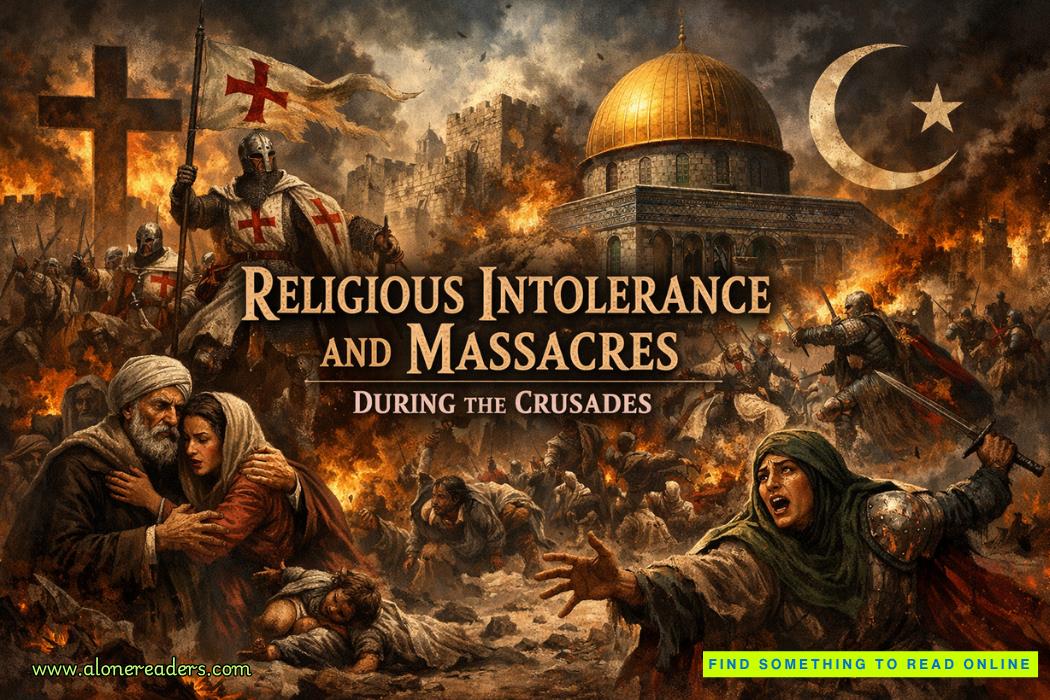
The Crusades stand as one of the most complex and controversial periods in medieval history, often framed as holy wars driven by religious devotion. Yet beneath the rhetoric of spiritual duty and divine mandate lay a far darker reality—systematic religious intolerance, brutal massacres, and the dehumanization of entire populations. While the Crusades are frequently associated with Christian-Muslim conflict over the Holy Land, the violence extended far beyond the battlefield, engulfing Jews, Eastern Christians, and even fellow Europeans in waves of fanaticism and bloodshed.
At the heart of this violence was an uncompromising worldview that framed religious difference not merely as disagreement, but as existential threat. Faith became a justification for annihilation. The idea that salvation could be earned through violence against perceived enemies of God created a moral framework in which atrocities were not only permitted but encouraged. This ideological transformation marked a significant departure from earlier forms of warfare, embedding religious intolerance into the core of military campaigns.
One of the earliest and most chilling examples of such intolerance occurred during the early phases of the First Crusade, when crusading mobs turned their fury against Jewish communities in Europe. As armies moved through regions along the Rhine, including cities such as Speyer, Worms, and Mainz, Jewish populations were subjected to forced conversions, torture, and mass killings. These were not strategic acts of war but premeditated acts of religious cleansing. Entire communities were wiped out, often with the tacit or explicit approval of local leaders. The justification was brutally simple: those who rejected the Christian faith were deemed unworthy of life.
This violence reveals a critical dimension of the Crusades often overshadowed by narratives focused on the Middle East. Religious intolerance was not limited to distant enemies; it was immediate, local, and deeply embedded within European society itself. The Crusaders’ journey to the Holy Land became a path of destruction across multiple regions, demonstrating how easily ideological fervor could be redirected toward vulnerable populations.
The capture of Jerusalem in 1099 stands as perhaps the most infamous episode of mass violence during the Crusades. After a grueling siege, Crusader forces breached the city’s defenses and unleashed a wave of slaughter that shocked even contemporary observers. Muslim and Jewish inhabitants were indiscriminately killed, with reports describing streets running with blood and bodies piled in sacred spaces. The Al-Aqsa Mosque and other religious sites became scenes of massacre rather than sanctity.
What is particularly striking about this event is not merely its scale but the mindset that enabled it. Crusaders interpreted their actions as divine justice. Violence was reframed as purification. The idea that killing non-Christians within a holy city could be an act of devotion illustrates the extent to which religious intolerance had become normalized. It was not seen as cruelty but as righteousness.
This normalization of violence extended to interactions with Eastern Christian communities as well. Despite sharing a broad religious identity, differences between Latin (Western) Christianity and Orthodox (Eastern) Christianity led to suspicion, hostility, and ultimately conflict. The Fourth Crusade, originally intended to target Muslim-controlled territories, instead culminated in the sack of Constantinople in 1204. This event marked a profound betrayal, as Crusaders turned against one of the most important Christian cities in the world.
The sack was characterized by looting, destruction, and widespread atrocities. Churches were desecrated, relics stolen, and civilians subjected to violence. The boundary between ally and enemy had collapsed under the weight of greed and ideological rigidity. Religious identity, rather than serving as a unifying force, became fragmented, revealing deep fractures within Christendom itself.
Beyond these high-profile events, the Crusades were marked by countless smaller episodes of brutality that collectively illustrate a broader pattern. Villages were destroyed, prisoners executed, and populations displaced. The logic of total war—where entire communities were seen as legitimate targets—was reinforced by religious narratives that framed opponents as inherently evil or subhuman. Dehumanization became a strategic tool, enabling soldiers to commit acts that would otherwise be morally unthinkable.
It is important to recognize that religious intolerance during the Crusades was not a one-sided phenomenon. While Crusader violence is well-documented, retaliatory actions by Muslim forces also involved brutality and massacre. However, the focus here is on the ideological framework that justified such actions. In many cases, leaders on all sides invoked divine authority to legitimize violence, creating a cycle of retribution that intensified over time.
The role of leadership in fostering intolerance cannot be understated. Religious authorities, including influential clerics, played a crucial role in shaping public perception and motivating participation. Sermons and proclamations often emphasized the spiritual rewards of fighting and dying in the Crusades, framing the conflict in apocalyptic terms. The enemy was not merely political but cosmic—an embodiment of evil that had to be eradicated. This rhetoric amplified fear, hatred, and a sense of urgency, making compromise or coexistence seem impossible.
Economic and social factors also contributed to the intensity of violence. Many participants in the Crusades were driven not only by faith but by the promise of wealth, land, and status. The convergence of material ambition with धार्मिक zeal created a volatile environment in which restraint was often abandoned. Looting and massacre became intertwined, as soldiers justified their actions both spiritually and materially.
Another critical dimension of religious intolerance during the Crusades was the erosion of moral boundaries. Traditional codes of warfare, which might have offered some protection to non-combatants, were frequently ignored. The distinction between soldier and civilian blurred, leading to widespread suffering among populations that had little direct involvement in the conflict. Innocence offered no immunity in a war defined by absolute beliefs.
The psychological impact of such violence was profound and long-lasting. Communities that experienced massacres carried the trauma across generations, shaping collective memory and identity. In many cases, these events became foundational narratives that influenced future conflicts, reinforcing cycles of mistrust and hostility. The legacy of Crusader violence can be seen in the enduring tensions between religious groups, even centuries after the events themselves.
At a broader level, the Crusades illustrate how religious intolerance can be institutionalized and weaponized. What began as a call to defend sacred territory evolved into a series of campaigns marked by systemic violence against diverse populations. The transformation of faith into a tool of exclusion and aggression highlights a fundamental risk inherent in any ideology that claims absolute truth. When belief systems are used to define who deserves to live or die, the potential for atrocity becomes immense.
Yet it is also important to approach this history with nuance. Not all participants in the Crusades were driven by hatred, and not all interactions between religious groups were violent. There were moments of cooperation, negotiation, and coexistence that complicate the narrative. However, these instances often existed alongside, rather than in place of, broader patterns of intolerance.
Understanding the massacres and religious violence of the Crusades requires more than recounting events; it demands an examination of the underlying mechanisms that enabled such behavior. Ideology, leadership, social dynamics, and individual agency all played a role in shaping outcomes. By analyzing these factors, it becomes possible to identify parallels with other historical and contemporary conflicts.
The Crusades serve as a stark reminder of how easily religious conviction can be transformed into justification for violence. They reveal the dangers of absolutism, the consequences of dehumanization, and the fragility of moral constraints in times of conflict. At the same time, they offer an opportunity for reflection—an invitation to consider how societies can resist the forces of intolerance and build frameworks that prioritize coexistence over division.
In examining this period, one is confronted with uncomfortable truths about human nature and the capacity for both belief and brutality. The massacres of the Crusades were not anomalies but products of specific conditions that allowed intolerance to flourish. Recognizing these conditions is essential not only for understanding the past but for navigating the present.
Ultimately, the history of religious intolerance and massacres during the Crusades is not merely a story of conflict; it is a case study in the consequences of unchecked ideology. It challenges us to question how beliefs are used, how differences are perceived, and how power is exercised in the name of faith. In doing so, it underscores the enduring relevance of this history in a world where the intersection of religion and politics continues to shape global events.



 The Hundred Days Offensive: How the Allies Defeated Germany in World War I
 The Second Battle of the Marne: The Turning Point of World War I in 1918
 The Spring Offensive of 1918: Germany's Final Gamble to Win World War I
 The Treaty of Brest-Litovsk: How Russia Left World War I
 The Russian Revolution and World War I: How War Brought Down the Tsar
 The Zimmermann Telegram Explained: Germany's Secret Offer to Mexico in World War I