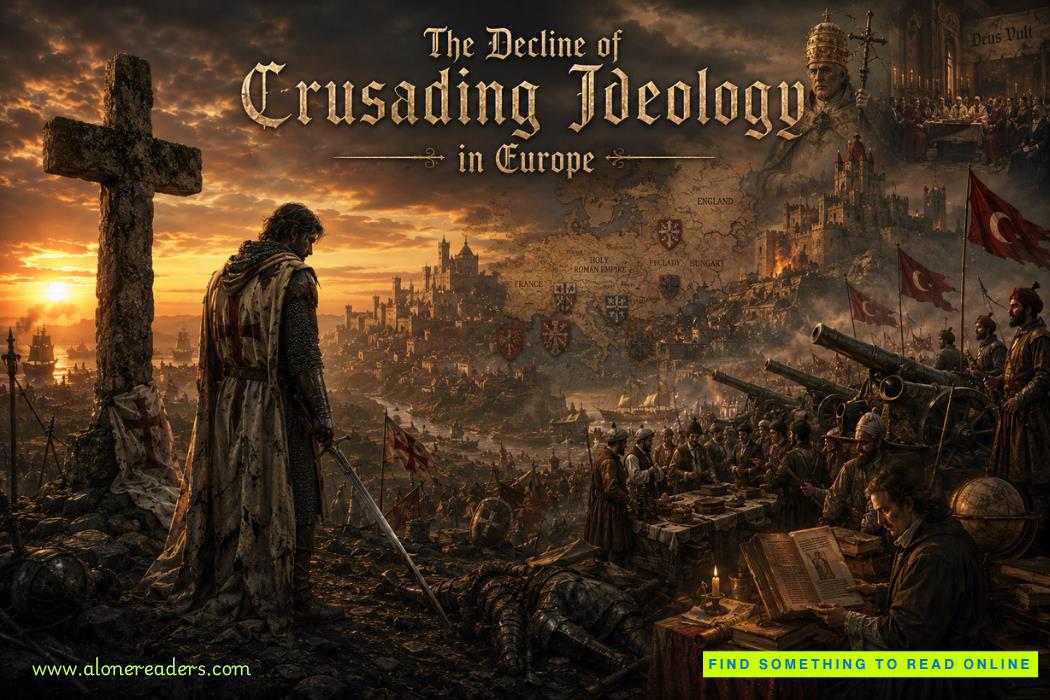
The history of the Crusades is often remembered through images of armored knights marching beneath the sign of the cross toward Jerusalem, convinced that warfare itself could become an act of spiritual devotion. For nearly two centuries, crusading ideology represented one of the most powerful religious and political forces in medieval Europe. Popes preached holy war with extraordinary emotional intensity, kings sought prestige through crusading campaigns, and ordinary Europeans viewed participation in crusades as a pathway toward salvation. Yet by the end of the medieval period, the ideological foundations that had sustained the Crusades began to weaken dramatically. What had once united Europe under a shared vision of sacred warfare gradually fragmented under the pressures of political transformation, economic change, military failure, intellectual evolution, and religious disillusionment.
The decline of crusading ideology was not a sudden collapse but a long and complicated process stretching across centuries. During the late eleventh and twelfth centuries, crusading ideals reached their height. The success of the First Crusade and the capture of Jerusalem in 1099 created a powerful myth of divine approval. European Christians interpreted these victories as evidence that God favored crusading efforts. Participation in holy war became associated with penitence, redemption, and eternal reward. The papacy transformed crusading into a sophisticated spiritual institution, promising indulgences and framing military service as sacred duty. The concept of milites Christi—the “soldiers of Christ”—allowed knights to reconcile warfare with Christianity in ways that had previously been morally complicated.
However, even during the height of crusading enthusiasm, structural weaknesses were already emerging beneath the surface. The Crusades required enormous financial resources, logistical organization, and political cooperation among European rulers who frequently distrusted one another. While religious rhetoric emphasized Christian unity, political rivalries constantly undermined crusading efforts. Kings and nobles often prioritized dynastic interests over spiritual goals, and crusading campaigns increasingly became entangled in European power struggles rather than purely religious missions.
One of the earliest signs of ideological decay came from repeated military failures. The initial triumphs of the First Crusade proved difficult to replicate. The loss of Edessa in 1144 triggered the Second Crusade, but this campaign ended in humiliation and defeat. The catastrophic failure shocked European society because it challenged the assumption that crusaders enjoyed guaranteed divine support. The charismatic preaching of figures such as Bernard of Clairvaux could not erase the growing realization that crusading victories were neither inevitable nor permanent.
The fall of Jerusalem to Saladin in 1187 intensified both crusading fervor and skepticism. Although the Third Crusade recovered portions of the Levantine coast, it failed to retake Jerusalem itself. Over time, the inability to secure lasting control over the Holy Land began eroding confidence in the spiritual legitimacy of crusading. Medieval Europeans increasingly faced difficult theological questions. If crusading truly represented God’s will, why did crusader states repeatedly collapse? Why did Christian armies suffer devastating defeats despite immense sacrifices?
The Fourth Crusade marked an even deeper ideological crisis. Instead of liberating Jerusalem, crusaders attacked and looted the Christian city of Constantinople in 1204. This shocking diversion revealed how vulnerable crusading ideology had become to political manipulation and economic interests. Venetian commercial ambitions and internal Byzantine conflicts transformed what had been presented as a sacred mission into an act of conquest against fellow Christians. The sack of Constantinople deeply damaged the moral credibility of crusading rhetoric throughout Europe and permanently weakened relations between the Latin West and the Orthodox East.
As crusading campaigns multiplied across different regions, the original spiritual clarity of the movement became diluted. Crusades were no longer limited to the Holy Land. The papacy declared crusades against heretics in southern France, against pagan communities in the Baltic, against political enemies within Europe, and even against rival Christian rulers. This expansion transformed crusading from a focused religious mission into a flexible political tool. The more widely crusading rhetoric was applied, the less spiritually exceptional it appeared. Many Europeans began viewing crusades as instruments of papal ambition rather than purely sacred enterprises.
Economic transformations within Europe also played a crucial role in weakening crusading ideology. During the High Middle Ages, Europe experienced rapid urbanization, commercial expansion, and the growth of merchant classes. Trade networks connecting Europe with the Islamic world became increasingly profitable. Italian maritime republics such as Venice, Genoa, and Pisa often benefited more from commerce with Muslim powers than from warfare against them. Economic pragmatism gradually replaced the earlier mentality of absolute religious confrontation.
This economic shift altered social priorities across Europe. Wealthy merchants and emerging urban elites frequently viewed crusading campaigns as financially disruptive rather than spiritually essential. Maintaining long-distance military expeditions drained resources and interrupted commercial activity. While earlier crusaders may have embraced ideals of sacrifice and pilgrimage, later generations increasingly calculated the material costs of holy war. Economic rationality slowly undermined the emotional and spiritual foundations of crusading enthusiasm.
The rise of centralized monarchies further contributed to the decline. In the twelfth and thirteenth centuries, European kings strengthened administrative systems, expanded taxation, and consolidated political authority. Monarchs became increasingly focused on territorial stability and domestic governance rather than expensive overseas campaigns. England and France, for example, devoted growing attention to conflicts such as the Hundred Years’ War, which demanded enormous military and financial commitments closer to home.
National interests gradually displaced the universal religious identity that crusading ideology depended upon. Medieval Europe was no longer united primarily through the authority of the papacy. Instead, rulers pursued state-building projects that emphasized dynastic power and national sovereignty. The ideal of a united Christendom fighting under papal leadership became increasingly unrealistic in an age of competitive kingdoms.
The papacy itself suffered severe crises that damaged its ability to inspire crusading commitment. During the thirteenth and fourteenth centuries, conflicts between popes and monarchs weakened papal prestige. The Avignon Papacy, during which popes resided in France rather than Rome, created widespread perceptions of corruption and political dependency. The later Great Schism, which saw rival popes competing for legitimacy, shattered the image of a spiritually unified Church. Crusading ideology relied heavily upon papal authority because the pope served as the ultimate source of spiritual legitimacy for holy war. When confidence in the papacy declined, confidence in crusading inevitably declined as well.
Intellectual and cultural transformations also reshaped European attitudes toward holy war. The rise of universities, scholastic inquiry, and renewed engagement with classical learning encouraged more complex approaches to theology and ethics. Although medieval intellectuals did not universally reject crusading, many became more cautious about simplistic narratives of divine warfare. By the fourteenth and fifteenth centuries, early humanist thinkers increasingly emphasized diplomacy, governance, education, and moral reform over military religious zeal.
The Renaissance further accelerated these changes. Renaissance culture celebrated classical antiquity, artistic achievement, and human potential in ways that gradually shifted attention away from apocalyptic religious warfare. Political realism became more influential among rulers and intellectuals. Leaders increasingly evaluated military campaigns according to strategic benefit rather than purely spiritual purpose. The crusader knight was slowly replaced by the diplomat, the bureaucrat, and the merchant as symbols of European power.
Technological developments in warfare also undermined traditional crusading ideals. Medieval crusading culture had been closely tied to the mounted knight and feudal military structures. However, the introduction of gunpowder weapons, professional infantry, and artillery transformed European warfare during the late medieval period. The heroic image of heavily armored crusader cavalry became less relevant in an age dominated by cannons and organized state armies. Military professionalism replaced much of the earlier romanticized vision of sacred chivalric warfare.
The rise of the Ottoman Empire created another important shift in European perceptions. Initially, Ottoman expansion revived calls for crusading resistance, especially after the fall of Constantinople in 1453. Yet despite repeated appeals, Europe struggled to organize unified crusading responses. Political divisions among Christian states proved too strong. Some European powers even formed pragmatic alliances or commercial relationships with the Ottomans. Religious hostility increasingly coexisted with diplomatic realism.
The Protestant Reformation delivered one of the final and most devastating blows to crusading ideology. Martin Luther and other reformers strongly criticized many aspects of medieval Catholicism, including indulgences and papal claims to spiritual authority. Since crusading ideology depended heavily upon these theological structures, Protestantism fundamentally undermined the religious foundations of holy war. Europe itself became divided into competing Catholic and Protestant camps, making the old vision of united Christendom impossible.
Religious warfare did not disappear after the Reformation, but its nature changed dramatically. Conflicts increasingly centered upon internal European divisions rather than external crusading missions. Catholics and Protestants fought one another across the continent, while rulers prioritized confessional survival and political stability. The crusading ideal of unified Christian expansion against non-Christians lost much of its relevance in a fragmented Europe consumed by domestic religious conflict.
By the seventeenth century, crusading ideology survived mostly as symbolic memory rather than practical political reality. European powers still invoked crusading language occasionally, particularly during wars against the Ottoman Empire, but these conflicts were increasingly driven by geopolitical strategy rather than genuine medieval-style holy war enthusiasm. The emotional intensity that had once inspired thousands to abandon homes and march toward Jerusalem had largely disappeared.
Despite its decline, crusading ideology left a profound legacy on European civilization. It shaped concepts of religious identity, justified expansionist ambitions, and influenced relationships between Christianity and Islam for centuries. The Crusades contributed to the growth of papal authority during their peak while simultaneously exposing the limitations of that authority during their decline. They accelerated commercial exchange, military innovation, and cultural interaction between Europe and the eastern Mediterranean world.
Perhaps the most revealing aspect of the decline of crusading ideology is that it reflected broader transformations within European society itself. Medieval Europe had once been organized around universal religious structures that transcended local politics. Over time, however, Europe evolved toward centralized states, commercial economies, intellectual pluralism, and competing national identities. Crusading ideology could not survive unchanged within this new environment because the social and political conditions that had originally sustained it no longer existed.
The fading of crusading ideology also revealed the limits of religious idealism when confronted with material realities. Financial burdens, military defeats, political rivalries, and institutional corruption steadily weakened the spiritual appeal of holy war. Europeans gradually learned that religious rhetoric alone could not overcome strategic failures or internal divisions. The Crusades, once presented as sacred missions guided by divine will, increasingly appeared as costly and often destructive political enterprises.
Yet the decline was never absolute in a cultural sense. Medieval crusading myths continued to influence literature, art, political propaganda, and historical memory long after active crusading movements faded. Romanticized images of crusader knights persisted within European imagination, especially during later nationalist periods. Even modern discussions about religious conflict and civilizational struggle occasionally draw upon symbolic narratives shaped during the Crusading era.
Ultimately, the decline of crusading ideology marked the end of one of medieval Europe’s most powerful unifying visions. What began in the eleventh century as an explosive fusion of faith, warfare, and salvation gradually dissolved beneath the pressures of changing political structures, economic priorities, intellectual developments, and religious fragmentation. The collapse of crusading enthusiasm did not occur because Europeans suddenly abandoned religion, but because Europe itself transformed into a fundamentally different civilization. The world that produced the First Crusade—a world dominated by papal authority, feudal knighthood, and dreams of unified Christendom—slowly disappeared, taking the age of crusading ideology with it.



 The Hundred Days Offensive: How the Allies Defeated Germany in World War I
 The Second Battle of the Marne: The Turning Point of World War I in 1918
 The Spring Offensive of 1918: Germany's Final Gamble to Win World War I
 The Treaty of Brest-Litovsk: How Russia Left World War I
 The Russian Revolution and World War I: How War Brought Down the Tsar
 The Zimmermann Telegram Explained: Germany's Secret Offer to Mexico in World War I










