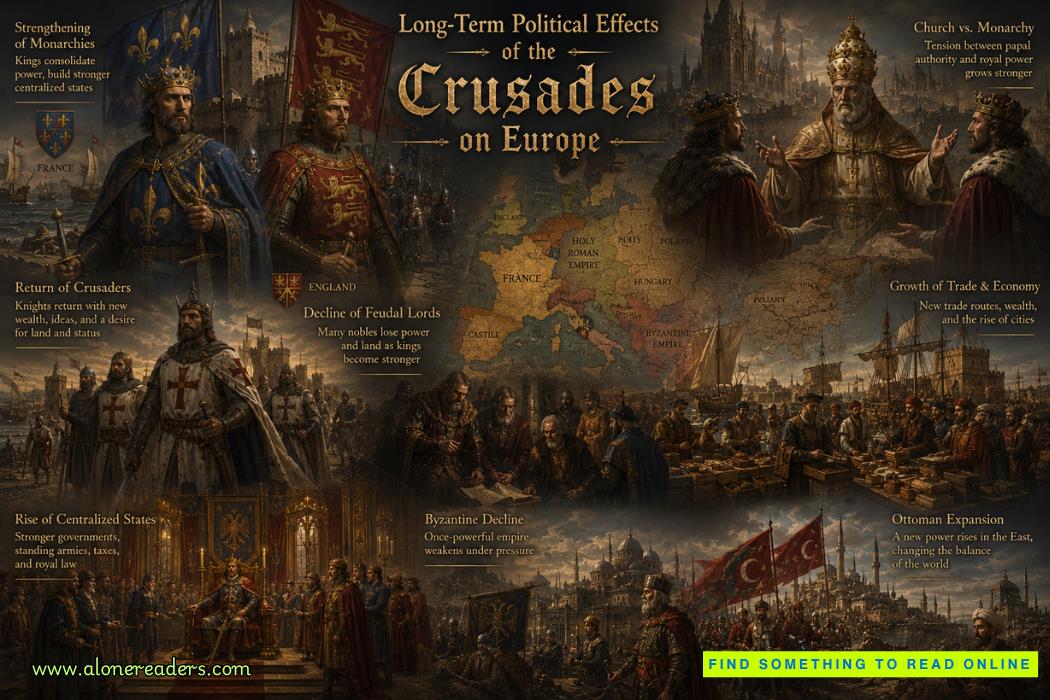
The Crusades are often remembered as a series of brutal religious wars fought between Christian Europe and the Muslim powers of the eastern Mediterranean between the late eleventh and thirteenth centuries. Popular imagination usually focuses on crusader knights marching toward Jerusalem, dramatic sieges, holy relics, and legendary battles between famous rulers such as Richard the Lionheart and Saladin. Yet the true significance of the Crusades extends far beyond the battlefields of the Middle East. While many discussions concentrate on their military or religious dimensions, the long-term political consequences of the Crusades fundamentally reshaped Europe itself. Over several centuries, the Crusades altered the balance of power between kings and nobles, transformed the authority of the Church, accelerated the decline of feudalism, strengthened monarchies, influenced diplomatic systems, and contributed to the rise of centralized states that would later dominate Europe.
When Pope Urban II called for the First Crusade in 1095 at the Council of Clermont, Europe was politically fragmented. Medieval Europe consisted largely of feudal territories controlled by local nobles who often possessed more practical authority than kings themselves. Political loyalty was personal rather than national. Dukes, counts, and barons commanded private armies, collected taxes, and governed lands with considerable independence. Monarchs frequently struggled to impose direct authority over their kingdoms. At the same time, the Roman Catholic Church possessed extraordinary political influence, often intervening in disputes between rulers and shaping the legitimacy of governments. The Crusades emerged within this unstable political environment and gradually transformed it in ways that few contemporaries could have predicted.
One of the most significant political effects of the Crusades was the strengthening of royal power. Crusading expeditions were enormously expensive. Nobles who joined the Crusades often sold land, borrowed heavily, or mortgaged estates to finance their journeys to the Holy Land. Many never returned. Others returned financially ruined. As a result, European monarchs gained opportunities to reclaim lands and expand royal domains. Kings in countries such as England and France increasingly consolidated authority by absorbing weakened noble territories into centralized royal administrations.
In France, the Crusades indirectly contributed to the expansion of Capetian royal power. During the early medieval period, French kings technically ruled France but possessed direct control over only limited territories around Paris. Powerful feudal lords exercised greater local authority than the monarchy. However, crusading campaigns drained noble resources and weakened regional independence. Over time, French monarchs exploited these conditions to strengthen centralized governance. Royal taxation systems improved, standing bureaucracies emerged, and monarchs became increasingly capable of enforcing laws across broader territories. By the late Middle Ages, the French monarchy had become one of the most powerful political institutions in Europe.
England experienced similar developments. Kings such as Henry II and later monarchs used crusading taxation systems to increase state revenues and administrative sophistication. Special taxes imposed to fund crusades required improved recordkeeping, more organized financial institutions, and broader royal oversight. Even though crusading campaigns themselves often failed militarily, the governmental mechanisms created to support them strengthened the English crown in lasting ways. The English monarchy gradually expanded judicial systems, centralized taxation, and administrative control, laying foundations for the future English state.
The Crusades also contributed significantly to the decline of feudalism. Feudal society relied heavily on decentralized military obligations. Lords provided protection, while vassals offered military service in return for land and status. However, crusading warfare exposed limitations within this traditional system. Long-distance military campaigns required large-scale financing, logistics, professional organization, and sustained supply networks that feudal structures struggled to provide efficiently. As monarchs increasingly relied on paid soldiers and organized taxation instead of feudal levies, centralized governments gained strength at the expense of local nobility.
The death of many nobles during crusading expeditions accelerated this transformation. Entire noble families sometimes disappeared, leaving estates vulnerable to royal acquisition or redistribution. Furthermore, crusading debts forced many aristocrats into financial dependence on monarchs or wealthy merchants. The political independence of feudal lords gradually weakened as centralized governments expanded their economic and military capacities. Over time, Europe shifted away from fragmented feudal authority toward more organized territorial states.
Another major political consequence of the Crusades was the changing relationship between Church and state. Initially, the Crusades represented the peak of papal political authority. Pope Urban II successfully mobilized thousands of knights and rulers across Europe under a unified religious banner. The papacy demonstrated an unprecedented ability to direct European politics beyond national borders. Participation in crusades became associated with spiritual salvation, and the Pope emerged as a central figure capable of influencing kings, nobles, and entire populations.
However, the long-term outcome proved more complicated. Although the papacy initially gained prestige, repeated crusading failures gradually damaged its credibility. The disastrous Fourth Crusade, which culminated in the sack of Constantinople in 1204 by fellow Christians rather than Muslims, deeply undermined moral confidence in crusading leadership. Later failed crusades further weakened public trust in papal authority. Many rulers began questioning whether the Church should dominate political and military affairs.
As monarchies grew stronger, kings increasingly resisted papal interference. Conflicts between secular rulers and the papacy intensified throughout the late medieval period. In France, King Philip IV openly challenged Pope Boniface VIII over taxation and royal sovereignty. Such confrontations reflected a broader shift in European politics: monarchs no longer viewed themselves merely as subordinate defenders of Christendom under papal guidance. Instead, they increasingly asserted independent national authority.
The Crusades also encouraged the development of more sophisticated diplomatic systems. European rulers encountered complex political realities in the eastern Mediterranean, where alliances often crossed religious boundaries. Crusader states negotiated with Muslim powers, Byzantine emperors, Italian merchant republics, and rival European factions. These interactions required more advanced diplomacy, treaty-making, intelligence gathering, and political negotiation.
Italian maritime republics such as Venice, Genoa, and Pisa gained enormous political influence during the Crusading era. These city-states provided ships, supplies, and commercial networks essential for crusading expeditions. In return, they secured trading privileges, ports, and political influence throughout the Mediterranean. Venice in particular emerged as a major political and economic power. The Fourth Crusade effectively became a Venetian geopolitical project, demonstrating how commercial interests increasingly shaped European political decisions.
The growing importance of trade during and after the Crusades contributed to the rise of urban political influence. Medieval towns expanded rapidly as Mediterranean commerce flourished. Merchants accumulated wealth and increasingly demanded political representation and legal protections. Kings often allied with urban merchants against feudal nobles because towns provided valuable tax revenue and economic stability. This alliance between monarchies and commercial classes helped accelerate political centralization across Europe.
The Crusades also had profound geopolitical consequences that reshaped Europe’s strategic outlook. Before the Crusades, European political attention remained largely regional. Most kingdoms focused on local rivalries, dynastic disputes, and nearby territorial conflicts. The crusading movement expanded European awareness of international politics, trade networks, and distant civilizations. European rulers increasingly viewed themselves as participants in broader continental and Mediterranean struggles.
This shift had lasting implications for the formation of European political identity. Although medieval Europe remained divided by language, ethnicity, and dynastic rivalry, the Crusades fostered a partial sense of collective Christian identity against external enemies. The idea of “Christendom” became politically significant. Rulers sometimes used crusading rhetoric to justify military campaigns within Europe itself, including wars against heretics, pagans, or political rivals. This ideological framework strengthened the connection between religion and political legitimacy for centuries.
At the same time, the Crusades intensified hostility between Christian and Muslim powers while also deepening divisions within Christianity itself. The sack of Constantinople during the Fourth Crusade permanently damaged relations between the Roman Catholic West and the Eastern Orthodox Byzantine Empire. Many Byzantines viewed Western crusaders as greedy invaders rather than protectors. This distrust weakened possibilities for Christian unity and contributed to the eventual vulnerability of Byzantium against Ottoman expansion.
The weakening of the Byzantine Empire became one of the most consequential geopolitical outcomes of the Crusades. Constantinople had long served as a buffer protecting Europe from eastern invasions. However, repeated crusader interventions destabilized Byzantine political structures. The catastrophic events of 1204 severely weakened imperial resources and legitimacy. Although Byzantium partially recovered afterward, it never regained its former strength. Eventually, the Ottoman Turks conquered Constantinople in 1453, fundamentally altering European geopolitics.
The Ottoman rise forced European states to adapt politically and militarily. New alliances formed, defensive strategies evolved, and centralized monarchies increasingly justified strong state power as necessary for resisting external threats. In this indirect but crucial way, the Crusades contributed to political developments extending far beyond the medieval period.
The Crusades also influenced the emergence of national consciousness in parts of Europe. Although medieval nationalism differed greatly from modern nationalism, repeated military mobilizations under royal leadership gradually strengthened political loyalty toward kingdoms rather than purely local feudal structures. English, French, and Spanish rulers increasingly portrayed themselves as defenders of distinct realms with shared interests and identities.
This trend became especially visible during the later medieval period. As centralized monarchies expanded, rulers developed more organized bureaucracies, legal systems, and military institutions tied directly to the crown. Political authority became increasingly territorial and institutional rather than purely personal or feudal. The Crusades did not singlehandedly create nation-states, but they accelerated processes that contributed to their eventual formation.
The political culture of Europe also changed in subtler ways because of the Crusades. The concept of holy war became deeply embedded in European political thinking. Rulers learned how effectively religious ideology could mobilize populations and legitimize military campaigns. Crusading language later influenced European expansionism, colonial ventures, and conflicts against perceived enemies of Christianity. Even after the Crusades themselves ended, their political logic survived.
Furthermore, the Crusades contributed to the militarization of political authority. Monarchs increasingly recognized the importance of organized armies, taxation systems, naval power, and logistical planning. Crusading campaigns required coordination across vast distances, encouraging administrative innovation and more sophisticated state structures. Over time, European governments became more capable of managing large-scale military operations, which strengthened centralized political systems.
The Iberian Peninsula offers another important example of long-term political transformation connected to crusading ideology. The Reconquista—the centuries-long Christian campaign against Muslim states in Spain and Portugal—became closely linked to broader crusading movements. Papal support, military orders, and religious propaganda reinforced the legitimacy of Christian expansion. The eventual unification of Spain under Ferdinand and Isabella created one of Europe’s first powerful centralized monarchies. This political consolidation later enabled Spanish global expansion and empire-building.
Military orders such as the Knights Templar, Knights Hospitaller, and Teutonic Knights also had important political effects. These organizations accumulated immense wealth, land, and influence across Europe. They operated almost like transnational institutions, sometimes rivaling secular rulers in power. Their existence demonstrated how the Crusades created new forms of organized political and military authority that transcended traditional feudal structures.
However, the growing power of these orders also alarmed monarchs. The suppression of the Knights Templar by King Philip IV of France in the early fourteenth century illustrates how increasingly powerful monarchies sought to eliminate competing institutions. The destruction of the Templars symbolized the broader triumph of centralized royal authority over independent medieval power networks.
By the late Middle Ages, many of the political systems that had defined early medieval Europe had fundamentally changed. Feudal fragmentation weakened, monarchies strengthened, urban economies expanded, diplomacy became more sophisticated, and state institutions grew more centralized. Although these developments resulted from many interconnected historical forces, the Crusades acted as a major catalyst accelerating political transformation across Europe.
The irony of the Crusades lies in the contrast between their original goals and their actual consequences. Militarily, most crusading efforts ultimately failed to secure lasting Christian control over the Holy Land. Spiritually, the violence and internal divisions of the crusading movement often contradicted the religious ideals it claimed to defend. Yet politically, the Crusades reshaped Europe in profound and lasting ways. They weakened feudal aristocracies, strengthened monarchies, transformed Church-state relations, expanded international diplomacy, stimulated urban political influence, and contributed to the rise of centralized states.
The Europe that emerged after the Crusading era differed dramatically from the fragmented continent that Pope Urban II addressed in 1095. Kings ruled with greater authority, governments possessed stronger institutions, and political identities increasingly centered around territorial states rather than purely feudal loyalties. In many respects, the political foundations of modern Europe were strengthened during the centuries shaped by the Crusades.
Ultimately, the long-term political effects of the Crusades reveal that history’s most important consequences are often indirect. The Crusaders marched eastward seeking religious victory in Jerusalem, but the most enduring transformations occurred back in Europe itself. The Crusades became a turning point not because they permanently conquered the Holy Land, but because they accelerated the political evolution of Europe from a fractured feudal society into a continent increasingly dominated by centralized states, ambitious monarchies, and expanding political institutions whose influence would shape world history for centuries to come.



 The Hundred Days Offensive: How the Allies Defeated Germany in World War I
 The Second Battle of the Marne: The Turning Point of World War I in 1918
 The Spring Offensive of 1918: Germany's Final Gamble to Win World War I
 The Treaty of Brest-Litovsk: How Russia Left World War I
 The Russian Revolution and World War I: How War Brought Down the Tsar
 The Zimmermann Telegram Explained: Germany's Secret Offer to Mexico in World War I