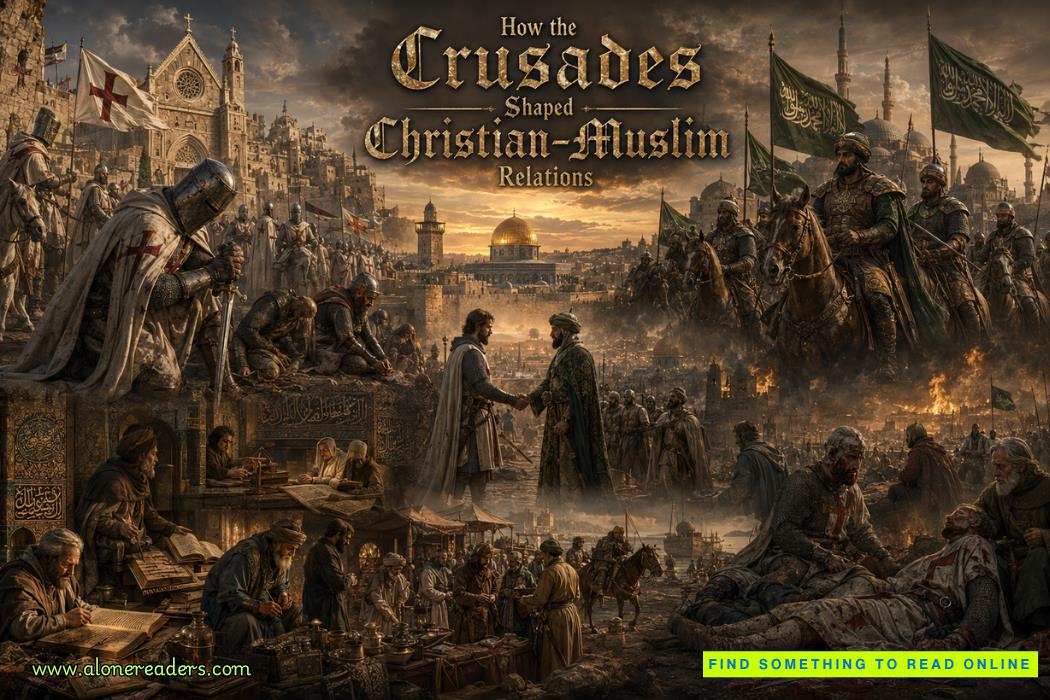
The Crusades remain among the most emotionally charged and historically transformative conflicts of the medieval world. More than a series of military campaigns, they became a defining moment in the relationship between Christianity and Islam, shaping perceptions, political structures, religious identities, and collective memories that continued for centuries long after the final crusader stronghold disappeared from the Middle East. Between the late eleventh century and the late thirteenth century, armies from Western Europe marched eastward under the banner of Christianity, claiming they sought to reclaim holy lands from Muslim control. Yet the consequences of these wars extended far beyond the battlefield. The Crusades altered how Christians and Muslims viewed one another, institutionalized religious hostility, encouraged mutual stereotypes, intensified political rivalries, and simultaneously opened channels for cultural exchange and intellectual transmission.
Before the Crusades began, relations between Christian and Muslim societies were far more complex than modern narratives often suggest. There were periods of warfare, but there were also long stretches of coexistence, diplomacy, trade, and cultural interaction. Muslims had ruled Jerusalem since the seventh century, yet Christian pilgrims generally retained access to holy sites for centuries. In regions such as Islamic Spain, Sicily, and parts of the eastern Mediterranean, Christians, Muslims, and Jews frequently interacted within shared commercial and intellectual environments. While religious differences certainly existed, the large-scale ideological framing of the other side as a permanent civilizational enemy had not yet hardened into the form that emerged during the Crusading era.
The turning point came in 1095 when Pope Urban II delivered his famous call to arms at the Council of Clermont. He urged Western Christians to take up arms and aid Eastern Christians while reclaiming Jerusalem from Muslim control. His speech transformed military action into a sacred religious obligation. Participants were promised spiritual rewards, including the remission of sins. This fusion of warfare and religious salvation fundamentally changed Christian attitudes toward Muslims. Muslims were increasingly portrayed in crusading propaganda not merely as political rivals but as enemies of God and obstacles to divine will. Religious rhetoric dehumanized the opponent, making violence appear spiritually justified.
The First Crusade achieved what many thought impossible. In 1099, crusader forces captured Jerusalem after a brutal siege. Contemporary chronicles described horrific massacres of Muslim and Jewish inhabitants. The violence left a deep scar in Muslim historical memory. To many Muslims, the crusaders appeared not as honorable warriors but as ruthless invaders driven by fanaticism and greed. The conquest of Jerusalem became one of the defining traumas of medieval Islamic consciousness. Although the Muslim world at the time was politically fragmented and initially slow to respond collectively, memories of the bloodshed gradually became central to later Islamic narratives about Western aggression.
The establishment of crusader states in the Levant further intensified tensions. European nobles created Christian kingdoms in territories surrounded largely by Muslim populations. These states depended heavily on military force and fortified castles to survive. Constant warfare became part of daily existence. Raids, sieges, shifting alliances, assassinations, and political betrayals created an atmosphere of continuous instability. Yet even amid conflict, practical realities forced interaction. Crusaders often traded with Muslim merchants, negotiated truces with Muslim rulers, and sometimes adopted aspects of local culture. This contradiction revealed one of the most fascinating aspects of the Crusades: hostility and cooperation existed simultaneously.
For the Muslim world, the Crusades gradually encouraged a stronger sense of political and religious unity. At the beginning, Muslim rulers were divided by dynastic conflicts and regional rivalries. However, the continued presence of the crusaders inspired increasing calls for jihad against the invaders. Leaders such as Nur ad-Din and later Salah ad-Din al-Ayyubi, known in Western history as Saladin, emerged as powerful symbols of Islamic resistance and unity. Saladin’s recapture of Jerusalem in 1187 became one of the most celebrated achievements in Islamic history. Unlike the massacres associated with the First Crusade, Saladin allowed many Christians to leave the city peacefully after its surrender. Muslim chroniclers frequently highlighted this contrast to portray Islamic leadership as morally superior to the brutality of the crusaders.
Saladin’s reputation later became extraordinary in both Muslim and Christian historical memory. In the Islamic world, he was celebrated as the ideal righteous ruler who defended Islam against foreign aggression. In Europe, despite being considered an enemy, he gained admiration for his chivalry, intelligence, and military skill. This level of mutual respect between elite figures demonstrated that even during intense religious wars, perceptions of the opposing side were not always entirely simplistic. Nevertheless, admiration for certain individuals did not remove the broader hostility that existed between the two societies.
The Crusades also strengthened religious identity within Christian Europe itself. The campaigns encouraged the idea of a unified Christian world defending itself against external threats. The authority of the papacy expanded significantly because the Church presented itself as the organizer and spiritual leader of holy warfare. Over time, crusading ideology spread beyond the Middle East and influenced conflicts within Europe, including wars against heretics, pagans, and political enemies of the papacy. As a result, the concept of religious warfare became deeply rooted in medieval Christian political culture. Muslims increasingly became part of a symbolic “other” against which Christian unity and identity were defined.
At the same time, Muslim societies developed changing perceptions of Europeans. Before the Crusades, many Muslims regarded Western Europeans as relatively unimportant compared to the sophisticated civilizations of the Byzantine Empire, Persia, or the Islamic caliphates. The crusader invasions forced Muslims to pay much greater attention to Latin Christian powers. European crusaders were often described in Islamic writings as fierce in battle but culturally less refined. Over time, however, Muslim rulers recognized the growing political and military significance of European kingdoms. This realization contributed to more organized diplomatic and military strategies toward the West.
One of the most overlooked consequences of the Crusades was the enormous level of cultural exchange they produced. Despite the violence and warfare, contact between Christian and Muslim societies accelerated the spread of ideas, technologies, and knowledge. Europeans encountered advanced Islamic achievements in medicine, mathematics, astronomy, architecture, navigation, agriculture, and philosophy. The translation of Arabic texts into Latin introduced Western scholars to the works of ancient Greek thinkers that had been preserved and expanded upon by Muslim intellectuals. Scientific and philosophical knowledge transmitted through Islamic civilization played a major role in the intellectual awakening that later contributed to the European Renaissance.
Trade also expanded dramatically during and after the Crusading era. Italian maritime powers such as Venice, Genoa, and Pisa gained enormous wealth from commerce with the eastern Mediterranean. Valuable goods including spices, silk, sugar, perfumes, textiles, and precious metals entered Europe in increasing quantities. In return, European merchants established long-lasting commercial networks throughout the Muslim world. Economic cooperation often continued even when religious hostility remained strong. This contradiction demonstrated that practical interests frequently outweighed ideological divisions.
The Crusades also influenced language, literature, and mythology in both Christian and Muslim civilizations. In Europe, crusading epics and chronicles often portrayed Muslims in exaggerated and distorted ways. Muslims were sometimes falsely depicted as barbaric idol worshippers despite Islam’s strong emphasis on monotheism. These literary portrayals reinforced stereotypes that shaped European attitudes for centuries. Meanwhile, in the Islamic world, crusaders were remembered as foreign invaders associated with destruction and occupation. These memories became deeply embedded in broader narratives of resistance against outside domination.
Although the Crusades officially ended with the fall of Acre in 1291, their psychological and political effects continued long afterward. The memory of the Crusades kept influencing Christian–Muslim relations for centuries. During the expansion of the Ottoman Empire into Europe, many Europeans viewed their conflicts with the Ottomans as a continuation of the Crusading struggle. Likewise, some Muslim narratives later portrayed European colonial expansion as a renewed form of crusading aggression. The symbolic power of the Crusades endured because they represented more than territorial wars; they became symbols of civilizational confrontation.
During the nineteenth and twentieth centuries, European colonialism in the Middle East revived historical memories connected to the Crusades. Some colonial leaders openly used crusading imagery and symbolism. When French General Henri Gouraud reportedly stood near Saladin’s tomb in Damascus in 1920 and declared, “We have returned,” many interpreted the statement as a symbolic continuation of medieval conflict. Whether fully accurate or not, such gestures strengthened Muslim suspicions regarding Western intentions in the region. European imperialism, missionary activity, and military intervention often became linked in popular memory with the earlier Crusading experience.
Modern political rhetoric has occasionally reinforced these historical associations. After the attacks of September 11, 2001, the use of the word “crusade” by certain Western political figures created major controversy in Muslim-majority countries. Even when used casually, the term carried centuries of emotional and historical significance. For many Muslims, it evoked memories of invasion, religious warfare, and foreign domination. This demonstrated how deeply the legacy of the Crusades still resonates within collective memory. Historical narratives formed nearly a thousand years ago continue to influence political language and international perceptions in the modern world.
However, focusing only on conflict risks oversimplifying historical reality. The Crusades also created moments of diplomacy, coexistence, and mutual influence. Muslim and Christian rulers frequently negotiated treaties, exchanged prisoners, and established trade agreements. Intellectual contact enriched both civilizations. In some frontier regions, ordinary people adapted pragmatically to multicultural environments. Shared experiences of warfare, commerce, and survival produced forms of interaction that cannot simply be reduced to hatred alone.
Modern historians increasingly emphasize that the Crusades should not be understood as an eternal clash between Christianity and Islam. Medieval societies were internally divided, politically fragmented, and motivated by many factors beyond religion. Economic ambitions, dynastic rivalries, political legitimacy, territorial expansion, and personal gain all played important roles. Many Muslims fought alongside crusaders against rival Muslim rulers, while some Eastern Christians distrusted or resisted Western crusaders. The historical reality was therefore far more complicated than a simple conflict between two unified civilizations.
Nevertheless, the emotional legacy of the Crusades remains powerful because religion was deeply connected to identity during the medieval era. Sacred cities, holy places, and divine missions carried immense spiritual importance. Violence committed in the name of religion created wounds that survived long after political conditions changed. The Crusades became a reference point through which later generations interpreted new conflicts between the Islamic world and the West.
In modern discussions, the Crusades are often invoked either as examples of Western aggression or as heroic religious campaigns. Both interpretations can become distorted when removed from historical complexity. Contemporary scholarship increasingly attempts to move beyond simplistic narratives by examining the Crusades within broader contexts of medieval politics, economics, theology, and intercultural exchange. Understanding the Crusades requires recognizing both the brutality and the interaction they produced.
Ultimately, the Crusades reshaped Christian–Muslim relations by transforming regional conflicts into long-lasting civilizational memories. They strengthened religious identities, encouraged mutual suspicion, and created narratives of sacred struggle that survived for centuries. At the same time, they stimulated trade, intellectual exchange, diplomatic engagement, and cultural interaction between two major civilizations. The legacy of the Crusades therefore remains deeply paradoxical. They were wars marked by extraordinary violence, yet they also became channels through which ideas, technologies, and cultural influences crossed borders. They fostered hatred, but they also generated curiosity and respect between rivals who could neither fully destroy nor completely ignore one another.
Even today, discussions surrounding religion, East–West relations, colonialism, and political conflict often echo themes shaped during the Crusading period. The Crusades continue to matter not only because of what happened on medieval battlefields, but also because of how those events were remembered, retold, and transformed into powerful symbols over the centuries. Their greatest historical impact may not have been the territories gained or lost, but rather the enduring psychological and cultural framework they created between the Christian and Muslim worlds.



 The Hundred Days Offensive: How the Allies Defeated Germany in World War I
 The Second Battle of the Marne: The Turning Point of World War I in 1918
 The Spring Offensive of 1918: Germany's Final Gamble to Win World War I
 The Treaty of Brest-Litovsk: How Russia Left World War I
 The Russian Revolution and World War I: How War Brought Down the Tsar
 The Zimmermann Telegram Explained: Germany's Secret Offer to Mexico in World War I










