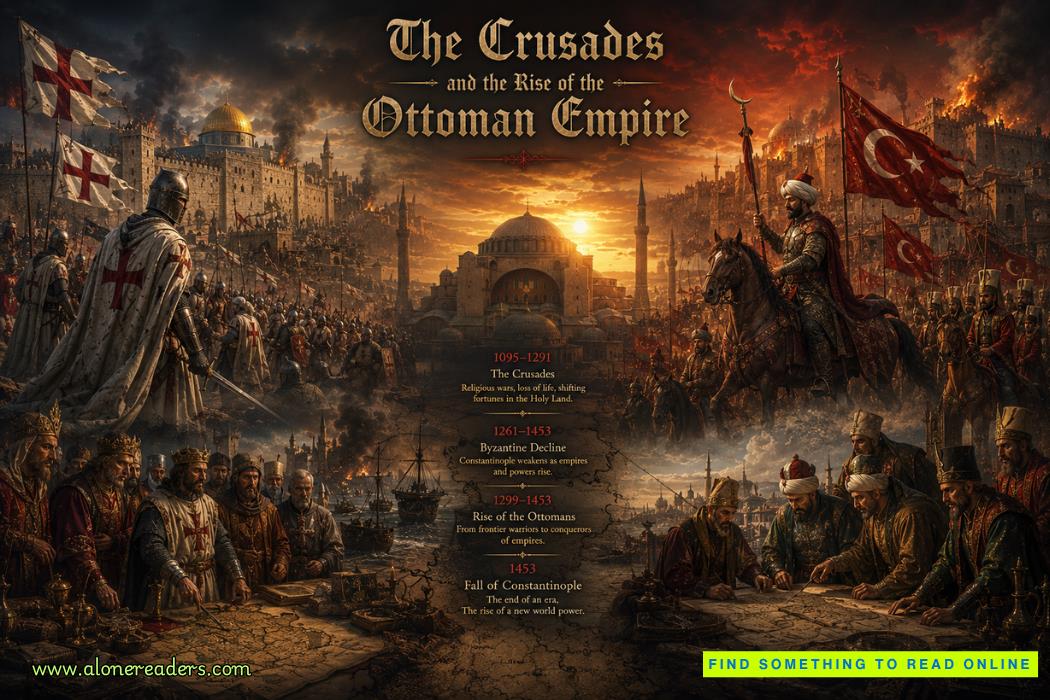
The Crusades are often remembered as a violent series of religious wars between Christian Europe and the Islamic world, fought primarily over control of Jerusalem and other sacred territories in the Holy Land. Yet the consequences of these conflicts extended far beyond the deserts of the Levant. The Crusades fundamentally altered the political, economic, and military structure of Europe and the Middle East, destabilized ancient empires, redirected trade routes, intensified religious hostility, and unintentionally created the conditions that allowed one of history’s greatest powers—the Ottoman Empire—to emerge. The rise of the Ottomans was not a direct result of the Crusades alone, but the Crusading era fractured older political systems so severely that a new imperial force eventually filled the vacuum.
When the First Crusade began in 1095, the medieval world looked dramatically different from the one that existed three centuries later. The Byzantine Empire still controlled significant territory in Anatolia and southeastern Europe. The Islamic world, though politically divided, remained economically sophisticated and militarily formidable. Western Europe was fragmented into feudal kingdoms with limited central authority. Few observers could have predicted that by 1453 Constantinople itself would fall to the Ottoman Turks, transforming the balance of power across Europe, Asia, and the Mediterranean.
The origins of the Crusades were rooted in both religion and geopolitics. In the late eleventh century, the Byzantine Emperor Alexios I Komnenos sought military assistance from Western Europe against the advancing Seljuk Turks, who had defeated Byzantine forces at the Battle of Manzikert in 1071. That defeat was catastrophic for Byzantium because it opened much of Anatolia—the empire’s military and economic heartland—to Turkish settlement and conquest. Pope Urban II responded to the Byzantine appeal during the Council of Clermont in 1095, calling upon Christian knights to reclaim Jerusalem and defend Eastern Christians.
Urban’s speech ignited religious fervor across Europe. Thousands of knights, nobles, peasants, and adventurers joined what became the First Crusade. The Crusades were not merely military expeditions; they were presented as sacred missions promising spiritual salvation. Crusaders believed participation could absolve sins and guarantee divine favor. This fusion of warfare and religious devotion created a powerful ideological movement that shaped European society for centuries.
The First Crusade achieved stunning success. Crusader armies captured Jerusalem in 1099 after brutal sieges and massacres that shocked both Muslim and Jewish communities. Several Crusader states emerged, including the Kingdom of Jerusalem, the County of Tripoli, and the Principality of Antioch. These Latin Christian states established a European presence deep within the Middle East. However, their survival depended on continuous military support from Europe, making them politically fragile from the beginning.
The Muslim world gradually responded with increasing unity. Leaders such as Zengi, Nur ad-Din, and eventually Salah ad-Din, known in the West as Saladin, began consolidating fragmented Muslim territories. Saladin’s victory at the Battle of Hattin in 1187 and his recapture of Jerusalem represented a major turning point. The Crusaders discovered that temporary victories could not compensate for their geographical isolation and limited manpower. Subsequent Crusades launched by European kings failed to permanently reverse Muslim advances.
While the Crusades continued intermittently for nearly two centuries, their broader consequences became increasingly complex. One of the most devastating moments occurred during the Fourth Crusade in 1204. Instead of attacking Muslim territories, Crusaders turned against Constantinople itself, the capital of the Byzantine Empire. The city was looted, burned, and occupied by Latin Crusaders. Churches, libraries, palaces, and ancient treasures were destroyed or stolen on an enormous scale.
The sack of Constantinople permanently weakened Byzantium. This event arguably did more to pave the way for Ottoman expansion than any Muslim military campaign of the era. Although the Byzantines eventually retook the city in 1261, the empire never fully recovered economically or militarily. Internal political instability increased, regional territories broke away, and Byzantine authority deteriorated across Anatolia and the Balkans.
At the same time, Turkish power in Anatolia continued evolving. After the decline of the Seljuk Sultanate of Rum following Mongol invasions in the thirteenth century, numerous small Turkish principalities known as beyliks emerged. Among them was a relatively minor frontier state led by Osman I near the Byzantine border in northwestern Anatolia. This principality eventually became known as the Ottoman state.
The conditions that enabled Ottoman growth were deeply connected to the post-Crusade environment. Byzantium was exhausted. Rival Christian powers such as Venice and Genoa prioritized trade dominance over Byzantine survival. The Crusader states in the Levant had largely collapsed by the late thirteenth century, eliminating buffer zones between Muslim and Christian territories. Meanwhile, Turkish frontier warriors known as ghazis were motivated by both economic opportunity and religious zeal.
Osman and his successors skillfully expanded into weakened Byzantine territories. Unlike fragmented European feudal lords, the early Ottomans developed a centralized military structure and flexible administrative system. Their rise reflected not only military strength but also political adaptability. They absorbed diverse populations, incorporated Christians into their bureaucracy, and utilized both Islamic legitimacy and pragmatic governance.
The Ottomans also benefited from innovations in military organization. The Janissaries, elite infantry units recruited through the devshirme system, became one of the most disciplined military forces in the medieval world. Ottoman armies effectively combined cavalry, infantry, siege technology, and gunpowder weapons. As European kingdoms struggled with dynastic conflicts and feudal rivalries, the Ottomans steadily expanded across southeastern Europe.
During the fourteenth century, the Ottomans crossed into the Balkans and captured strategic territories in modern-day Greece, Bulgaria, Serbia, and North Macedonia. Byzantine emperors increasingly became dependent on Ottoman assistance in internal civil wars, accelerating imperial decline. The Battle of Kosovo in 1389 became symbolic of Ottoman dominance in the Balkans, though the political realities were more complicated than later nationalist myths suggested.
European reactions to Ottoman expansion were deeply influenced by memories of the Crusades. Many Christian rulers viewed the Ottomans through the same religious lens once applied to earlier Muslim powers. Calls for new Crusades emerged repeatedly. However, Europe itself was divided by internal rivalries, the Hundred Years’ War, papal disputes, and economic instability. The unity that had briefly characterized the First Crusade no longer existed.
One of the most significant confrontations occurred at the Battle of Nicopolis in 1396, where a coalition of European Crusaders attempted to halt Ottoman expansion. The campaign ended in disaster. Ottoman Sultan Bayezid I decisively defeated the Crusader army, demonstrating that medieval European knights were no longer invincible. The defeat shocked Christian Europe and revealed the growing military sophistication of the Ottoman state.
Although the Ottoman Empire temporarily suffered a crisis after Timur defeated Bayezid at the Battle of Ankara in 1402, the empire recovered remarkably quickly. Ottoman rulers rebuilt their authority and resumed expansion within decades. This resilience highlighted the strength of Ottoman administrative institutions compared to many contemporary medieval states.
The final collapse of Byzantium came under Sultan Mehmed II, often called Mehmed the Conqueror. By the mid-fifteenth century, Constantinople was largely isolated, economically weakened, and surrounded by Ottoman territory. European assistance was limited and inconsistent. In 1453, Ottoman forces besieged the city using massive cannons capable of breaching the ancient Theodosian Walls that had protected Constantinople for centuries.
The fall of Constantinople was one of the most transformative events in world history. For many Europeans, it represented the definitive end of the medieval era. The last remnants of the Roman Empire disappeared, and the Ottoman Empire emerged as a dominant imperial power controlling strategic trade routes between Europe and Asia.
Ironically, the Crusades had contributed significantly to this outcome. The Fourth Crusade crippled Byzantium beyond recovery. Continuous warfare destabilized the eastern Mediterranean. Economic competition among Christian states weakened coordinated resistance. Furthermore, Crusader violence deepened distrust between Eastern Orthodox Christians and Western Catholics, making united defense against the Ottomans far more difficult.
The Ottoman Empire inherited and transformed many aspects of the Byzantine world. Constantinople, renamed Istanbul over time, became the Ottoman capital and one of the largest cities on Earth. Mehmed II consciously styled himself as a successor to Roman imperial authority. Ottoman governance blended Turkish, Persian, Islamic, and Byzantine traditions into a sophisticated imperial structure.
The rise of the Ottoman Empire also reshaped Europe itself. Fear of Ottoman expansion encouraged military modernization among European states. New fortification systems, standing armies, and centralized taxation emerged partly in response to the Ottoman threat. The Ottomans reached the gates of Vienna in 1529 and again in 1683, becoming a defining geopolitical force for centuries.
Economically, Ottoman control over eastern trade routes contributed indirectly to the European Age of Exploration. European powers sought alternative maritime routes to Asia that bypassed Ottoman-controlled territories. In this sense, the legacy of the Crusades and Ottoman expansion extended all the way to the voyages of Christopher Columbus and Vasco da Gama.
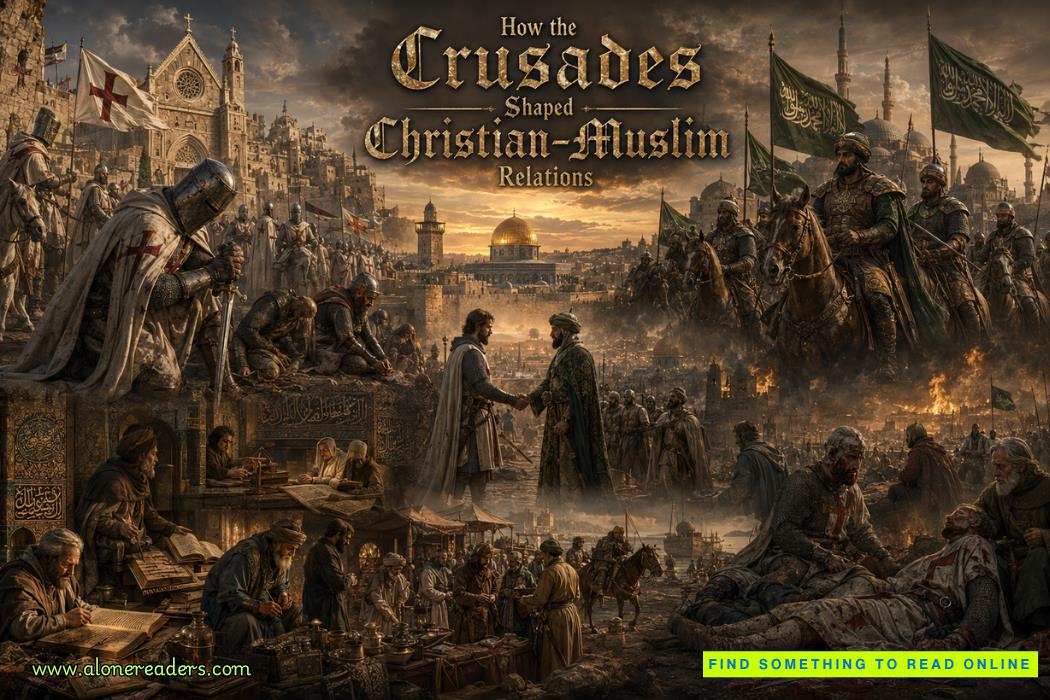
Religiously and culturally, the Crusades left enduring scars. Christian-Muslim relations were shaped for centuries by memories of massacres, sieges, and holy wars. Yet the period also facilitated cultural exchange. Europeans encountered advanced Islamic scholarship in mathematics, medicine, philosophy, architecture, and science. Trade networks expanded dramatically across the Mediterranean. Luxury goods, technologies, and intellectual ideas circulated between civilizations despite ongoing conflict.
The Ottoman Empire itself became remarkably diverse. Christians, Jews, Arabs, Greeks, Armenians, Slavs, Turks, and many other groups lived within Ottoman territory. Through systems such as the millet structure, various religious communities retained limited autonomy under Ottoman rule. Although inequalities existed, the empire often proved more administratively flexible than many contemporary European kingdoms.
Modern interpretations of the Crusades and Ottoman rise remain politically sensitive. Nationalist movements, religious ideologies, and modern geopolitical tensions have all shaped how these events are remembered. Some portray the Crusades as noble religious missions, while others emphasize their brutality and imperial ambition. Similarly, the Ottoman Empire has been remembered both as a tolerant multicultural empire and as an expansionist military power.
What remains undeniable is that the Crusades transformed the medieval world in ways their participants could never have anticipated. European Crusaders set out to secure holy sites and defend Christianity, but the long-term consequences included the weakening of Byzantium, the restructuring of Mediterranean trade, the militarization of religious identity, and the emergence of the Ottoman Empire as a global superpower.
The relationship between the Crusades and Ottoman expansion demonstrates one of history’s most important lessons: major historical events rarely produce the outcomes their participants expect. The Crusaders hoped to strengthen Christian dominance in the East, yet their actions helped create the conditions for centuries of Ottoman supremacy. Empires collapsed, new powers emerged, and entire civilizations were reshaped through cycles of conflict, adaptation, and transformation.
By the time the Ottoman Empire stood at the height of its power under rulers such as Suleiman the Magnificent, the medieval Crusading world had vanished completely. The political map of Europe and the Middle East had been redrawn. Ancient empires were gone, trade networks had shifted, and new global powers were beginning to rise. Yet the memory of the Crusades continued to echo through Ottoman-European relations for generations, influencing diplomacy, warfare, religion, and historical identity far into the modern age.



 The Hundred Days Offensive: How the Allies Defeated Germany in World War I
 The Second Battle of the Marne: The Turning Point of World War I in 1918
 The Spring Offensive of 1918: Germany's Final Gamble to Win World War I
 The Treaty of Brest-Litovsk: How Russia Left World War I
 The Russian Revolution and World War I: How War Brought Down the Tsar
 The Zimmermann Telegram Explained: Germany's Secret Offer to Mexico in World War I










