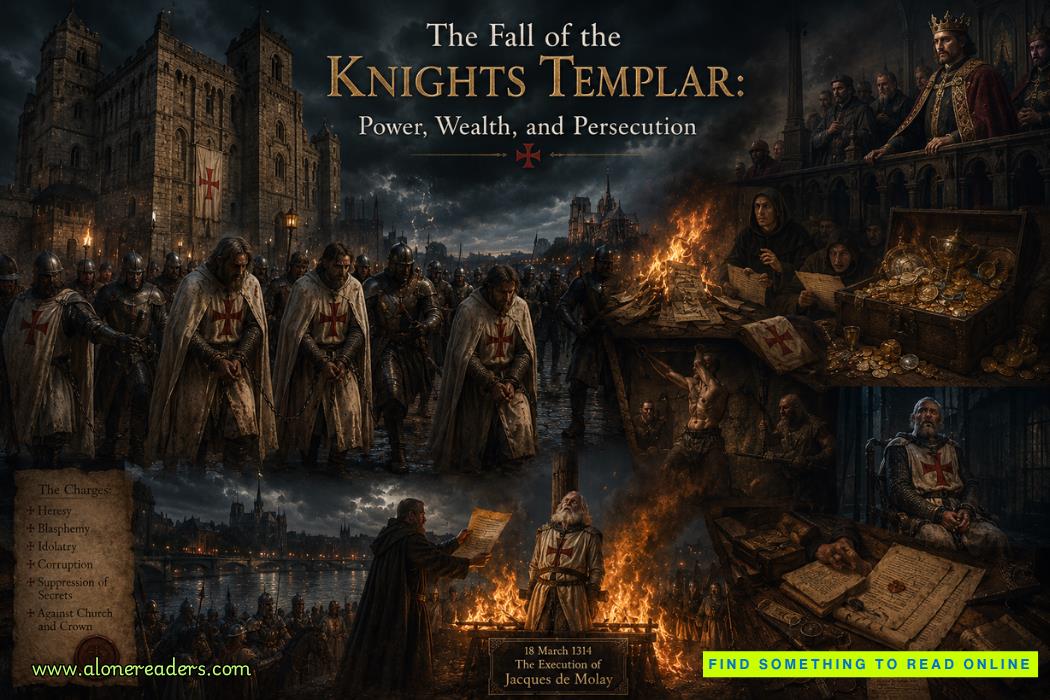
The Knights Templar remain one of the most mysterious and controversial organizations in medieval history. Their rise from a small band of impoverished warrior-monks to one of the wealthiest and most influential institutions in Europe was extraordinary, but their sudden destruction shocked the Christian world and permanently transformed the balance of power between monarchs, the Church, and military religious orders. The fall of the Knights Templar was not simply the collapse of a military organization; it was the violent destruction of a financial empire entangled in politics, religion, fear, and greed. Their downfall exposed the fragile relationship between kings and the Church during the late Middle Ages and demonstrated how wealth and influence could quickly become dangerous liabilities in a world ruled by suspicion and ambition.
The origins of the Knights Templar can be traced to the aftermath of the First Crusade. After Christian forces captured Jerusalem in 1099, European pilgrims began traveling to the Holy Land in large numbers. These journeys were extremely dangerous because roads were filled with bandits, raiders, and hostile forces. Around 1119, a small group of French knights led by Hugues de Payens formed a religious military brotherhood dedicated to protecting Christian pilgrims. They established themselves on the Temple Mount in Jerusalem, near the site believed to be the ancient Temple of Solomon. Because of this location, they became known as the Poor Fellow-Soldiers of Christ and of the Temple of Solomon, later shortened to the Knights Templar.
Although they began in poverty, the Templars rapidly gained support from European nobles and Church leaders. Their combination of monastic discipline and military skill fascinated medieval society. Unlike ordinary knights, the Templars took vows of poverty, chastity, and obedience while simultaneously fighting in brutal wars against Muslim powers during the Crusades. This unique fusion of monk and warrior created a powerful religious image that inspired admiration across Europe. In 1129, the order received official recognition from the Church at the Council of Troyes, largely due to the support of the influential monk Bernard of Clairvaux. Bernard described the Templars as holy warriors serving God directly through battle, giving them enormous religious legitimacy.
Over the next two centuries, the Knights Templar expanded into an international institution with properties, castles, farms, ports, churches, and financial centers spread across Europe and the Middle East. Wealth poured into the order from kings, nobles, merchants, and ordinary believers who donated money or land to support the Crusades. The Templars became exempt from many taxes and answered directly to the Pope rather than local rulers. This independence allowed them to operate with unusual freedom and accumulate extraordinary economic power.
Their military reputation also became legendary. Templar knights were considered some of the most disciplined and fearless warriors in medieval warfare. They played major roles in important Crusader battles and defended critical fortresses throughout the Holy Land. Their white mantles marked with red crosses became symbols of Christian militancy and sacrifice. However, military success alone did not explain their growing influence. The Templars also revolutionized medieval finance in ways that resembled early international banking systems.
Pilgrims traveling to the Holy Land often deposited money at a Templar house in Europe and received coded financial documents that could be redeemed in the East. This reduced the danger of robbery during long journeys. The order also provided loans to nobles and monarchs, managed estates, transferred funds across continents, and safeguarded treasures. The Templars effectively became one of the first multinational financial institutions in European history. Their wealth became so immense that kings themselves relied on Templar resources and expertise. In Paris, the royal treasury of France was sometimes stored within the secure walls of the Templar fortress known as the Paris Temple.
Yet the very factors that created Templar success eventually contributed to their destruction. By the late thirteenth century, the Crusader states in the Holy Land were collapsing under pressure from Muslim forces led by powerful leaders such as Saladin and later the Mamluks. In 1291, the city of Acre, the final major Crusader stronghold, fell to Muslim armies. This catastrophic defeat effectively ended the Crusader presence in the Holy Land and severely damaged the purpose of military orders like the Templars.
Without Jerusalem or major Crusader territories to defend, critics increasingly questioned why the Templars continued to exist. Their immense wealth appeared suspicious at a time when they no longer achieved significant military victories. Rumors spread across Europe accusing the order of arrogance, secrecy, corruption, and heresy. Because Templar rituals were conducted privately, outsiders often imagined dark ceremonies and forbidden practices occurring within their fortified compounds. Medieval societies frequently feared organizations that operated beyond ordinary public oversight, especially those possessing enormous wealth and political independence.
The most dangerous enemy of the Templars emerged in the form of King Philip IV of France. Philip was a determined and ruthless monarch struggling with severe financial problems caused by wars and political conflicts. He had already demonstrated a willingness to confront powerful institutions, including the papacy itself. Philip owed enormous debts to the Templars and deeply resented their financial influence. Destroying the order offered multiple advantages: he could erase debts, confiscate wealth, and eliminate an organization operating independently within his kingdom.
At the same time, the papacy was politically weakened. Pope Clement V, the first pope of the Avignon Papacy period, depended heavily on French support and remained vulnerable to pressure from Philip IV. This political imbalance created the perfect conditions for a coordinated attack on the Templars.
On Friday, October 13, 1307, one of the most dramatic mass arrests in medieval history unfolded across France. Acting under secret royal orders, French officials simultaneously arrested hundreds of Templars at dawn. The operation shocked Europe because the Templars had long been respected defenders of Christianity. The accusations against them were severe and sensational. They were charged with heresy, blasphemy, idol worship, obscene initiation rituals, and denying Christ.
Many of the accusations were likely fabricated or exaggerated. Under torture, numerous Templars confessed to crimes they later denied once torture ceased. Medieval inquisitorial methods were brutal and designed to force admissions regardless of truth. Prisoners were stretched on racks, burned, starved, and psychologically terrorized. Confessions extracted through torture became the primary weapon used to destroy the order.
One of the most notorious accusations involved claims that Templars worshipped a mysterious idol known as Baphomet. Others alleged that recruits spat on crosses during initiation ceremonies or engaged in immoral acts. Modern historians generally view these allegations as politically motivated inventions designed to justify persecution. The secrecy surrounding Templar ceremonies made it easy for enemies to spread horrifying rumors that frightened the public.
Despite Philip’s determination, not all European rulers immediately accepted the accusations. In some kingdoms, investigations found little evidence of heresy, and Templars were treated more leniently. However, the pressure exerted by France and the papacy gradually overwhelmed resistance. Pope Clement V eventually ordered investigations throughout Christian Europe. Although many inquiries produced weak or contradictory evidence, the political momentum against the order continued to grow.
The Templars faced another critical disadvantage: their organizational structure depended heavily on obedience and secrecy. Members were trained to follow commands without resistance, and the order lacked the ability to mobilize military force quickly against coordinated royal authority. Furthermore, many ordinary people struggled to distinguish between genuine evidence and confessions extracted under torture. Fear, propaganda, and political manipulation combined to isolate the Templars from broader public support.
In 1312, under intense pressure from Philip IV, Pope Clement V officially dissolved the Knights Templar during the Council of Vienne. Importantly, the order was not formally condemned as heretical in a definitive theological sense; instead, it was suppressed for the sake of preserving Church unity and avoiding scandal. Nevertheless, the practical consequences were devastating. Templar properties were seized, their organizational structure destroyed, and surviving members dispersed or imprisoned.
Some former Templars joined other military orders such as the Hospitallers, while others disappeared into ordinary society. In Portugal, portions of the order effectively survived under a new name, the Order of Christ, which later played an important role during the Age of Exploration. However, in France, Philip IV pursued harsher measures.
The final tragedy came with the execution of Jacques de Molay, the last Grand Master of the Knights Templar. After years of imprisonment, de Molay publicly withdrew earlier confessions and proclaimed the innocence of the order. His defiance enraged the French monarchy. On March 18, 1314, Jacques de Molay and another senior Templar leader were burned alive on an island in the Seine River in Paris.
According to later legend, de Molay cursed both Pope Clement V and King Philip IV from the flames, summoning them before divine judgment within a year. Remarkably, both men died soon afterward, fueling myths that the Templars possessed supernatural power or divine favor. These dramatic events transformed the fall of the Templars from a political purge into one of history’s enduring legends.
The destruction of the Knights Templar reflected broader transformations occurring in medieval Europe. Powerful monarchies were expanding centralized authority and increasingly challenging institutions that operated independently of royal control. The papacy itself was weakening politically after conflicts with secular rulers. The Templars represented an older Crusading world where international religious military orders possessed immense autonomy. Their downfall symbolized the decline of that era.
Economics also played a central role. Medieval rulers desperately needed money to fund wars, administration, and political ambitions. Organizations with large independent financial networks became tempting targets. The persecution of the Templars demonstrated how economic envy and debt could be transformed into religious accusations and political violence. The pattern would appear repeatedly throughout history whenever governments sought to seize wealth from vulnerable groups.
After the order vanished, myths surrounding the Knights Templar expanded dramatically. Rumors claimed they had hidden enormous treasures before the arrests. Others believed surviving Templars escaped with sacred relics such as the Holy Grail or secret religious knowledge. Over centuries, the Templars became associated with conspiracies, secret societies, occult traditions, and hidden power networks. Many of these legends lack historical evidence, yet they persist because the dramatic destruction of the order created an atmosphere of mystery unlike almost any other medieval event.
Modern popular culture has further amplified these myths through novels, films, games, and conspiracy theories. Yet beneath the legends lies a more historically significant reality. The Knights Templar were pioneers of international finance, military organization, and administrative efficiency during the medieval period. Their rise demonstrated the possibilities created by religious unity and Crusading zeal, while their fall revealed the dangers of concentrated wealth and political vulnerability.
The collapse of the Templars also exposes the terrifying power of coordinated propaganda. Once the French crown and papacy aligned against the order, even an institution respected across Christendom struggled to defend itself. Torture, fear, rumor, and public spectacle proved capable of destroying reputations built over two centuries. The Templars discovered too late that military strength and economic influence offered little protection against political isolation.
Today, the story of the Knights Templar continues to fascinate historians because it combines nearly every element of medieval drama: Crusades, religion, warfare, finance, conspiracy, royal ambition, torture, and martyrdom. Their downfall was not inevitable, but it emerged from a dangerous convergence of political greed, economic desperation, weakening Crusader ideals, and institutional secrecy. The order that once protected pilgrims and guarded Christian strongholds ultimately became the victim of the very powers it had long served.
The fall of the Knights Templar remains one of history’s clearest examples of how rapidly fortune can reverse when wealth, influence, and political hostility collide. From holy warriors celebrated across Europe to prisoners condemned as heretics, the Templars experienced a transformation so dramatic that it permanently shaped medieval memory. Their destruction marked the end of one of the most powerful military-religious organizations ever created and left behind a legacy that still echoes through history, legend, and popular imagination centuries later.



 The Hundred Days Offensive: How the Allies Defeated Germany in World War I
 The Second Battle of the Marne: The Turning Point of World War I in 1918
 The Spring Offensive of 1918: Germany's Final Gamble to Win World War I
 The Treaty of Brest-Litovsk: How Russia Left World War I
 The Russian Revolution and World War I: How War Brought Down the Tsar
 The Zimmermann Telegram Explained: Germany's Secret Offer to Mexico in World War I