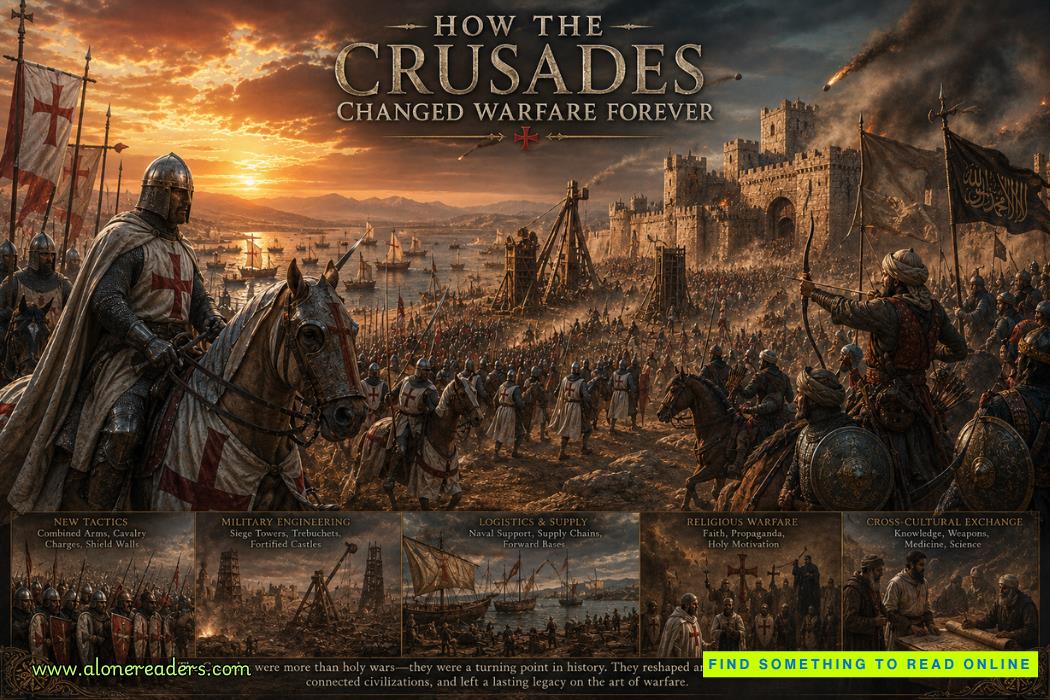
The Crusades were far more than a series of religious wars fought between Christian Europe and the Islamic powers of the Middle East. Between the late eleventh century and the late thirteenth century, these campaigns reshaped military organization, battlefield tactics, siege warfare, logistics, fortification engineering, naval operations, and the psychological nature of warfare itself. The Crusades became one of the greatest military laboratories of the medieval world, exposing European armies to unfamiliar climates, technologies, enemies, and methods of combat that forced rapid adaptation. By the time the Crusading era ended, warfare in Europe had evolved dramatically from the relatively localized feudal conflicts that existed before the First Crusade.
Before the Crusades began in 1096, much of European warfare was fragmented and regional. Armies were often temporary feudal levies raised by local lords, and campaigns were generally short because soldiers could not remain away from their lands for extended periods. Battles frequently revolved around armored knights charging on horseback, while siege operations were often primitive and poorly coordinated. Logistics were limited, military communication was weak, and strategic planning rarely extended beyond local territorial disputes. The First Crusade changed this completely because it required tens of thousands of soldiers from different kingdoms and languages to travel thousands of kilometers across hostile territory toward Jerusalem. This unprecedented military expedition forced Europe to think about warfare on a continental and international scale for the first time.
One of the most important transformations brought by the Crusades was the development of advanced siege warfare. The Middle East contained some of the strongest fortifications in the medieval world, including heavily defended cities such as Antioch, Acre, and Jerusalem. European Crusaders quickly realized that brute force alone could not overcome these defenses. They had to adopt sophisticated siege tactics involving towers, mining operations, battering rams, scaling ladders, and massive trebuchets capable of destroying stone walls from a distance. During the sieges of Antioch and Jerusalem, Crusader armies learned how critical engineering and patience were in warfare. Victory increasingly depended not merely on courage, but on technical skill, planning, and sustained logistical support.
The exposure to Islamic and Byzantine fortification design profoundly influenced European castle architecture. Crusaders encountered concentric castles with multiple defensive layers, thick stone walls, rounded towers, and strategically designed gatehouses that were far more advanced than many European fortresses of the time. Upon returning home, European nobles and military engineers began incorporating these ideas into castle construction across England, France, Germany, and Spain. The result was the rise of massive stone fortresses designed not simply as noble residences but as highly organized military installations. The Crusades accelerated the transition from wooden castles to sophisticated stone fortifications throughout Europe.
Crusader states in the Levant became centers of military experimentation. Castles such as Krak des Chevaliers demonstrated extraordinary defensive sophistication, including angled walls, defensive towers positioned for overlapping fire, and carefully designed supply systems capable of surviving long sieges. European observers recognized the value of these innovations and carried them back westward. The emphasis on defensive depth and strategic fortification would later influence castle design for centuries.
The Crusades also transformed battlefield tactics. European knights had long dominated warfare through heavy cavalry charges that relied on shock and momentum. However, Crusaders encountered highly mobile Muslim cavalry forces skilled in mounted archery, rapid maneuvering, feigned retreats, and harassment tactics. Turkish and Arab horse archers often avoided direct confrontation, instead exhausting Crusader armies through constant attacks on supply lines and isolated units. Battles such as Hattin in 1187 demonstrated the devastating effectiveness of these tactics. Saladin’s forces successfully surrounded and exhausted the Crusader army, cutting off access to water and destroying morale before launching decisive attacks.
These experiences forced European commanders to rethink military discipline and coordination. The era of reckless cavalry charges began giving way to more organized combined-arms warfare. Infantry, crossbowmen, engineers, cavalry, and naval support increasingly needed to operate together rather than independently. Crusader armies learned the importance of maintaining formation, protecting supply lines, and coordinating multiple military branches simultaneously. This gradual shift toward integrated warfare laid important foundations for later medieval military evolution.
The widespread use of the crossbow during the Crusades also changed European warfare forever. Although crossbows existed before the Crusades, their effectiveness against armored knights became far more apparent during campaigns in the Holy Land. Crossbows required less training than longbows and possessed immense penetrating power capable of piercing chainmail and even threatening plate armor at close range. Both Christian and Muslim armies adopted them extensively. The increasing effectiveness of missile troops weakened the battlefield dominance of traditional feudal knights and gradually shifted military power toward disciplined infantry formations. The Crusades accelerated the slow decline of purely knight-centered warfare.
Religious ideology itself became militarized during the Crusading era. Before the Crusades, warfare in Europe was often viewed with suspicion by religious authorities, who attempted to limit violence through movements such as the Peace of God. However, Pope Urban II’s call for the First Crusade transformed warfare into an act of religious devotion. Soldiers fighting in the Holy Land were promised spiritual rewards, including forgiveness of sins. This fusion of faith and warfare created an entirely new psychological dimension in military history. Crusaders believed they were fighting not merely for territory or wealth, but for divine purpose.
This ideological transformation had profound consequences. The Crusades normalized the concept of holy war within European Christianity. Warfare became increasingly tied to religious identity, political legitimacy, and spiritual duty. Future conflicts in Europe, including wars against heretics, pagans, and rival Christian factions, often adopted Crusading language and symbolism. Military campaigns gained moral and religious justification on an unprecedented scale.
The Crusades also gave rise to powerful military orders that permanently changed military organization. Groups such as the Knights Templar, Knights Hospitaller, and Teutonic Knights combined monastic discipline with professional military service. Unlike feudal levies, these organizations maintained permanent fighting forces, centralized command structures, standardized training, and financial networks spanning multiple kingdoms. They operated castles, managed supply systems, coordinated intelligence, and maintained standing military capabilities long before modern professional armies emerged.
The Knights Templar in particular became one of the most sophisticated military institutions of the medieval world. Their network of fortresses, banking operations, and logistical systems allowed them to support campaigns across vast distances. The military orders demonstrated the effectiveness of disciplined professional soldiers compared to temporary feudal armies. European rulers increasingly recognized the value of centralized military organization, which gradually contributed to the rise of royal standing armies in later centuries.
Naval warfare underwent significant transformation during the Crusades as well. Transporting armies across the Mediterranean required unprecedented maritime coordination. Italian maritime republics such as Venice, Genoa, and Pisa became essential partners in Crusading campaigns by providing ships, sailors, and naval expertise. In exchange, these cities gained enormous commercial and political influence.
Crusader campaigns demonstrated that naval control could determine the success or failure of entire military operations. Coastal cities, ports, and supply routes became strategic priorities. European powers learned the importance of maintaining maritime logistics, transporting cavalry by sea, and supporting land campaigns with naval operations. The Crusades contributed significantly to the emergence of Mediterranean naval powers and the growing strategic importance of sea control.
Logistics became another area of revolutionary change. Crusading armies traveled through deserts, mountains, and hostile territory for years at a time. Supplying food, water, weapons, horses, and medical care became extraordinarily complex. European commanders learned harsh lessons about starvation, disease, dehydration, and the vulnerability of extended supply lines. Campaign success increasingly depended on careful preparation and resource management rather than battlefield heroics alone.
The disaster at Hattin illustrated the catastrophic consequences of logistical failure. Crusader forces, deprived of water under extreme heat, collapsed before the main battle even began. The Crusades proved that logistics could decide wars before swords were ever drawn. Future European campaigns increasingly emphasized supply planning, transportation systems, and strategic positioning.
Medical knowledge in warfare also improved during the Crusading period. Contact with the Islamic world exposed Europeans to more advanced medical practices, surgical techniques, and hospital systems. Muslim physicians possessed sophisticated knowledge preserved from Greek, Persian, and Roman traditions. Military orders such as the Hospitallers developed organized medical facilities for wounded soldiers, representing an important evolution in battlefield care. Although medieval medicine remained limited, the Crusades facilitated important exchanges of medical knowledge that gradually improved military healthcare in Europe.
Intelligence gathering and reconnaissance became more sophisticated during the Crusading era as well. Crusader states operated in hostile environments surrounded by rival powers, making information crucial for survival. Scouts, spies, translators, diplomats, and local alliances became essential components of military strategy. European armies learned that understanding enemy movements, terrain, climate, and political conditions could be as important as battlefield strength. The Crusades elevated intelligence and strategic awareness into central pillars of military success.
The psychological brutality of warfare intensified during the Crusades. Massacres at Jerusalem, Antioch, and other cities demonstrated a level of ideological violence fueled by religious fanaticism and mutual fear. Both Christian and Muslim chroniclers recorded acts of extreme brutality intended to terrorize enemies and strengthen morale among allies. Warfare increasingly targeted civilian populations, religious sites, and symbolic locations. The Crusades reinforced the idea that war could involve total cultural and religious struggle rather than limited feudal disputes.
At the same time, prolonged interaction between Christian and Muslim societies also produced military respect and cultural exchange. Crusaders adopted elements of Middle Eastern armor, clothing, tactics, and military technology. Muslim leaders studied Frankish heavy cavalry methods and fortress design. This cross-cultural exchange enriched military development on both sides. Warfare became more adaptive, flexible, and technically sophisticated because competing civilizations constantly learned from one another.
The economic consequences of the Crusades also reshaped warfare permanently. Sustaining long-distance campaigns required enormous financial resources, leading rulers to develop new taxation systems, loans, trade agreements, and administrative structures. Kings increasingly centralized power to finance military expeditions. The financial demands of Crusading accelerated the growth of stronger centralized states capable of supporting larger and more organized military operations. Over time, this contributed to the gradual decline of fragmented feudal structures.
Gunpowder warfare would eventually transform the medieval world centuries later, but many of the organizational foundations for large-scale military systems emerged during the Crusades. Standing military institutions, logistical planning, advanced fortifications, naval coordination, strategic intelligence, professional military orders, and ideological mobilization all expanded dramatically during this era. The Crusades did not merely influence warfare temporarily; they altered the entire trajectory of military development across Europe and the Mediterranean.
By the late thirteenth century, the Crusader states in the Holy Land had collapsed, but the military legacy of the Crusades endured. European kingdoms returned home with new engineering knowledge, improved tactics, stronger administrative systems, and broader strategic awareness. Warfare became increasingly international, professionalized, and technologically sophisticated. The old image of isolated feudal knights fighting small local conflicts had been replaced by a far more complex model of organized military power.
The Crusades permanently changed the meaning of warfare itself. They transformed war from localized feudal violence into large-scale ideological conflict involving logistics, engineering, naval coordination, economic systems, intelligence networks, and multinational cooperation. The military innovations born from centuries of conflict between Europe and the Islamic world continued shaping battlefields long after the Crusades ended. In many ways, the foundations of later medieval and even early modern warfare were forged in the deserts, fortresses, and battlefields of the Crusading age.



 The Hundred Days Offensive: How the Allies Defeated Germany in World War I
 The Second Battle of the Marne: The Turning Point of World War I in 1918
 The Spring Offensive of 1918: Germany's Final Gamble to Win World War I
 The Treaty of Brest-Litovsk: How Russia Left World War I
 The Russian Revolution and World War I: How War Brought Down the Tsar
 The Zimmermann Telegram Explained: Germany's Secret Offer to Mexico in World War I