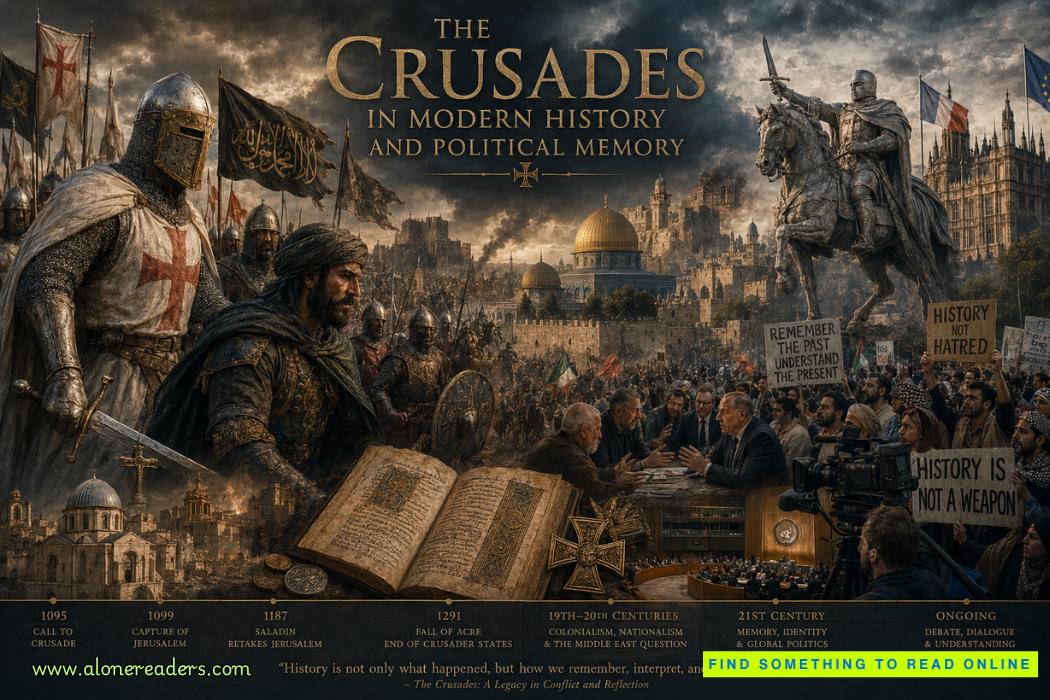
The Crusades remain among the most politically charged and emotionally powerful events in world history. Although the medieval Crusades officially ended centuries ago, their memory never disappeared. Instead, these wars continued to evolve within literature, politics, nationalism, religion, and global identity. In modern history, the Crusades transformed from medieval military campaigns into symbols, myths, and political instruments that shaped the way societies viewed themselves and their enemies. The memory of the Crusades became deeply embedded in European imperialism, Middle Eastern nationalism, Christian identity, Islamic revivalism, and modern geopolitical rhetoric. In many ways, the Crusades survived not on battlefields, but within historical imagination.
The original Crusades emerged between the eleventh and thirteenth centuries as military campaigns initiated primarily by Latin Christian Europe against Muslim-controlled territories in the eastern Mediterranean. Medieval chroniclers framed these expeditions as sacred wars designed to reclaim holy places, especially Jerusalem. Yet modern interpretations increasingly recognize that the Crusades also involved political ambition, economic expansion, dynastic rivalry, and social transformation. Over time, the medieval reality became less important than the symbolic meaning later generations attached to it.
During the eighteenth and nineteenth centuries, Europe experienced dramatic intellectual and political changes that reshaped public understanding of the Crusades. Romanticism played a major role in reinventing medieval history. Writers, artists, and historians began portraying Crusaders as heroic warriors driven by faith, honor, and civilization. Medieval castles, knightly orders, and crusading legends became celebrated throughout European culture. The Crusades were no longer viewed simply as distant religious wars; they became part of Europe’s cultural mythology.
This romantic reinterpretation coincided with the rise of European nationalism. Emerging nation-states searched for historical narratives that could inspire unity and pride. In countries such as France, England, Germany, and Spain, medieval crusading history became linked to national identity. Leaders and intellectuals selectively emphasized particular crusading figures as symbols of patriotism and military glory. Richard the Lionheart became a heroic figure in British memory, while France glorified kings such as Louis IX. These representations often ignored the brutality and complexity of the Crusades, focusing instead on heroic sacrifice and civilizational mission.
At the same time, European colonial expansion into Africa, Asia, and the Middle East increasingly borrowed crusading language and imagery. Colonial powers often portrayed themselves as bearers of civilization entering supposedly backward regions. Although colonial administrators rarely described themselves explicitly as Crusaders, the underlying rhetoric frequently echoed crusading ideology. European domination was framed as morally justified, culturally superior, and historically destined. In this context, the Crusades became connected to imperial identity.
The nineteenth century saw renewed European interest in the Middle East itself. Archaeological expeditions, biblical exploration, and oriental scholarship intensified Western fascination with Jerusalem and the broader region. European powers competed for influence within the weakening Ottoman Empire, and crusading memory became intertwined with diplomatic and military ambitions. France in particular cultivated an image as protector of Eastern Christians, drawing symbolic continuity between medieval Crusaders and modern imperial interests.
One of the most significant moments in the modern political memory of the Crusades occurred during the colonial period following World War I. After the collapse of the Ottoman Empire, Britain and France divided much of the Middle East through mandates and political agreements. Many Arab intellectuals and political leaders interpreted European intervention through the historical lens of the Crusades. Western occupation appeared not as a completely new phenomenon, but as a continuation of centuries-old foreign intrusion.
This interpretation intensified throughout the twentieth century. Nationalist movements across the Arab world increasingly used crusading imagery to describe Western military and political influence. European colonialism, Zionism, and later American intervention were frequently compared to medieval Crusader states. The term “Crusader” became politically charged, symbolizing foreign domination and cultural aggression. This memory was especially powerful because it connected contemporary struggles with a long historical narrative of resistance.
Modern Islamic political movements also contributed to the revival of Crusader memory. During the late nineteenth and twentieth centuries, Islamic reformers and revivalists sought historical examples of Muslim unity against foreign invaders. Figures such as صلاح الدين الأيوبي—known in English as Saladin—were transformed into symbols of resistance, leadership, and Islamic solidarity. Saladin’s victory over the Crusaders at the Battle of Hattin and his recapture of Jerusalem became central themes in modern Islamic historical memory.
Importantly, medieval Muslim chroniclers did not always view the Crusades with the same intensity later generations would. In many medieval Islamic texts, Crusaders were simply one among many political and military threats facing the Islamic world. However, modern nationalism and anti-colonial struggles elevated the Crusades into a defining civilizational conflict. Saladin himself evolved from a medieval ruler into a near-mythic symbol of dignity and resistance against Western invasion.
The twentieth century also witnessed the emergence of modern mass media, which amplified historical symbolism on an unprecedented scale. Newspapers, films, novels, documentaries, and political speeches continuously revived crusading imagery. Hollywood productions often portrayed Crusaders through romantic or heroic narratives, while Middle Eastern media frequently emphasized themes of invasion and resistance. These competing portrayals shaped public consciousness across different societies.
One of the most controversial aspects of crusading memory emerged through political rhetoric in modern conflicts. During periods of war in the Middle East, leaders and commentators sometimes used the language of crusade to mobilize public emotion. Such language carried enormous historical weight. For many audiences in the Islamic world, references to crusades evoked memories of occupation, massacre, and religious hostility. For some Western audiences, however, crusading terminology symbolized moral struggle or civilizational defense.
The modern misuse of crusading language became especially visible after the terrorist attacks of September 11, 2001. When political leaders or commentators used the word “crusade” to describe military campaigns in the Middle East, reactions were immediate and intense. Many Muslims interpreted the terminology as confirmation that Western powers viewed modern conflicts through a religious and civilizational framework. Even when the term was used casually or unintentionally, its historical associations created deep controversy.
Extremist organizations also exploited crusading memory for propaganda purposes. Groups such as al-Qaeda and ISIS repeatedly described Western governments as “Crusader forces.” This rhetoric served strategic purposes. By framing modern geopolitical conflicts as continuations of the medieval Crusades, extremist leaders attempted to create a narrative of eternal religious war between Islam and the West. Historical memory became weaponized to recruit followers, justify violence, and intensify polarization.
At the same time, far-right nationalist groups in Europe and North America revived crusading symbolism for entirely different reasons. Some extremist movements adopted Crusader crosses, medieval imagery, and knightly symbolism as representations of Christian or Western identity. These groups often imagined themselves as defenders of Europe against immigration, Islam, or multiculturalism. In many cases, their understanding of crusading history was highly selective and historically inaccurate, reducing centuries of complex interaction into simplistic narratives of civilizational conflict.
This politicization demonstrates how the Crusades function not merely as historical events but as memory frameworks. Collective memory rarely reflects objective historical reality. Instead, societies reinterpret the past according to present fears, ambitions, and identities. The Crusades became especially vulnerable to political manipulation because they involved religion, warfare, sacred geography, and cultural identity—all emotionally powerful themes.
Modern historians increasingly challenge simplistic interpretations of the Crusades. Contemporary scholarship emphasizes that the medieval Mediterranean world was characterized not only by warfare but also by diplomacy, trade, cultural exchange, and coexistence. Christians, Muslims, and Jews interacted in highly complex ways across centuries. Crusader states themselves depended heavily on negotiation, alliances, and practical cooperation with neighboring Muslim powers. Historical reality was far more complicated than modern ideological narratives suggest.
Academic research also demonstrates that the Crusades were not a single unified conflict. They involved numerous campaigns with varying motivations, participants, and outcomes. Political rivalries within Christian Europe often shaped crusading efforts as much as religious devotion. Likewise, Muslim political fragmentation significantly influenced the course of events. Modern political rhetoric frequently ignores these complexities in favor of simplified narratives of eternal religious hostility.
The memory of the Crusades also differs dramatically between regions and cultures. In much of Western Europe during earlier centuries, the Crusades were often remembered positively as examples of bravery and religious devotion. In contrast, modern Middle Eastern memory increasingly emphasized invasion, destruction, and resistance. These divergent memories developed not directly from medieval experience alone, but from later political transformations including colonialism, nationalism, and global conflict.
Education systems played a major role in shaping these collective memories. School textbooks, national histories, and public monuments often reflected contemporary political priorities rather than balanced scholarship. In some countries, Crusaders were celebrated as heroes of civilization. In others, they were portrayed as violent invaders driven by greed and fanaticism. Generations grew up absorbing these interpretations, reinforcing distinct historical identities.
Religious institutions also contributed to modern reinterpretations of crusading history. During the twentieth century, interfaith dialogue between Christians and Muslims increasingly addressed the legacy of the Crusades. Some Christian leaders publicly acknowledged the violence committed during crusading campaigns and called for reconciliation. These efforts reflected broader attempts to reduce religious hostility and promote historical understanding.
One of the most important developments in recent scholarship has been the recognition that political memory can become detached from historical evidence. The Crusades are frequently invoked in modern political discourse by individuals who possess little detailed knowledge of medieval history. The term itself functions symbolically, representing ideas about identity, conflict, morality, and civilization. As a result, debates about the Crusades often reveal more about modern anxieties than about medieval realities.
The digital age further transformed crusading memory. Social media, online forums, video games, and internet propaganda accelerated the spread of simplified historical narratives. Crusader imagery became highly visible in memes, extremist propaganda, nationalist movements, and entertainment culture. Medieval symbols were repurposed for modern ideological battles, often stripped entirely from their original historical context.
Despite these controversies, the Crusades also remain subjects of genuine scholarly fascination because they illuminate broader themes in human history. They reveal how religion can intersect with politics, how historical memory shapes modern identity, and how societies construct myths around warfare and heroism. The Crusades demonstrate that the past is never truly finished. Historical events continue to evolve long after the original participants disappear.
Modern political memory surrounding the Crusades ultimately reflects a struggle over interpretation. Different groups seek to define what the Crusades mean and how they should be remembered. Were they holy wars, imperial invasions, defensive campaigns, acts of devotion, or early examples of colonialism? The answer often depends less on medieval evidence than on modern perspective.
The continuing power of crusading memory reveals the extraordinary longevity of historical symbolism. Few medieval events remain as globally recognized or politically sensitive as the Crusades. Their legacy extends far beyond castles, battlefields, and ancient chronicles. They survive within political speeches, national myths, religious debates, cultural identity, and geopolitical rhetoric.
Understanding the Crusades in modern history therefore requires more than studying medieval warfare. It demands examining how societies remember, reinterpret, and weaponize the past. The Crusades became mirrors reflecting modern fears, ambitions, and ideological conflicts. They demonstrate that historical memory can become as influential as history itself.
In the modern world, where identity politics, religious tension, nationalism, and global conflict continue to shape international relations, the Crusades remain deeply relevant. Their memory still influences perceptions between cultures and civilizations. The challenge for historians and societies alike is to move beyond mythologized narratives toward a more nuanced understanding of the past. Only by confronting both the realities and the distortions of crusading memory can modern societies fully understand why these medieval wars continue to echo so powerfully across the modern political imagination.



 The Hundred Days Offensive: How the Allies Defeated Germany in World War I
 The Second Battle of the Marne: The Turning Point of World War I in 1918
 The Spring Offensive of 1918: Germany's Final Gamble to Win World War I
 The Treaty of Brest-Litovsk: How Russia Left World War I
 The Russian Revolution and World War I: How War Brought Down the Tsar
 The Zimmermann Telegram Explained: Germany's Secret Offer to Mexico in World War I