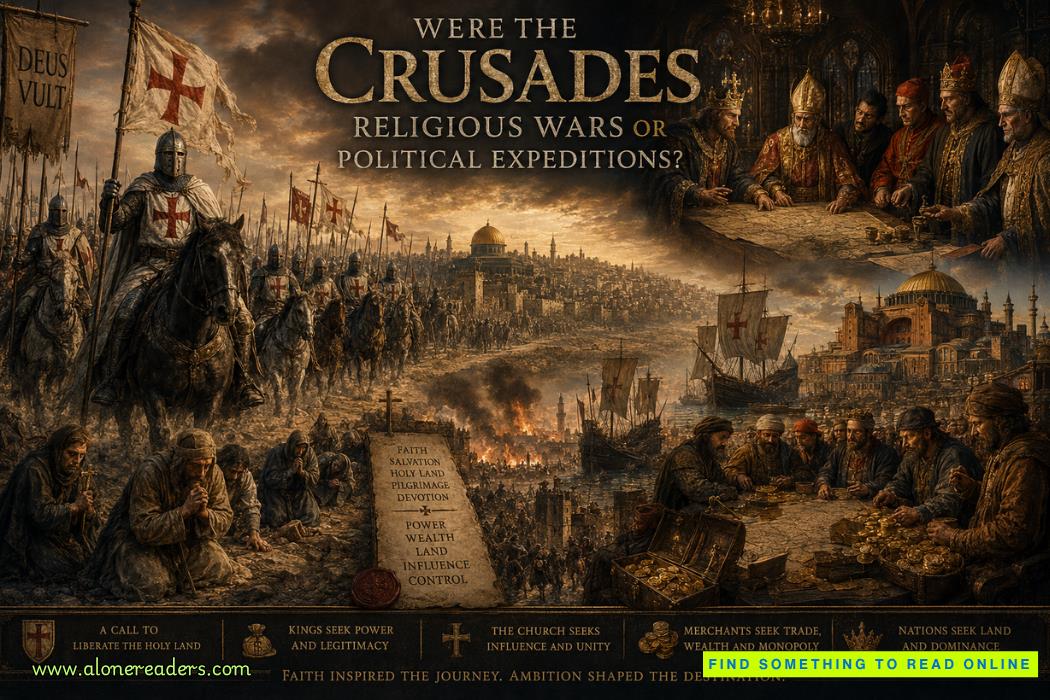
The Crusades remain among the most controversial and misunderstood conflicts in medieval history. For centuries, they were described primarily as holy wars fought by Christian Europe to reclaim sacred lands from Muslim control. Yet modern historians increasingly argue that the Crusades cannot be explained through religion alone. Behind the banners marked with crosses stood kings seeking territory, nobles pursuing wealth, merchants chasing trade routes, and popes attempting to expand their political authority across Europe and the eastern Mediterranean. The Crusades therefore existed at the intersection of faith, ambition, economics, and geopolitical struggle. To reduce them to either purely religious wars or purely political expeditions oversimplifies one of the most complex movements of the medieval world.
The origins of the Crusades were deeply tied to the political fragmentation and religious atmosphere of eleventh-century Europe. Western Europe at the time was dominated by feudal warfare, noble rivalries, and a warrior culture that glorified combat. The Catholic Church sought ways to channel the violence of European knights away from internal conflicts and toward external enemies. Simultaneously, the Byzantine Empire faced severe military pressure from the Seljuk Turks after the devastating Battle of Manzikert in 1071. Emperor Alexios I Komnenos appealed to Western Europe for military assistance to help defend Byzantine territories in Anatolia. This request became the catalyst for a much larger movement after Pope Urban II delivered his famous speech at the Council of Clermont in 1095.
Urban II framed the campaign in unmistakably religious language. He called upon Christians to aid their eastern brethren and liberate Jerusalem from Muslim rule. Participants were promised spiritual rewards, including remission of sins, a revolutionary concept that transformed warfare into an act of religious devotion. The pope portrayed the expedition as a sacred duty sanctioned by God Himself. According to chroniclers, cries of “God wills it!” erupted from the crowd. For many ordinary Europeans, especially peasants and lower-ranking knights, this message was profoundly persuasive. Medieval society was intensely religious, and salvation dominated daily life. The idea that one could secure divine forgiveness through military service gave the Crusades immense emotional power.
However, beneath this spiritual rhetoric lay important political calculations. The papacy itself was engaged in fierce struggles for supremacy against secular rulers and the Byzantine Church. By leading a massive international military campaign, the pope could strengthen his authority over Christian Europe while presenting himself as the supreme leader of Christendom. The Crusades therefore enhanced papal prestige and centralized religious influence. The pope was not merely organizing pilgrims; he was exercising geopolitical leadership on a continental scale.
European nobles also had strong secular motivations. Many younger sons of noble families possessed little inheritance due to feudal customs favoring eldest sons. The Crusades offered opportunities for land acquisition, titles, and wealth in the eastern Mediterranean. Some crusaders established entire Crusader states, including the Kingdom of Jerusalem, the County of Edessa, the Principality of Antioch, and the County of Tripoli. These territories quickly evolved into political entities governed according to European feudal traditions rather than purely religious communities. Castles were built, taxes imposed, alliances negotiated, and dynasties established. This transformation demonstrates that the Crusades rapidly evolved beyond spiritual pilgrimage into colonial and political enterprises.
Economic factors further complicate the narrative. Italian maritime republics such as Venice, Genoa, and Pisa played crucial roles in transporting crusaders across the Mediterranean. In return, they gained lucrative trade privileges, ports, and commercial monopolies. The Crusades opened new trade networks connecting Europe with the eastern Mediterranean and the broader Islamic world. Spices, silk, sugar, glassware, and luxury goods flowed westward in increasing quantities. Merchant classes profited enormously from the instability and military expansion created by crusading campaigns. Venice in particular became one of the greatest beneficiaries of Crusader activity, using military support to expand its maritime empire and commercial dominance.
The Fourth Crusade provides perhaps the clearest example of political and economic motives overwhelming religious objectives. Originally intended to attack Muslim-controlled Egypt, the crusade became entangled in Venetian financial interests and Byzantine political disputes. In 1204, Crusaders shockingly attacked and sacked Constantinople, the largest Christian city in the eastern world. Churches were looted, relics stolen, civilians massacred, and the Byzantine Empire severely weakened. A crusade launched in the name of Christianity ended with Christians slaughtering fellow Christians for political and economic gain. This event deeply damaged relations between Eastern Orthodox and Western Catholic Christianity and revealed how far crusading ideals could be manipulated for secular purposes.
Despite these political realities, religion cannot simply be dismissed as propaganda or disguise. Many crusaders genuinely believed they were serving God. Medieval chronicles reveal extraordinary devotion among participants. Pilgrimage traditions, sacred vows, fasting rituals, and prayers formed central aspects of crusading culture. Knights often viewed themselves as spiritual warriors engaged in a cosmic struggle between Christianity and Islam. Some sold property or bankrupted themselves to join expeditions that offered little realistic chance of financial return. Mortality rates were enormous, and many crusaders died from disease, starvation, or combat long before reaching Jerusalem. If economic profit had been the sole motivation, countless participants would never have volunteered for such dangerous journeys.
The capture of Jerusalem during the First Crusade in 1099 demonstrates the intensity of religious fervor. Crusaders who entered the city reportedly marched barefoot in prayer after enduring brutal hardships across Anatolia and the Levant. Yet the conquest also exposed the darker dimensions of religious extremism. Muslim and Jewish inhabitants were massacred in scenes described by chroniclers with disturbing triumphalism. The conviction that violence was divinely sanctioned enabled extraordinary brutality. Religious zeal did not eliminate political ambition; instead, it often intensified military aggression by presenting warfare as morally righteous.
Muslim perspectives on the Crusades also reveal a complex mixture of political and religious responses. Initially, the Islamic world was politically fragmented, divided among rival dynasties and regional powers. Some Muslim leaders viewed the Crusaders primarily as another group of foreign invaders rather than uniquely religious enemies. Over time, however, resistance movements increasingly framed the conflict in Islamic religious terms. Leaders such as Nur ad-Din and Saladin combined military leadership with Islamic legitimacy, presenting themselves as defenders of the faith against Christian aggression. Saladin’s recapture of Jerusalem in 1187 became a defining moment in Islamic history, celebrated not only as a military victory but also as a religious triumph.
Political rivalries within Europe also shaped crusading campaigns. Kings frequently used crusades to enhance prestige, strengthen legitimacy, or distract from domestic problems. Richard the Lionheart of England became legendary for his role in the Third Crusade, yet his participation was as much about royal image and international influence as spiritual duty. French and German rulers similarly viewed crusading participation as demonstrations of power and honor. In many cases, crusading rhetoric provided political rulers with moral justification for expansionist policies.
The Crusades also targeted groups beyond Muslims in the Holy Land. Crusading ideology expanded into campaigns against heretics, pagans, and political enemies within Europe itself. The Albigensian Crusade against the Cathars in southern France illustrates how the Church used crusading principles to eliminate internal dissent while strengthening political control. Northern Crusades against pagan populations in the Baltic region similarly combined forced conversion with territorial conquest. These campaigns reveal that the Crusading movement became a flexible instrument of power that could be redirected toward numerous political objectives.
Another significant dimension involved the relationship between violence and medieval identity. The Crusades helped construct a broader sense of Christian unity across Europe, even though internal rivalries persisted. Nobles from England, France, Germany, Italy, and other regions temporarily united under a shared religious cause. At the same time, the conflicts intensified divisions between Christians, Muslims, Jews, and Eastern Orthodox communities. The Crusades contributed to the development of enduring stereotypes, religious hostility, and collective memories that influenced relations between civilizations for centuries.
Modern interpretations of the Crusades often reflect contemporary political concerns. During the nineteenth and early twentieth centuries, some European historians portrayed Crusaders as heroic civilizing warriors spreading Western culture. In contrast, modern scholarship increasingly emphasizes imperialism, economic exploitation, and religious intolerance. In parts of the Islamic world, the Crusades are remembered as early examples of Western colonial aggression. Political leaders and extremist groups in modern times have sometimes invoked Crusader imagery to justify contemporary conflicts, demonstrating how emotionally powerful the historical memory remains.
Yet interpreting the Crusades solely through modern ideological frameworks risks distorting medieval realities. The people who participated in these campaigns lived in a world fundamentally different from the modern secular age. Religion and politics were not separate spheres in medieval society. Kings ruled by divine legitimacy, wars were blessed by religious authorities, and salvation shaped political behavior. To medieval Europeans, a military expedition could simultaneously be a sacred pilgrimage, a political mission, an economic opportunity, and a personal quest for honor. These motivations did not necessarily conflict with one another; they often reinforced each other.
The Crusades therefore cannot be accurately categorized as either purely religious wars or merely political expeditions. They were both. Religion supplied the emotional force, moral legitimacy, and mass mobilization necessary to launch massive campaigns across continents. Politics and economics shaped strategic decisions, territorial ambitions, and long-term outcomes. The spiritual language of the Crusades inspired ordinary believers, while secular leaders exploited the movement for power, influence, and wealth.
Perhaps the most revealing truth about the Crusades is that they exposed the inseparable connection between ideology and power in medieval civilization. Faith was not simply a mask hiding political ambition, nor was politics merely secondary to religion. Instead, the Crusades represented a world in which spiritual conviction, military violence, economic expansion, and political authority operated together within a single worldview.
The enduring fascination with the Crusades comes partly from this moral complexity. They produced acts of devotion and cruelty, courage and greed, sacrifice and conquest. Some crusaders sincerely believed they were defending sacred ideals, while others pursued personal glory or material gain. Entire populations suffered under campaigns justified as holy missions. Trade flourished alongside massacres. Religious devotion inspired both charity and brutality.
Ultimately, the Crusades were not defined by one singular motive because medieval society itself was shaped by overlapping systems of belief and power. To ask whether the Crusades were religious wars or political expeditions is to confront the reality that in the medieval world, religion and politics were deeply intertwined. The Crusades emerged from that fusion, becoming one of history’s most transformative and controversial movements. Their legacy continues to shape historical memory, religious discourse, and geopolitical narratives even today, nearly a thousand years after the first Crusaders marched toward Jerusalem under the sign of the cross.



 The Hundred Days Offensive: How the Allies Defeated Germany in World War I
 The Second Battle of the Marne: The Turning Point of World War I in 1918
 The Spring Offensive of 1918: Germany's Final Gamble to Win World War I
 The Treaty of Brest-Litovsk: How Russia Left World War I
 The Russian Revolution and World War I: How War Brought Down the Tsar
 The Zimmermann Telegram Explained: Germany's Secret Offer to Mexico in World War I










