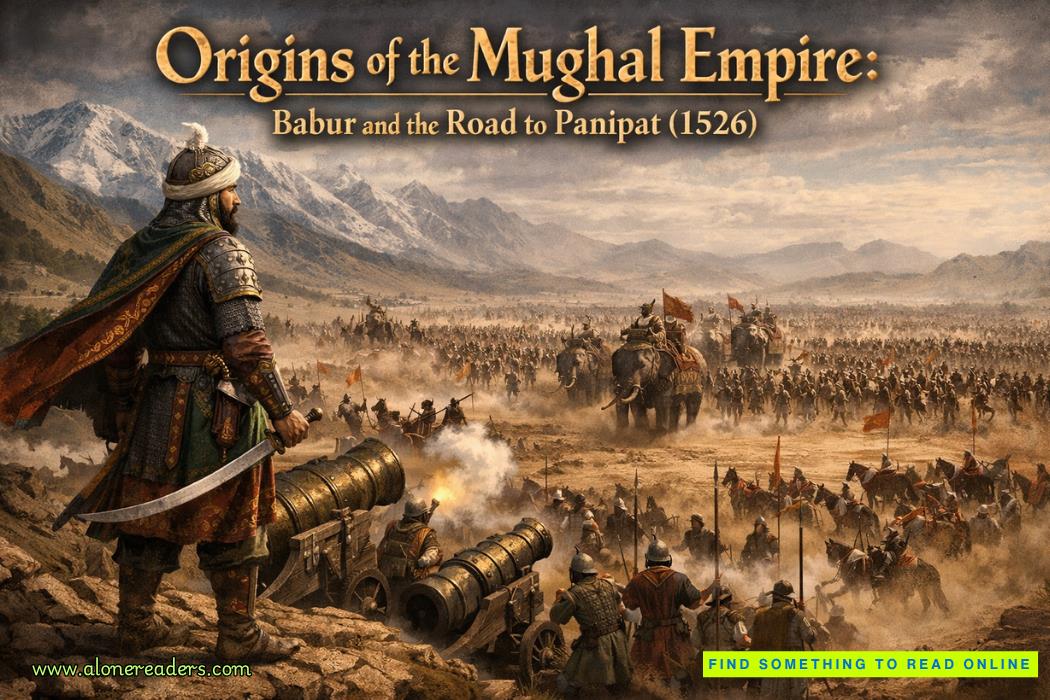
The origins of the Mughal Empire represent one of the most decisive transformations in South Asian history, where a displaced Central Asian prince, hardened by adversity and driven by ambition, reshaped the political destiny of the Indian subcontinent. The rise of Babur was neither inevitable nor straightforward; it was the result of calculated strategy, cultural inheritance, military innovation, and a relentless pursuit of legitimacy. To understand how the Mughal Empire emerged, one must examine the convergence of Central Asian political traditions, the fragmentation of North India, and the technological shift in warfare that culminated in the First Battle of Panipat in 1526.
Babur’s lineage was itself a powerful political asset. He was a direct descendant of Timur on his father’s side and Genghis Khan through his mother. This dual heritage was not merely symbolic; it provided Babur with a deep reservoir of legitimacy rooted in the traditions of conquest and empire-building. Yet, despite such prestigious ancestry, Babur’s early life was marked by instability rather than dominance. Born in 1483 in the small principality of Fergana, he inherited his father’s throne at the age of twelve, only to find himself surrounded by rival claimants and internal dissent.
The political landscape of Central Asia during Babur’s youth was fragmented and volatile. The once-mighty Timurid Empire had splintered into competing principalities, each ruled by ambitious princes vying for supremacy. Babur’s early attempts to consolidate power were focused on capturing Samarkand, the symbolic heart of Timurid authority. His repeated campaigns to secure the city reveal both his determination and the structural challenges he faced. Although he briefly succeeded in occupying Samarkand, he lacked the resources to maintain control, and his position in Fergana simultaneously weakened. These setbacks forced him into a cycle of conquest and loss, shaping his strategic thinking and resilience.
One of the most critical turning points in Babur’s career was his eventual shift away from Central Asia toward the Indian subcontinent. This decision was not impulsive but rather the result of geopolitical necessity. The rise of the Uzbeks under Muhammad Shaybani Khan effectively blocked Babur’s ambitions in Transoxiana. Unable to compete with the growing Uzbek power, Babur redirected his focus southward, where opportunities were emerging in a politically fragmented India.
At the beginning of the sixteenth century, North India was under the rule of the Delhi Sultanate, specifically the Lodi dynasty. However, this regime was internally weakened by factional disputes, regional rebellions, and declining central authority. The ruling sultan, Ibrahim Lodi, faced opposition not only from external threats but also from within his own nobility. Afghan chiefs and regional governors resented his centralizing policies and authoritarian style, creating a climate ripe for invasion.
Babur’s initial incursions into India were exploratory rather than decisive. Between 1519 and 1524, he launched several raids across the northwestern frontier, testing the terrain, assessing political conditions, and gathering intelligence. These campaigns also allowed him to establish alliances with discontented local rulers, including Daulat Khan Lodi and Alam Khan, who saw Babur as a potential ally against Ibrahim Lodi. These alliances were crucial, as they provided Babur with both legitimacy and logistical support for a larger campaign.
What distinguished Babur from previous invaders was not merely his ambition but his adaptation of military technology and tactics. He had been exposed to Ottoman methods of warfare, particularly the use of field artillery and matchlock firearms. Under the guidance of Ottoman gunners such as Ustad Ali Quli, Babur integrated gunpowder weapons into his army, fundamentally altering the dynamics of battle. This innovation would prove निर्णative at Panipat.
By 1525, Babur had committed to a full-scale invasion of India. Crossing the Indus River with an army estimated at around 12,000 men, he advanced toward Delhi. Despite being heavily outnumbered by Ibrahim Lodi’s forces, which reportedly numbered over 100,000 soldiers along with war elephants, Babur relied on discipline, mobility, and tactical ingenuity rather than sheer numbers.
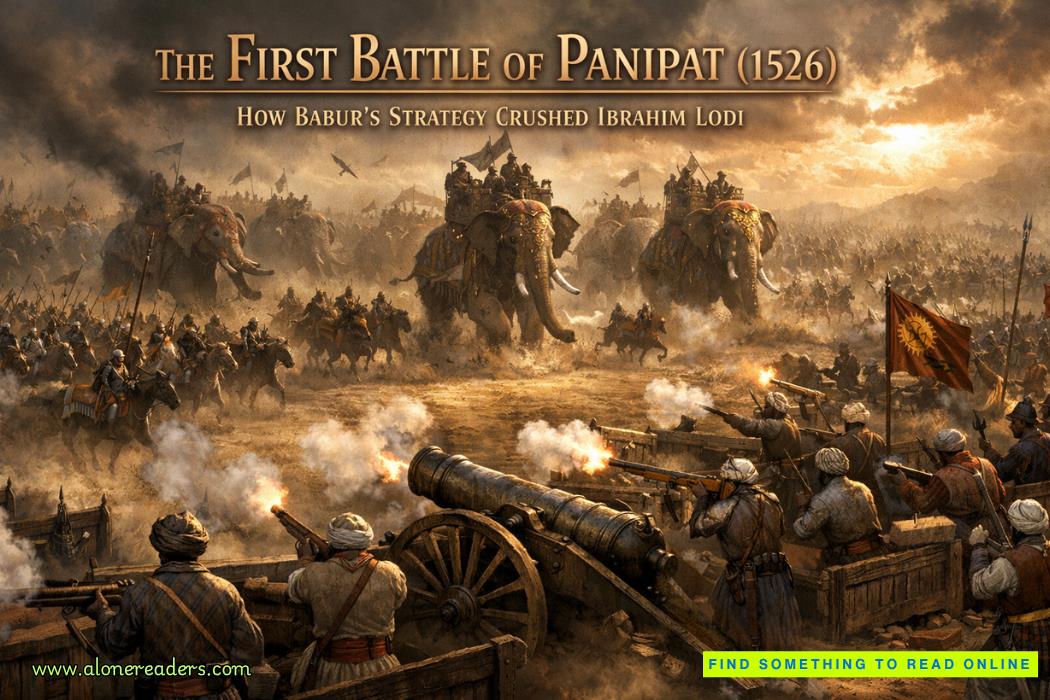
The First Battle of Panipat, fought on April 21, 1526, stands as a watershed moment in Indian history. Babur’s preparation for the battle demonstrates his strategic acumen. He employed a defensive formation known as the tulughma system, combined with the use of carts (araba) tied together with ropes to create a fortified front. Behind these barriers, his artillery and matchlock men were positioned to deliver concentrated fire. This arrangement effectively neutralized the numerical advantage of Ibrahim Lodi’s army.
The battle itself was swift but decisive. As Ibrahim Lodi’s forces advanced, they were met with devastating artillery fire, which caused confusion and disarray. The psychological impact of gunpowder weapons, unfamiliar to many Indian troops, further intensified the chaos. Babur then executed flanking maneuvers using his cavalry, encircling the enemy and exploiting their collapsing formation. Ibrahim Lodi was killed on the battlefield, and his army collapsed.
The significance of Babur’s victory at Panipat cannot be overstated. It marked the end of the Lodi dynasty and the effective collapse of the Delhi Sultanate’s authority. More importantly, it laid the foundation for the Mughal Empire, which would go on to become one of the most powerful and culturally influential empires in early modern history. This was not merely a change of rulers; it was the beginning of a new imperial paradigm.
Babur’s success was rooted in several interrelated factors. First, his Central Asian military traditions, emphasizing mobility and cavalry warfare, gave him an edge over the more static forces of the Delhi Sultanate. Second, his adoption of gunpowder technology introduced a new dimension to warfare in the subcontinent. Third, his ability to exploit political divisions among Indian elites allowed him to enter the region not just as a conqueror but as a participant in existing power struggles.
Equally important was Babur’s personal leadership. His memoirs, known as the Baburnama, reveal a ruler who was not only a capable military commander but also a keen observer of culture, geography, and human behavior. His writings provide insight into his strategic thinking, his appreciation for the Indian landscape, and his efforts to establish a stable government in a foreign land. This combination of military pragmatism and intellectual curiosity would later become a defining characteristic of Mughal rule.
However, it is essential to recognize that Babur’s position after Panipat was far from secure. His victory granted him control over Delhi and Agra, but much of northern India remained contested. Afghan resistance persisted, and Rajput powers under leaders such as Rana Sanga posed significant challenges. The establishment of the Mughal Empire was therefore not a single event but a process of consolidation that would continue under Babur’s successors.
In retrospect, the origins of the Mughal Empire can be understood as the product of historical convergence. Babur’s Central Asian heritage, the political fragmentation of North India, and the emergence of gunpowder warfare combined to create conditions conducive to imperial transformation. The First Battle of Panipat was the decisive moment where these forces intersected, resulting in a victory that reshaped the subcontinent.
What makes this episode particularly compelling is the contrast between Babur’s precarious beginnings and his eventual success. From a displaced prince struggling to hold onto a minor kingdom, he emerged as the founder of a new empire in a distant land. This transformation underscores the importance of adaptability, strategic vision, and the ability to leverage both tradition and innovation.
The Mughal Empire that Babur established would endure for over three centuries, influencing the political, cultural, and architectural landscape of India. Yet its origins remain rooted in the uncertain journeys, calculated risks, and decisive battles of its founder. The road to Panipat was not merely a campaign of conquest; it was the culmination of a lifetime of struggle and ambition.
In examining the origins of the Mughal Empire, one is reminded that history is often shaped not by inevitability but by moments of decision and opportunity. Babur’s choice to turn toward India, his willingness to adopt new technologies, and his ability to exploit existing divisions transformed him from a regional contender into an imperial founder. The First Battle of Panipat stands as a testament to this transformation—a moment where strategy overcame numbers, innovation overcame tradition, and ambition reshaped destiny.



 The Hundred Days Offensive: How the Allies Defeated Germany in World War I
 The Second Battle of the Marne: The Turning Point of World War I in 1918
 The Spring Offensive of 1918: Germany's Final Gamble to Win World War I
 The Treaty of Brest-Litovsk: How Russia Left World War I
 The Russian Revolution and World War I: How War Brought Down the Tsar
 The Zimmermann Telegram Explained: Germany's Secret Offer to Mexico in World War I










