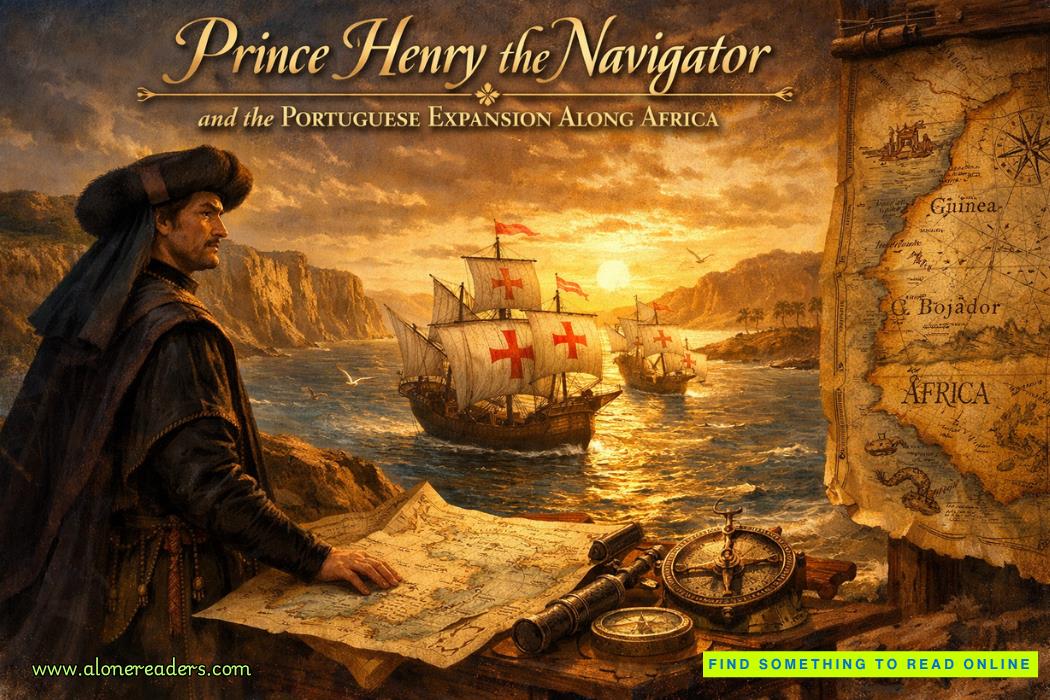
Prince Henry of Portugal, known to history as Prince Henry the Navigator, occupies a unique and transformative place in the chronicles of Europe’s maritime expansion. Though he never sailed far himself, his vision, patronage, and intellectual drive redefined how the Western world perceived the sea — not merely as a barrier but as a pathway to global power. In the fifteenth century, when Europe stood at the threshold of discovery and ambition, it was Henry who taught a small kingdom at the edge of the continent to look outward, beyond its rocky shores, toward the mysterious coasts of Africa.
The Portugal of Henry’s youth was recovering from centuries of warfare during the Christian Reconquista, finally secure within its borders and eager to channel its newfound stability into ventures beyond. The age demanded courage, technology, and a willingness to defy myth and superstition. It was widely believed that the tropics were uninhabitable, that monstrous creatures lurked beyond Cape Bojador, and that the equatorial sun itself could burn human flesh. Yet, Henry saw not monsters but opportunity, not peril but promise. His genius lay in transforming fear into curiosity and curiosity into systematic exploration.
Born in 1394 as the third son of King John I, Henry was never destined for the throne. This freedom gave him latitude to pursue intellectual and religious ambitions rather than dynastic ones. The pivotal event that shaped his worldview was the capture of Ceuta in 1415, a North African port once buzzing with trade routes linking the Mediterranean to sub-Saharan Africa. From Ceuta, Henry observed spices, gold, ivory, and slaves passing through markets — evidence that Africa was not a blank map but a thriving commercial world profoundly connected to the Indies beyond. It was then, historians often agree, that Henry conceived the idea of directly accessing these riches by sea.
Henry’s base of operation became the promontory of Sagres, a windswept outpost near Cape St. Vincent. Though later romantically called his “school of navigation,” Sagres was less an academy than a technical command center — a gathering place for cosmographers, chart makers, shipbuilders, and pilots, all united under Henry’s patronage. Here, in an otherwise isolated corner of Europe, knowledge from earlier Islamic, Mediterranean, and Mediterranean-Jewish traditions merged with Portuguese ambition. The mariners developed the caravel, a nimble vessel that could sail windward, and perfected the use of instruments such as the astrolabe and cross-staff, which allowed measurements of latitude by the stars. In these advances, science married statecraft.
From this crucible of innovation came a succession of voyages that transformed Portugal from a small Iberian realm into a maritime power. Under Henry’s directives, captains ventured gradually down the West African coast, each journey pushing slightly farther than the last. In 1434, the navigator Gil Eanes broke the barrier of Cape Bojador, long deemed impassable. His return to Lisbon disproved centuries of geographers’ terror and marked the symbolic boundary between medieval ignorance and modern courage. Later expeditions reached Cape Verde, Senegal, and Sierra Leone, charting not just coastlines but strong currents, prevailing winds, and the cultural landscapes of numerous African peoples.
Henry’s motives, however, were as complex as they were visionary. Beyond curiosity and commerce, his enterprise was imbued with religious zeal. A devout Christian knight of the Order of Christ, he believed exploration could become a form of crusade — a way to strike at Islam from the rear, convert African rulers, and ultimately reach the mythical Prester John, the supposed Christian monarch of the East. Every voyage thus carried both the cross and the compass, serving God as well as king. This fusion of faith, profit, and discovery would later define much of European expansion.
The effects of Henry’s policies rippled far beyond his lifetime. The coastal outposts established under his aegis became the skeleton of an empire: Arguim Island off Mauritania, trading posts at Guinea, and later the islands of Madeira and the Azores. The Portuguese began to dominate the Atlantic islands, transforming them into testbeds for colonial agriculture, especially sugar cultivation, which would later devastate much of the New World. These same islands also became the first laboratories of the Atlantic slave trade, a grim precursor to centuries of exploitation. The paradox of Henry’s legacy lies here — in the same sails that carried progress and science, there also lurked conquest and bondage.
Henry’s death in 1460 did not halt the momentum he had unleashed. His successors — notably King Afonso V and later King John II — inherited a transformed vision of power: that mastery of the ocean equaled mastery of trade and territory. Within decades, Henry’s intellectual descendants would push south beyond the Gulf of Guinea, round the Cape of Good Hope under Bartolomeu Dias in 1488, and finally reach India with Vasco da Gama in 1498. This era, which began under Henry’s modest command, opened the maritime highways of the Atlantic, the Indian Ocean, and soon the Pacific — the true dawn of the Age of Discovery.
What distinguishes Prince Henry from later conquerors is that he reigned through influence rather than force. He built no vast armies, commanded few ships directly, and yet his quiet insistence that knowledge itself was power permanently altered Europe’s destiny. Lisbon, under his inspiration, turned from a provincial harbor into the throat of global exchange — a corridor through which passed gold from Guinea, spices from India, silver from Brazil, and new ideas about geography and science. European cartography was reborn; maps shifted from theological to empirical, from mythical to measurable.
Henry’s intellectual courage deserves equal recognition to his political foresight. At Sagres, he encouraged translation of ancient works on astronomy and navigation, including those from Arabic scholars, whose star charts and mathematical tables proved invaluable. He understood that exploration was not the opposite of scholarship but its extension. The mariners who sailed for Henry were not reckless adventurers but disciplined experimenters. Each voyage functioned as an inquiry — gathering new data, correcting earlier charts, and returning home with logs and sketches that fed the next mission. This feedback loop between experience and intelligence formed the first institutionalized system of scientific exploration in Europe.
In the broader sweep of world history, this shift initiated a seismic reordering of trade and culture. Before Henry’s time, Europe depended heavily on overland routes across the Islamic world to reach Asian goods. With the African route opening, Portugal began to bypass these intermediaries. By monopolizing access to sub-Saharan gold and West African enslaved peoples, the Portuguese crown gained wealth that financed further navigation. This combination of economic greed, strategic foresight, and technical innovation united under Henry’s initial impulse, set the groundwork for the first global economy.
Yet we must not romanticize his vision without scrutiny. The early Portuguese explorations, encouraged by Henry’s aims, catalyzed what would become the transatlantic slave trade. Beginning with the raids along the African coast, captives were brought to Lisbon and sold in European markets. While Henry justified these actions under a religious cloak — framing them as the salvation of heathen souls — the reality was starkly economic. The emerging system valued bodies as commodities, and thus the same intellectual curiosity that illuminated the world also darkened it with exploitation.
Despite this shadow, it remains undeniable that Henry’s initiatives expanded human understanding. His ships mapped the winds and waters of the Atlantic, creating the first reliable maritime routes between Europe, Africa, and the islands that dot the ocean’s vast surface. They learned to harness the Canary Current northward and the Guinea Current southward, forming the navigational triangle that later sustained the Atlantic empires. More figuratively, Henry’s legacy lies in opening the European imagination — teaching it to see the horizon not as an end, but as an invitation.
In retrospect, Prince Henry the Navigator embodied the contradictions of modernity itself: faith and science, curiosity and conquest, learning and greed. He stood at a crossroads where medieval superstition met the empirical method, where Christian evangelism merged with capitalist ambition. The Age of Discovery that followed him would both enlighten and devastate the world. Civilizations would collide; continents long separated would exchange crops, animals, technologies, and diseases. Yet underlying all of it was the spark first lit at Sagres — that restless belief that knowledge of the unknown could grant greatness.
Through this lens, Henry’s project becomes not merely national but universal. Every culture that has turned its gaze outward to explore — from the Polynesian sailors of the Pacific to modern astronauts venturing beyond Earth — follows, in a sense, his intellectual footprint. The sea, once feared as chaos, became under Henry’s vision a medium of connection. By emphasizing learning, disciplined observation, and innovation, he foreshadowed the scientific revolutions that would soon transform Europe as completely as discovery transformed its maps.
When we measure his life’s work today, we encounter both glory and guilt. Portugal’s maritime expansion brought unprecedented global exchange — creating markets where none existed before, mapping coastlines unknown to Europe, and linking continents in a new system of commerce and communication. But it also inaugurated centuries of racial hierarchy and ecological exploitation. The Atlantic became a stage of both exchange and enslavement. Henry’s compass pointed to both knowledge and dominion, and history has walked that line ever since.
Therefore, to understand the Age of Discovery is to understand Prince Henry’s enduring duality. His genius lay not in any single voyage but in setting a process in motion — one that would unfold for centuries. He united ambition with intellect, faith with navigation, and transformed a small Iberian kingdom into the architect of a global world order. In doing so, he became the quiet architect of modern exploration, a figure whose influence echoes in every charted sea and every mapped star.
Though the world has changed immeasurably since his death, the story of Prince Henry the Navigator remains a mirror for our own age — an age that once more stands at the frontier of unknowns, now not in oceans but in the vastness of space and technology. His legacy reminds us that the pursuit of discovery always carries a choice: whether to use knowledge for domination or for understanding. The seas he opened remain a timeless metaphor — reflecting both the courage and the cost of humanity’s irresistible urge to know.



 The Hundred Days Offensive: How the Allies Defeated Germany in World War I
 The Second Battle of the Marne: The Turning Point of World War I in 1918
 The Spring Offensive of 1918: Germany's Final Gamble to Win World War I
 The Treaty of Brest-Litovsk: How Russia Left World War I
 The Russian Revolution and World War I: How War Brought Down the Tsar
 The Zimmermann Telegram Explained: Germany's Secret Offer to Mexico in World War I