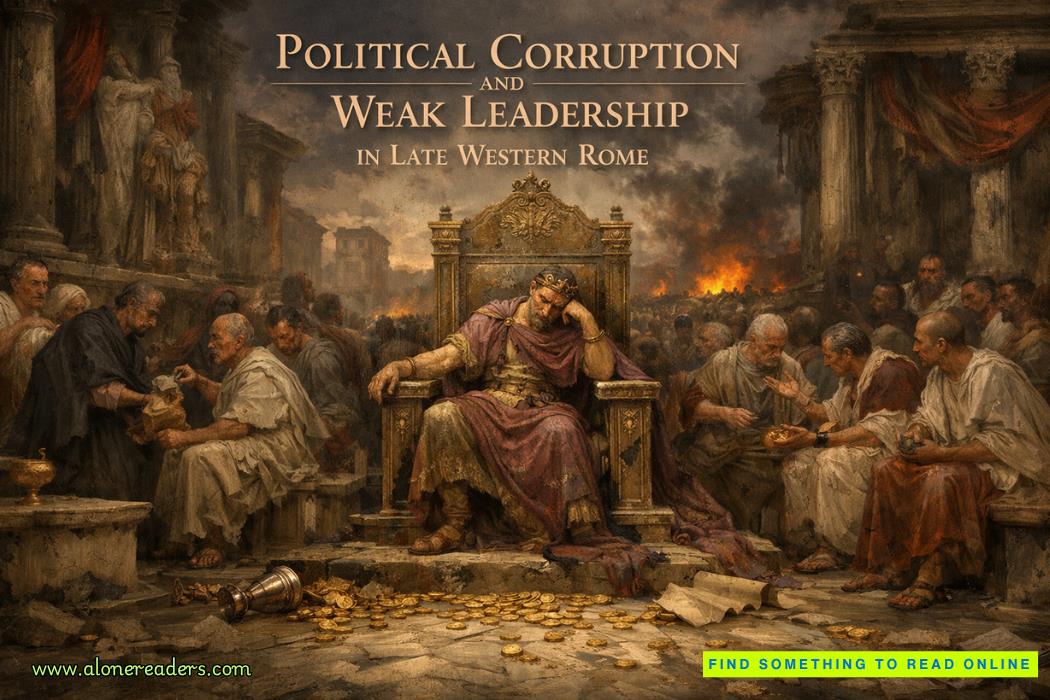
The fall of the Western Roman Empire in 476 AD did not happen overnight or as the result of one cataclysmic battle. It was the product of centuries of internal decay, moral disintegration, and the erosion of capable leadership. Among the forces that hollowed out the empire from within, political corruption and weak leadership stand as the most corrosive. They gradually weakened Rome’s institutional stability, emboldened its enemies, and left a civilization that once governed the known world in a state of terminal exhaustion.
In the earlier centuries of the Roman Republic, civic virtue—virtus, gravitas, and disciplina—guided the political and military life of its citizens. Senators were expected to serve the state with integrity, and the consulship was a burden of duty rather than a prize of ambition. But by the fourth and fifth centuries AD, those values had largely disintegrated. The empire’s bureaucracy had turned into a theater of bribery and power-brokering where loyalty was for sale and political offices were traded like merchandise.
One of the clearest signs of this corruption was the sale of imperial titles and administrative positions. Governors and generals who once gained their authority through service and merit began to purchase it through gold and promises of allegiance. The late Roman court, especially under emperors such as Honorius and Valentinian III, became a stage of scheming courtiers and palace eunuchs whose only concern was to preserve influence, not the empire. It was a far cry from the disciplined councils of the early Principate under Augustus or Trajan.
This transformation was not just moral but structural. The empire, already split between East and West, relied on complex bureaucracies to manage its vast territories. In the Western half, these systems became bloated and inefficient. Officials extracted crushing taxes from impoverished provinces, much of which never reached the imperial coffers but filled the pockets of middlemen and corrupt administrators. The peasantry, once proud citizens and soldiers of Rome, were suffocated by unjust demands. As their loyalty waned, so did the backbone of Roman society.
A government that feeds on its people’s resources without returning protection or justice soon loses legitimacy. That was exactly the fate of late Western Rome. The power of the emperor became symbolic—more ceremonial than commanding. The real authority drifted into the hands of opportunists like Stilicho, Aetius, and later Ricimer, each of whom acted as puppet masters behind child-emperors or incompetents. The empire, it seemed, had become an organism without a functioning brain—alive by inertia, dying by corruption.
The root of this decline in leadership can be traced to the constant civil wars and court intrigues of the late third and fourth centuries. Every emperor feared assassination more than barbarian invasion. The Praetorian Guard, once protectors of the Caesar, had become a mercenary force that murdered emperors and auctioned the purple robe to the highest bidder. Such instability made it nearly impossible for any single ruler to reform governance or restore public virtue. Even well-intentioned emperors like Majorian were quickly overthrown by their jealous subordinates.
The emperor’s image, once divine and awe-inspiring, had been desecrated. By the time Romulus Augustulus, the final Western emperor, ascended to a powerless throne, the title itself had been emptied of its ancient majesty. Rome’s citizens no longer looked to their emperor as the embodiment of law and justice but as another cog in the machinery of greed.
Meanwhile, corruption reached its most malignant form in the military establishment. The legions that had once conquered Gaul and Britannia were now shadows of their former selves. Officers bought commands for personal status rather than for military competence. Funds meant for fortifications or equipment were embezzled by governors or quartermasters. Troops, unpaid for months, turned to extortion, desertion, or even selling their services to enemies.
As the frontier defenses weakened, the empire increasingly relied on foreign mercenaries, especially Germanic foederati. These barbarian troops were given land and authority in exchange for protection. But this arrangement was rooted in desperation—and inherently unstable. The foederati owed loyalty not to Rome, but to their tribal leaders and immediate paymasters. When the gold shipments stopped, so did their allegiance.
It was thus corruption that financed Rome’s enemies while bankrupting its own institutions. The paradox of the late Western Empire is that it paid its invaders to guard its borders. By doing so, it replaced professional soldiers with mercenaries who would later carve kingdoms out of Roman soil.
Beyond administration and military failure, the empire’s soul itself corroded. Civic duty, once the foundation of Roman glory, had given way to personal enrichment and self-preservation. Senators who previously financed public works began to spend their wealth on private villas and extravagant games. The Senate’s debates turned into whispers of conspiracy, and governors became predators rather than protectors. The empire’s political culture had become a carnival of vanity.
One emblematic figure of late Roman corruption was Petronius Maximus, who seized the throne in 455 AD after bribing the imperial guard and orchestrating the murder of his predecessor, Valentinian III. His reign lasted only a few weeks before he was stoned to death by the mob as the Vandals entered Rome. His story is a parable of the final decay of Roman power: rulers rising by deceit and falling by cowardice.
Even the church, which had risen as a stabilizing force amid chaos, was not immune. Bishops often entangled themselves in politics, using sacred offices to wield secular influence. Although Christianity gave the empire a new moral framework, by the fifth century it had also become a vehicle for factional struggles between rival bishops and emperors. Instead of uniting the empire spiritually, it sometimes deepened internal divisions between Arian and Nicene Christians, between East and West, between faith and empire.
Weak leadership, then, was not simply an accident—it was the logical outcome of two centuries of political decay. The selection of emperors became driven by convenience, not competence. Most late Western emperors were crowned as minors or puppets manipulated by generals and court factions. Few possessed military skill, and even fewer displayed administrative insight. Their short, turbulent reigns fostered a culture of impermanence and cynicism.
Consider Honorius, who reigned during the sack of Rome in 410 AD. Historians portray him as deeply detached from reality, more interested in his pet chickens at Ravenna than the fate of the city that once ruled the world. His reign epitomizes the lethargy of the imperial court. When Alaric the Visigoth marched upon Rome, the empire’s response was paralysis and negotiation rather than action. For many citizens, this indifference symbolized the moral death of Roman leadership.
The pattern repeated itself again and again: emperors too young, too weak, or too afraid to govern. Their thrones survived on illusion, not authority. The army and the administration, once bound together by shared loyalty to the Roman ideal, became separate self-serving factions. Trust evaporated between generals and statesmen, between the provinces and the capital.
This diffusion of leadership also fractured the empire’s strategic coherence. While the Eastern Empire under Theodosius II and later Leo I maintained a semblance of centralized control and bureaucratic discipline, the West was undone by factionalism. Roman Gaul, Hispania, and North Africa each drifted toward autonomy. As the treasury dried up and the gold of Africa’s grain provinces was lost, the emperor’s court at Ravenna became beggars among ruins.
The final act came not in a grand battle, but in administrative collapse. When Odoacer, the Germanic general, deposed Romulus Augustulus in 476 AD, there was little resistance because there was little left to resist. No citizen armies marched for Rome, no senators wept for the republic’s end. The empire had already died in spirit long before its last emperor vanished from history.
The late Western Roman experience offers a timeless warning about governance. No empire, however vast, can endure when corruption supplants civic virtue, and when leaders care more for survival than for service. The essence of imperial Rome had once rested not in its monuments, but in the integrity of its citizens and the command of its rulers. When those foundations collapsed, no wall, legion, or treasury could save it.
If corruption was the poison, weak leadership was the cup through which it was drunk. The combination created a culture where mediocrity was safer than excellence, flattery was more rewarding than courage, and silence became more useful than truth. Talented generals like Aetius, who defeated Attila the Hun, were murdered by their emperors out of jealousy. Capable reformers were undermined by courtiers fearing loss of privilege. Over time, the empire forgot how to recognize virtue even when it stood before it.
The tragedy of Rome was thus not that it fell, but that it rotted before it fell. Its institutions lingered like ghosts while the body of the empire, eaten by internal parasites, could no longer support itself. Every bribe, every betrayal, every cowardly policy chipped away at its foundations. What the barbarians did in the fifth century was only to push over what centuries of corruption had already hollowed.
By the late fifth century, the Western Empire had transformed from a symbol of civilized order into a cautionary tale of power corrupted from within. The once-proud Roman Senate was no longer the guardian of republican ideals but an instrument of delay and division. The imperial treasury, once overflowing with the spoils of conquest, became a skeleton of debt and deception. The roads that had united an empire now connected scattered ruins and empty fields.
Yet the moral remains enduring: no civilization collapses from external assault until it first betrays itself from within. Political corruption makes betrayal an institution; weak leadership makes it an inevitability. Rome fell because those charged with preserving it became its greatest enemies, and their decadence rendered the empire defenseless long before the sword of Odoacer’s men pierced its flesh.
When we look upon the broken columns and faded frescoes of ancient Rome, we are reminded not only of its grandeur but of its vulnerability—a warning echoing through time. The decline of Western Rome teaches that states rot not because of the strength of their enemies, but because of the weakness of their souls.



 The Hundred Days Offensive: How the Allies Defeated Germany in World War I
 The Second Battle of the Marne: The Turning Point of World War I in 1918
 The Spring Offensive of 1918: Germany's Final Gamble to Win World War I
 The Treaty of Brest-Litovsk: How Russia Left World War I
 The Russian Revolution and World War I: How War Brought Down the Tsar
 The Zimmermann Telegram Explained: Germany's Secret Offer to Mexico in World War I










