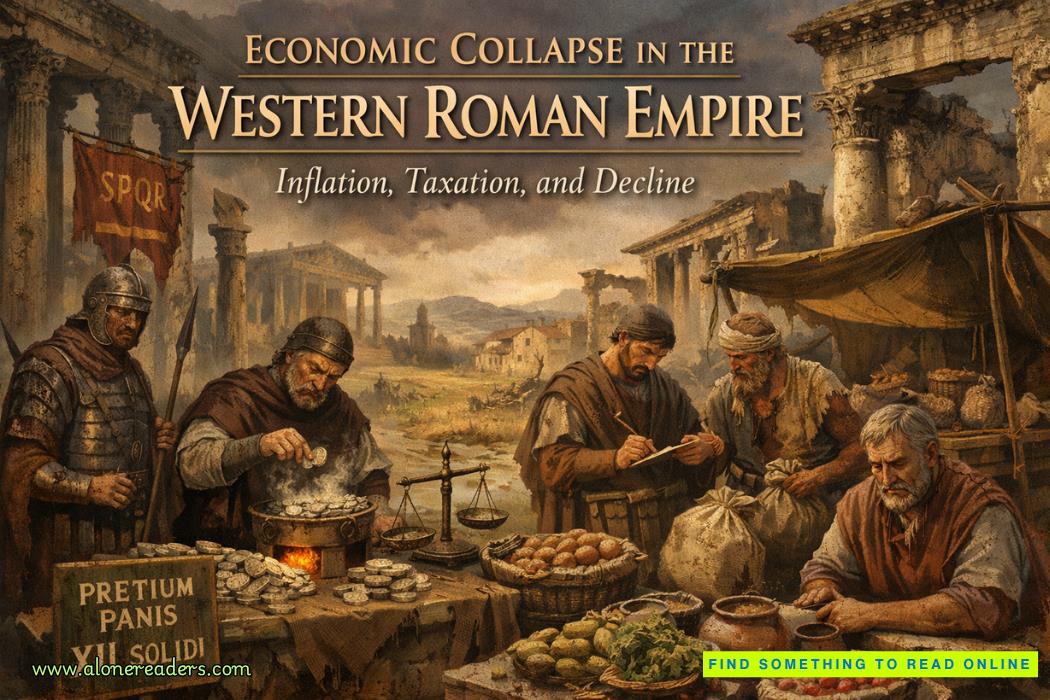
The Western Roman Empire, once the unrivaled master of the Mediterranean world, did not fall solely because of barbarian invasions or military defeats. At the heart of its collapse lay a profound economic breakdown—a slow but relentless erosion of fiscal stability that hollowed out Rome’s administrative strength, demoralized its population, and paved the way for its disintegration in 476 AD. This decline was driven primarily by inflation, excessive taxation, and the disintegration of trade and productivity that had sustained imperial power for centuries.
The empire’s economic troubles can be traced back to the late third century, when the Silver Denarius—the cornerstone of Roman currency—lost much of its intrinsic value. Successive emperors, desperate to fund an ever-growing army and bureaucracy, debased their coinage, reducing the silver content and replacing it with cheaper metals. Each reduction in purity was a silent tax on the population, eroding trust in money and forcing prices to soar. By the time of Emperor Diocletian, inflation had reached catastrophic levels; what once cost a few denarii now required sacks of near-worthless coins. The empire tried to fix this collapse of confidence through strict price controls, but they only deepened the crisis, driving goods into the black market and increasing resentment toward imperial authority.
This relentless debasement was both a cause and a symptom of a deeper malaise. The Roman state had built its wealth on conquest and plunder. As expansion ceased in the second century, new sources of precious metals and slaves dwindled, but the imperial system continued to grow more expensive. Maintaining vast borders, legions, and administrators required continuous revenue—revenue that had to come from within rather than from conquest. Thus, the imperial government turned inward, squeezing its own citizens through an increasingly oppressive taxation system.
Roman taxation in the later empire was not merely high; it was crushingly inflexible. Tax obligations, measured in both money and kind (such as grain, oil, and livestock), became hereditary burdens. Landowners were forced to stay on their estates and ensure production, while smallholders and peasants who could not pay were ruined. Over time, many of these small farmers sought protection under powerful landlords, exchanging freedom for safety. This process gave rise to the proto-feudal system that would dominate medieval Europe. Thus, taxation that was meant to sustain the empire instead corroded its social fabric, driving the middle class into extinction and creating a divided society of rich elites and impoverished serfs.
The annona, the compulsory grain tax that fed the army and citizens of Rome, reflected this system’s inefficiency. As imperial demands rose, provincial administrators often extorted more than was required, enriching themselves while farmers starved. Corruption thrived. The empire’s bureaucracy, which had expanded enormously since Diocletian’s reforms, became both essential and parasitic: it organized the collection of taxes but consumed much of the revenue in salaries, bribes, and luxuries. The more the state taxed, the less productive its economy became.
Meanwhile, a fatal decline in trade and urban life sapped vitality from the empire’s core. The once-bustling Mediterranean, Rome’s economic artery, became increasingly insecure as imperial control fractured. Piracy and invasions disrupted shipping routes, and wealthy elites withdrew into self-sufficient rural villas instead of investing in commerce. Cities—formerly centers of trade and industry—fell into decay as artisans deserted their workshops and merchants closed their stalls. Where once there had been bustling marketplaces filled with foreign goods, by the fifth century there remained only empty forums and weeds growing through marble tiles.
This urban decline fed back into the empire’s financial weakness. With trade shrinking and cities depopulating, tax revenues plummeted. In response, emperors raised taxes further, driving even more citizens into destitution and shrinking productivity. It was a vicious cycle that no policy reform could reverse. Even ambitious emperors like Diocletian and Constantine, who restructured taxation and currency, could not undo the fundamental flaw: a state built on coercion and control rather than organic economic vitality.
Constantine’s introduction of the solidus, a new gold coin of high purity, brought temporary stability for the eastern provinces but could not rescue the West. The Western Empire lacked sufficient gold reserves and continued to rely on base metals. While the Eastern Roman (Byzantine) economy remained resilient thanks to its control of eastern trade routes and wealthier provinces, the Western Empire’s financial foundations collapsed under the weight of its obligations.
By the fourth and fifth centuries, the crisis had penetrated every level of society. The army, once Rome’s pride, became an unsustainable expense. To cut costs, emperors recruited foederati—barbarian mercenaries who fought for pay and land. This policy was born of necessity, but it eroded military discipline and loyalty. With fewer funds to maintain fortifications or equip soldiers, frontier defenses weakened, inviting further invasions. The fiscal weakness of the empire led directly to its military helplessness.
At the same time, the social contract between the Roman state and its subjects dissolved. Citizens no longer saw Rome as a guarantor of stability but as a predatory force. Tax collectors were despised, the coinage was distrusted, and trade guilds—once engines of prosperity—became instruments of state control, binding craftsmen and merchants to their professions under threat of punishment. Where the early empire had been marked by a sense of shared participation in imperial glory, the late empire was characterized by economic coercion, despair, and decline.
The psychological impact of economic collapse was profound. As wealth concentrated in fewer hands and agricultural output declined, famine and depopulation spread. Estates became isolated fortresses; commerce shifted from coin exchange to barter. The belief in imperial stability—a cornerstone of Roman identity—began to crumble. For many in the provinces, the arrival of Germanic tribes was not an apocalypse but merely the replacement of one overlord with another. Rome’s failure to govern itself had already prepared its people for life beyond empire.
What makes this period so instructive is how economic dysfunction intertwined with political decay. The empire’s leaders attempted reform after reform—currency stabilization, tax adjustments, administrative reorganization—but none addressed the root issue: the economy could no longer sustain the demands of a vast centralized state. Every attempt to enforce order through decree, such as Diocletian’s Edict on Maximum Prices, only revealed the state’s impotence. Markets ignored official commands, and the already meager confidence in government disintegrated.
In economic terms, the late Western Roman Empire became a closed system collapsing under its own weight. As production and trade contracted, the government’s response was always to raise taxes, inflate the currency, or requisition more goods—each measure accelerating the decline. Historians today recognize that economic collapse was not a sudden event in 476 AD but a long process of erosion spanning nearly two centuries. By the time the Visigoths sacked Rome in 410 AD, the empire’s financial core was already rotten; by 476, when the last emperor Romulus Augustulus was deposed, the economy had ceased to function as an imperial system.
Ironically, the Eastern Roman Empire, which shared many of the same institutions, survived and even thrived for nearly another thousand years. Its success lay in maintaining a stable fiscal base, abundant trade with Asia and Africa, and better-managed taxation systems that did not destroy the middle class. This contrast underscores how geography and strategic wealth preserved one half of the Roman world while the other succumbed to economic entropy.
In retrospect, the economic decline of the Western Roman Empire was both a symptom and a cause of its fall. Inflation eroded the foundations of trust. Taxation suffocated innovation and destroyed the rural economy. Administrative bloat drained resources from the very provinces that kept the empire alive. When combined with external pressures and internal corruption, the economic collapse ensured that no political or military effort could reverse the empire’s fate.
The fall of Rome, therefore, should not be seen simply as the triumph of barbarian invaders but as the self-destruction of an economy that had lost its capacity to adapt. In the ruins of its markets, in the worthless coins scattered across its collapsed cities, we can read the story of an empire that transformed abundance into scarcity through mismanagement and systemic rigidity.
When the Western Roman Empire finally dissolved in 476 AD, the political event merely formalized what had long been true: Rome had already fallen economically. Its currency was broken, its peasants impoverished, and its trade silenced. The grandeur of the empire had been hollowed out from within by the invisible yet relentless forces of inflation, taxation, and economic decline.
The legacy of this collapse endures as a timeless warning. No civilization, however mighty, can survive when its economic foundation erodes faster than it can reform. The story of Rome’s fall is the story of money losing meaning, of power disconnected from productivity, and of a state consuming the wealth it once created. It reminds us that empires rarely die in battle—they die when their economies implode.



 The Hundred Days Offensive: How the Allies Defeated Germany in World War I
 The Second Battle of the Marne: The Turning Point of World War I in 1918
 The Spring Offensive of 1918: Germany's Final Gamble to Win World War I
 The Treaty of Brest-Litovsk: How Russia Left World War I
 The Russian Revolution and World War I: How War Brought Down the Tsar
 The Zimmermann Telegram Explained: Germany's Secret Offer to Mexico in World War I










