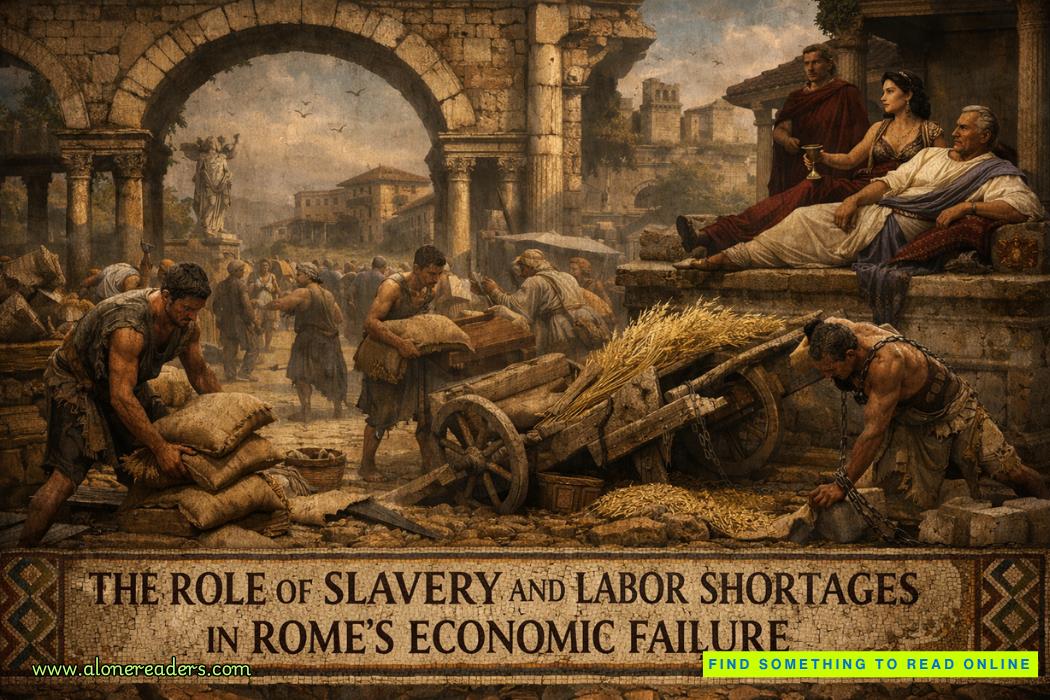
The Western Roman Empire once stood as the most formidable power in the ancient world, stretching across Europe, North Africa, and the Middle East. Yet beneath its majestic architecture and shimmering gold, the empire’s foundations were rotting silently. A complex chain of economic, social, and moral weaknesses brought about its downfall, and among the most decisive of these were slavery and labor shortages — two intertwined forces that shaped and ultimately sabotaged Rome’s economy from within.
The Roman economy, at its height, was a masterpiece of organization supported by an immense slave labor force. Slavery penetrated every layer of Roman life — from the vast agricultural estates, known as latifundia, to urban workshops, mines, and domestic service. Captives from conquests across Gaul, Greece, Egypt, and Carthage supplied an almost endless pool of human labor. The empire’s prosperity, in its early centuries, rested squarely upon the backs of these enslaved men and women. But this abundance of cheap, unpaid labor created a dangerous dependency that discouraged technological advancement, suppressed free labor markets, and ultimately eroded the economic resilience essential to Rome’s survival in its later centuries.
At first glance, the use of slaves appeared to be an advantage. Roman aristocrats could cultivate vast tracts of land with minimal cost, generating enormous profits from grain, olive oil, and wine exports. Yet, as generations passed, what began as an economic engine turned into a structural weakness. Slave-based agriculture produced a distorted economy where innovation was unnecessary and improvement was discouraged. Why invest in machinery, better tools, or farming techniques when an endless supply of forced human labor was available at almost no expense?
This mindset strangled real productivity growth. Unlike later European societies that would evolve through innovation and mechanization, Rome’s economic system stagnated. Industries that could have advanced technologically remained primitive. Tools changed little over centuries, and manual labor replaced mechanical ingenuity. In essence, Rome’s dependence on slavery froze its economy in time, leaving it unable to adapt when the external flow of new slaves began to dwindle.
The decline of conquest was pivotal in this shift. Rome’s vast supply of slaves depended heavily on continuous military victories. Every war brought new captives, who filled mines and plantations. But as the empire’s expansion slowed after the first century CE, its sources of slaves also began to dry up. New territories were rarely conquered, existing provinces produced diminishing returns, and population losses from wars and epidemics further reduced the labor pool. The result was a gradual but catastrophic labor shortage, especially in agriculture — the empire’s economic backbone.
This shortage was exacerbated by demographic crises. Plagues, wars, and declining birth rates among free citizens left both rural and urban economies underpopulated. Without fresh supplies of slaves or an adequate population of paid laborers, production faltered. Large estates went uncultivated, food shortages became common, and the empire’s ability to feed its cities dwindled. The same aristocracy that once thrived on surplus suddenly found their estates barren and unprofitable.
Moreover, the pervasive use of slave labor had long undermined the free working class. Skilled artisans, small farmers, and independent tradesmen — the free citizens who once formed the economic and military heart of the Republic — found themselves displaced by slave workers who undercut their wages. The social fabric of Roman society, based on the dignity of citizen labor, unraveled. Many citizens abandoned their trades, fell into poverty, or migrated to the cities in search of sustenance, swelling the ranks of the urban unemployed who relied on the state’s grain dole to survive.
These depressed conditions created an economic paradox: Rome had both labor shortages and unemployment at the same time. On the one hand, vast estates lacked willing workers; on the other, countless citizens lived idle in the cities, unwilling or unable to return to the countryside. This imbalance demonstrated how deep the moral and structural consequences of slavery ran. Work itself became stigmatized — a task for slaves, not for citizens. Over time, this cultural disdain for manual labor hollowed out the empire’s ability to recover from crises.
To address these problems, emperors and landowners turned to desperate measures. The colonate system, which emerged during the late empire, tried to stabilize the rural workforce by tying peasants (coloni) to the land they worked. These coloni were not technically slaves, but in practice their freedom was severely limited. Bound by law and birth to their estates, they represented a halfway status between slave and freeman — a grim preview of medieval serfdom. This system may have slowed the labor crisis temporarily, but it deepened social inequality and again discouraged innovation. Productivity remained low, and peasant unrest increased.
The urban economy also suffered. The reliance on slave artisans and imported goods weakened Rome’s manufacturing base. Workshops once bustling with skilled craftsmen became dependent on slave-run production, flooding markets with cheap, low-quality goods. As economic pressure mounted, small-scale industries collapsed, and the great cities of the empire began to decay. Rome and other urban centers that once symbolized prosperity became filled with unemployed masses, government-dependent and resentful.
Meanwhile, the empire’s agricultural structure grew increasingly inefficient. The latifundia, originally symbols of Roman success, became paralyzing burdens. Their owners often resided in distant cities, uninterested in hands-on management. Overseers exploited both slaves and coloni harshly, leading to declining productivity and frequent revolts. Soil exhaustion on overworked estates reduced yields further, while newer frontiers — less fertile or less secure — could not compensate for the losses.
The chain reaction was devastating. As the economic base crumbled, tax revenues declined. Yet the imperial government’s expenses — especially the massive military outlays needed to defend far-flung borders — continued to soar. To compensate, emperors raised taxes on the remaining productive classes, drowning small farmers and merchants in debt. Many fled their lands or sought refuge under powerful landlords, further accelerating the concentration of wealth into fewer hands. This polarization of society — a wealthy elite isolated from an impoverished majority — became another symptom of decline.
At its core, Rome’s economic failure was not merely a matter of money or manpower; it was a failure of structure and mindset. The entire economy had been designed around exploitation rather than sustainability. Dependence on slavery promoted short-term efficiency but long-term decay. The Romans never developed an incentive for sustainable resource management, rural population growth, or technological innovation. Even when some thinkers and engineers proposed mechanical devices to improve production, their inventions were seldom adopted. As long as human labor was cheap and plentiful, efficiency held little value.
When crises finally struck — invasions, plagues, climate changes, and trade disruptions — the empire had no flexibility to adapt. The economic model could not pivot from forced to voluntary labor, from expansion to self-sufficiency, or from exploitation to innovation. By the fourth and fifth centuries CE, the western economy had entered a death spiral: shrinking revenue, declining production, and vanishing markets fed each other in endless loops.
Rome’s leadership recognized the symptoms but misdiagnosed the causes. They blamed “moral decay,” barbarian incursions, or divine punishment, but few addressed the deep-seated economic contradictions. Even reforms like Diocletian’s price edicts or Constantine’s labor laws failed to restore vitality. The empire’s reliance on coercion — in taxation, labor, and governance — mirrored its slave-based foundations. Freedom, creativity, and enterprise, essential drivers of economic renewal, were largely extinguished.
In the end, slavery both built and destroyed Rome. It powered the empire’s ascent but undermined its adaptability. The wealth of the elite came at the cost of the vitality of the masses, and when the flow of slaves and resources stopped, the system collapsed under its own weight. Labor shortages were not the disease itself, but the visible symptom of a terminal condition — a civilization that had based its prosperity on the dehumanization of others.
As Western Rome fell in 476 AD, the ruins of its grandeur stood as silent witnesses to a paradox: the empire that once commanded millions of human lives could no longer command enough labor to sustain its own economy. Its fields lay fallow, its workshops silent, its citizens dependent, and its armies unpaid. The Roman world, which had boasted “eternal” strength, crumbled under the economic fragility born of centuries of exploitation and neglect.
The story of Rome’s fall is a powerful cautionary tale. Economic systems built on unfree labor might shine brilliantly for a time, but they hollow out societies from within. The Roman experience reminds us that sustainable prosperity arises not from subjugation but from participation — not from coercion, but from creative human energy freely given. When a civilization strangles that energy, its fall becomes only a matter of time.



 The Hundred Days Offensive: How the Allies Defeated Germany in World War I
 The Second Battle of the Marne: The Turning Point of World War I in 1918
 The Spring Offensive of 1918: Germany's Final Gamble to Win World War I
 The Treaty of Brest-Litovsk: How Russia Left World War I
 The Russian Revolution and World War I: How War Brought Down the Tsar
 The Zimmermann Telegram Explained: Germany's Secret Offer to Mexico in World War I