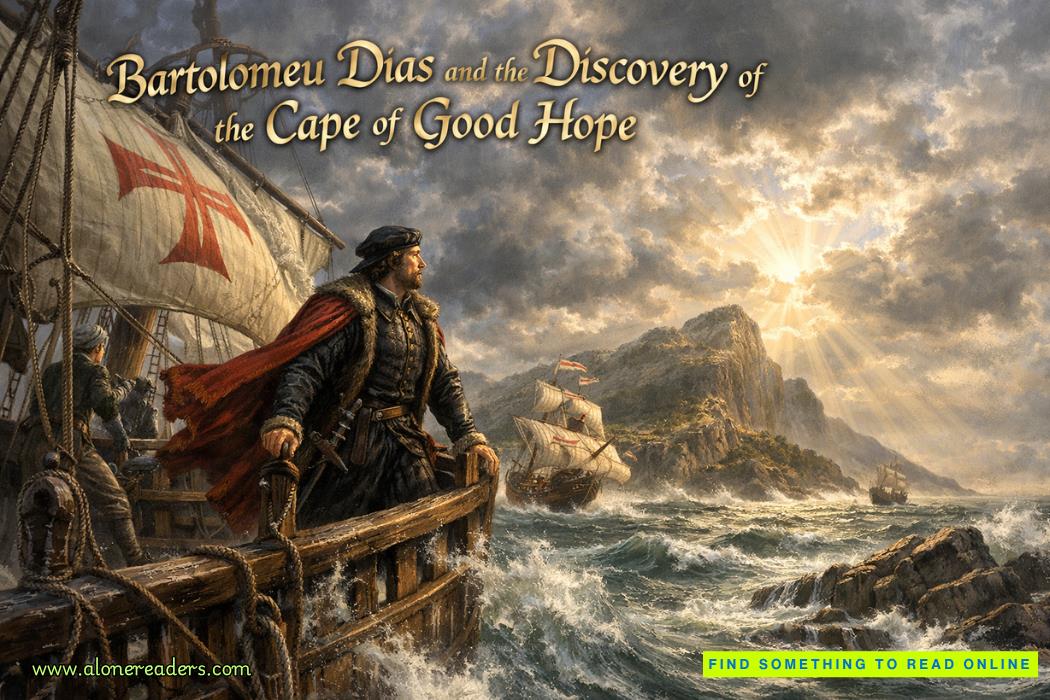
Bartolomeu Dias stands among the great navigators of the Age of Discovery, a century of daring voyages that redrew the world map and ushered in global trade. His expedition in 1487–1488 to find a sea route around the southern tip of Africa was driven by equal parts ambition, curiosity, and strategic necessity. While earlier mariners had explored the African coast and established trading posts, Dias became the first European to sail around what he named the Cape of Storms, later known as the Cape of Good Hope—a name that symbolized Europe’s emerging confidence in reaching the riches of the East by sea.
In the mid‑fifteenth century, Portugal’s rulers envisioned their small Atlantic kingdom as a maritime power. The Portuguese crown, led by King John II, sought a direct route to the Indian Ocean to break the Venetian and Arab dominance over the lucrative spice trade. The overland Silk Road was not only long and expensive but also politically unstable. The dream of a direct sea passage to India and the East Indies promised unimaginable profit and prestige. Bartolomeu Dias, an experienced captain and member of the royal court, was chosen to lead an expedition that would push farther south than any European had yet dared.
Dias’s voyage began from Lisbon in August 1487, with three ships—a square‑rigged caravel commanded by Dias himself, a supply ship, and another smaller caravel. His crew consisted of sailors hardened by years navigating along the African coast, interpreters to communicate with local peoples, and even convicts sent as expendable explorers at landing sites. The expedition’s mission was to follow in the wake of earlier navigators, such as Diogo Cão, who had reached as far as modern‑day Angola, and to determine whether the Atlantic and Indian Oceans were indeed connected.
From the start, the journey tested the limits of endurance and seamanship. Dias headed south along the west coast of Africa, making stops at known Portuguese outposts such as the Congo River mouth. From there, he pressed into uncharted waters. As his ships advanced, the Atlantic currents grew more unpredictable and winds turned violent, marking the onset of the treacherous weather patterns of the southern Atlantic. At the edge of the known world, Dias displayed both courage and tactical brilliance by venturing further into open ocean rather than clinging to the coast as most mariners would have done. Unaware at the time, this wide arc took his fleet far southwest into the Atlantic before being blown eastward by gales, effectively rounding the southern tip of Africa without sighting it.
When the storm subsided, Dias and his men turned northward, expecting to rejoin the familiar western coastline. Instead, to their astonishment, they saw new and unfamiliar shores stretching eastward—evidence that they had passed the southern extremity of Africa. This moment of realization, sometime in early 1488, marked one of the great turning points in world history. The Portuguese had finally found a passage to the other side of the continent, opening the possibility of reaching Asia entirely by sea.
Dias continued sailing eastward along the coast until reaching a bay that he named Aguada de São Brás, now known as Mossel Bay, in present‑day South Africa. He traveled as far as the Great Fish River, before rising tensions among the crew and dwindling provisions forced a return. The men were weary, the seas had been relentless, and morale was dangerously low. Many feared they had sailed beyond the limits of navigable waters. Recognizing the balance between ambition and survival, Dias made the difficult decision to turn back—a decision that preserved his discovery for history. On his return voyage, he finally sighted the dramatic cape that had eluded their view earlier, a rocky headland beaten by wind and surf. Its savage weather led him to name it the Cabo das Tormentas—the Cape of Storms.
When Dias returned to Lisbon in December 1488, after a voyage of nearly sixteen months, King John II recognized the strategic significance of his discovery. Although the monarch retained the name “Cape of Storms,” he officially renamed it the Cape of Good Hope, emphasizing its promise rather than its peril. This renaming captured the essence of Portugal’s ambitions—the cape represented not an end, but a gateway to the riches of Asia. It symbolized the “hope” of a direct maritime route to India, which was later realized by Vasco da Gama in 1498.
Dias’s achievement cannot be understood without seeing it within the broader context of the Portuguese maritime revolution. By the late fifteenth century, Portugal had developed advanced navigational instruments such as the astrolabe and improved ship designs like the caravel, capable of tacking efficiently against the wind. These innovations, combined with meticulous record‑keeping and royal sponsorship, turned exploration into a form of organized science. The Portuguese methodically explored the African coastline, built fortresses and trading stations, and collected hydrographic data at every phase. Dias’s success embodied the fruition of decades of this steady progress.
Yet his voyage was not without tragedy and hardship. The sailors endured brutal storms, scurvy, and exhaustion, often clinging to survival through sheer determination. Food supplies rotted; fresh water ran short; and the desolation of uninhabited coasts offered little relief. Encounters with local African communities were limited, cautious, and occasionally tense. But beyond the immediate challenges of survival lay a deeper sense of purpose—the conviction that they were participating in a mission that could transform the world.
The psychological impact of rounding the Cape resonated across Europe. For the first time, the Atlantic and Indian Oceans were proven to be connected, and the map of the known world had to be redrawn. The voyage shattered the old medieval conception of geography rooted in myth and scripture and replaced it with an emerging scientific worldview. Dias’s discovery hinted that the boundaries of the Earth were broader—and more navigable—than previously believed. It ignited a surge of national pride in Portugal and accelerated investments in further expeditions. The newfound route also shifted the balance of power among European nations, setting the stage for the colonial competition that would define the coming centuries.
Despite the magnitude of his success, Bartolomeu Dias did not immediately reap full recognition. King John II, focused on consolidating earlier gains, postponed immediate expeditions toward India. Instead, Dias was assigned administrative and advisory roles within Portugal’s growing network of coastal forts in Africa. However, when Vasco da Gama was chosen to lead the 1497 expedition to India, Dias played a key supporting role, helping plan the route and providing strategic insight drawn from his earlier passage. He even accompanied da Gama as far as the Cape Verde Islands before returning home—a symbolic gesture linking the two greatest Portuguese voyages.
Tragically, Dias’s life ended at sea, the same element that had given him immortality. In 1500, he joined Pedro Álvares Cabral’s fleet bound for India, which famously discovered Brazil along the way. On the return passage, a fierce storm near the Cape of Good Hope—the very waters he had unveiled to the world—claimed his ship and his life. Thus, the explorer who first courageously navigated the cape met his fate in its unyielding surf.
Dias’s legacy endures as one of fearless exploration and enduring vision. The Cape of Good Hope remains not only a geographical milestone but also a symbolic threshold between the Atlantic and Indian Oceans, between ignorance and understanding, between isolation and connection. His journey demonstrated that human determination, guided by science and fueled by ambition, could overcome even nature’s most punishing barriers. The name “Good Hope” encapsulates the optimism that underpinned the Age of Discovery—a belief that perseverance and intellect could open the path to new worlds.
In evaluating his contribution, it is easy to overlook how critical Dias’s voyage was in bridging the gap between mere coastal reconnaissance and true oceanic navigation. Before him, Portuguese mariners had hugged the coasts, relying on sight of land to maintain their bearings. Dias dared to lose sight of land entirely, trusting in celestial navigation and logical reasoning about wind patterns and ocean currents. That bold decision to turn seawards, away from the coastline, marked the transition from coastal exploration to blue-water sailing—a technique that would dominate oceanic expansion thereafter.
The broader implications of his discovery rippled through centuries. It paved the way for maritime empires, the global spice trade, the colonization of Asia and Africa, and the eventual emergence of a globalized economy. The Cape of Good Hope became the linchpin of world commerce, a maritime crossroads where ships from Europe, Africa, and Asia converged. The vision King John II had invested in Dias’s voyage ultimately became the foundation of Portugal’s Golden Age of exploration—a time when a small Atlantic kingdom commanded routes stretching from Brazil to Japan.
Today, historians regard Bartolomeu Dias not only as a conqueror of seas but as a figure emblematic of humanity’s eternal drive to explore the unknown. His name adorns monuments, ships, and coastlines, yet his truest memorial lies in the expanded horizon of the human imagination that he helped create. From a world once bounded by myth and fear, Dias and his fellow navigators carved a planet interconnected by oceans. The Cape of Good Hope, once dreaded as the end of the world, became a gateway of possibility, marking the dawn of a truly global age.



 The Hundred Days Offensive: How the Allies Defeated Germany in World War I
 The Second Battle of the Marne: The Turning Point of World War I in 1918
 The Spring Offensive of 1918: Germany's Final Gamble to Win World War I
 The Treaty of Brest-Litovsk: How Russia Left World War I
 The Russian Revolution and World War I: How War Brought Down the Tsar
 The Zimmermann Telegram Explained: Germany's Secret Offer to Mexico in World War I










