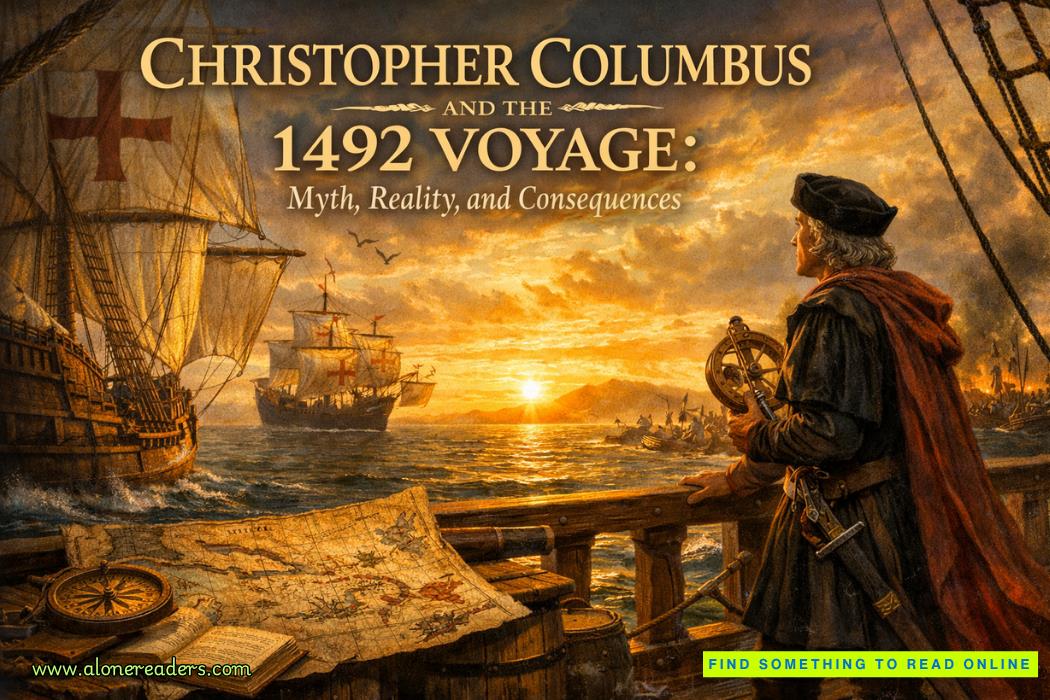
The year 1492 stands as one of the turning points in human history, a moment that bridged the old medieval world with the dawn of the modern era. When Christopher Columbus set sail from Spain under the sponsorship of Queen Isabella I of Castile and King Ferdinand II of Aragon, his goal was not to discover a “New World.” His intention was far more practical and commercial: to find a westward maritime route to Asia, particularly the rich markets of India and China that had captivated European imaginations for centuries. Yet what unfolded from this single voyage reshaped continents, societies, and the course of global civilization.
Columbus’s journey is often taught as a bold adventure led by a visionary explorer defying the conventions of his time. The popular myth depicts him as a man who proved the Earth was round when everyone else thought it was flat. In truth, educated Europeans of the late fifteenth century already knew the Earth was spherical. The real debate was not about its shape, but about its size. Columbus underestimated the Earth’s circumference and overestimated the size of Asia. His flawed calculations made him believe he could reach the East Indies by sailing west across what he assumed was a much smaller ocean. Ironically, his miscalculation led to one of history’s most consequential discoveries—although from his perspective, he never truly grasped it.
When Columbus departed from Palos de la Frontera on August 3, 1492, with his three ships—the Niña, the Pinta, and the Santa María—his crew faced an uncertain and perilous journey across the Atlantic. Many of his sailors feared they might never return. After more than two months at sea, on October 12, a lookout from the Pinta sighted land. They had arrived not in Asia but on an island in what we now know as the Bahamas, which Columbus named San Salvador. Convinced he had reached islands near Asia, he called the indigenous inhabitants “Indios,” a name that reflected his geographical misunderstanding but would tragically define centuries of identity and misrepresentation.
The man behind this voyage, Christopher Columbus, remains one of the most controversial figures in history. To some, he symbolizes courage and discovery. To others, he represents imperialism, exploitation, and the beginning of a devastating colonial order. The duality of his legacy is what makes his story both fascinating and contentious. The myth of Columbus as a heroic discoverer did not arise immediately. It evolved over centuries through political motives, national pride, and historical reinterpretation.
In the early modern period, European monarchies competed fiercely for territorial expansion and global dominance. Spain’s sponsorship of Columbus’s voyages gave the crown a head start in overseas conquest, setting off the so-called Age of Discovery. This era was marked by both ambition and brutality, with explorers acting as pioneers of empire. Columbus’s voyages opened the gateway to Spain’s vast empire in the Americas—territories that would produce immense wealth through gold, silver, and agricultural exploitation, but at an immense human cost for the indigenous peoples who lived there.
The reality of Columbus’s voyage differed profoundly from the myth. His journals reveal a man equally driven by faith, greed, and ambition. Columbus believed his success was guided by divine will. His writings frequently attribute his navigation and endurance to the hand of God, reflecting the deep religiosity of his age. However, the spiritual language often masked pragmatic motives. The promise of riches, titles, and prestige motivated his persistence before the Spanish court. He demanded the hereditary title “Admiral of the Ocean Sea” and governance over any lands he might find—a demand that reveals his personal aspirations for power and legacy.
Yet behind the glorified narrative lies the dark consequence of his arrival. The indigenous societies he encountered, such as the Taíno people of the Caribbean, initially greeted him with kindness and curiosity. Columbus, however, viewed them through the lens of potential servitude and religious conversion. He wrote that they would make excellent servants and that they could be easily converted to Christianity. This view foreshadowed the systematic colonization and cultural annihilation that European expansion would impose across the Americas. Within decades of 1492, millions of native lives were lost through warfare, enslavement, and disease—what historians now call the Columbian Exchange had begun.
The Columbian Exchange was not merely an exchange of goods; it was a profound, often devastating, biological and cultural collision. Europe introduced horses, cattle, pigs, wheat, and diseases like smallpox, while the Americas contributed maize, potatoes, tomatoes, and tobacco to global trade. These transfers transformed diets, economies, and populations on both sides of the Atlantic. Yet while Europe and Asia gained wealth and new resources, the Americas suffered depopulation and cultural destruction on an unimaginable scale.
It is essential to understand that Columbus’s voyage also marked the beginning of a new worldview—one that expanded humanity’s perception of geography, commerce, and global interconnection. Before 1492, the known world to Europeans was confined mainly to the Old World—Europe, parts of Asia, and northern Africa. The discovery of the American continents literally doubled the known world, challenging philosophical, religious, and political assumptions that had structured medieval thought.
Still, the term “discovery” itself carries a loaded meaning. The lands Columbus reached were not empty; they were home to civilizations with complex social systems, spiritual traditions, and histories stretching back millennia. To describe Columbus as the “discoverer” of the New World is thus a Eurocentric distortion. From the perspective of the indigenous peoples, 1492 symbolizes not discovery but conquest and dispossession. Recognizing this difference is crucial to understanding the full consequences of his voyage.
Over time, as Spain expanded its empire through conquistadors like Hernán Cortés and Francisco Pizarro, the structures that began with Columbus hardened into a global system of exploitation. The transatlantic slave trade, which emerged in the decades that followed, was deeply intertwined with this legacy. The economic systems that fed European growth—plantation farming, mineral extraction, and forced labor—can trace their origins to the model of colonial domination initiated in the late fifteenth century.
Even the mythology of Columbus evolved with history. In the centuries following his death in 1506, different nations transformed him into a symbol for their own purposes. In eighteenth- and nineteenth-century Europe and the Americas, Romantic and nationalist movements recast him as a visionary man of science and faith. In the newly forming United States, Columbus became a symbol of progress and enterprise, his name immortalized in monuments, cities, and even the national holiday of Columbus Day. Yet such celebrations often concealed the darker aspects of his legacy.
Modern scholarship now approaches Columbus with a critical lens. Historians and anthropologists seek to separate the man from the myth by reassessing period sources and indigenous accounts. Columbus’s own letters and logs reveal an explorer caught between medieval cosmology and emerging Renaissance rationalism. He was not an enlightened scientist in the modern sense, but rather a figure shaped by faith, ambition, and a flawed understanding of the world’s geography. Ironically, his voyage, born from error, opened the path to truth—showing the vast interconnectedness of Earth’s continents and the shared destiny of its inhabitants.
The consequences of 1492 endure today in tangible and symbolic forms. The very concept of globalization—a world linked by trade, migration, and cultural exchange—has its origins in Columbus’s crossing. But so too does the enduring trauma of colonization, displacement, and the erasure of native histories. Across the Americas, movements for decolonization and indigenous recognition challenge the imperial narratives that once glorified figures like Columbus. Statues have been removed, place names changed, and history rewritten from multiple viewpoints.
In education and public discourse, the controversy over Columbus now represents a larger struggle: how to remember the past with honesty rather than nostalgia. Should Columbus be remembered as a pioneer who bridged worlds, or as a symbol of conquest and suffering? The answer, perhaps, lies in acknowledging both truths simultaneously. His voyage was undeniably transformative—without it, the world as we know it would not exist—but its human costs must never be dismissed or forgotten.
The story of Columbus is, therefore, both mythic and modern, tragic and triumphant. It reveals how exploration is rarely pure discovery; it is also encounter, exchange, and conflict. In 1492, Columbus set sail believing he would find a new route to Asia. Instead, he found a new world—one that changed history’s course forever but demanded a price history still struggles to reconcile.
Today, more than five centuries later, the image of Columbus continues to provoke debate. His ships, his determination, and his mistaken geography form a lasting chapter in the human story—a reminder that ambition can reshape destiny, and misunderstanding can spark revolutions of thought. The myth of heroic discovery may no longer hold, yet the reality of his voyage remains an eternal mirror reflecting humanity’s capacity for both greatness and destruction. In that way, Christopher Columbus and his 1492 voyage stand as the most paradoxical event in all of recorded history—the moment when the world truly became one, even as it began to divide.



 The Hundred Days Offensive: How the Allies Defeated Germany in World War I
 The Second Battle of the Marne: The Turning Point of World War I in 1918
 The Spring Offensive of 1918: Germany's Final Gamble to Win World War I
 The Treaty of Brest-Litovsk: How Russia Left World War I
 The Russian Revolution and World War I: How War Brought Down the Tsar
 The Zimmermann Telegram Explained: Germany's Secret Offer to Mexico in World War I