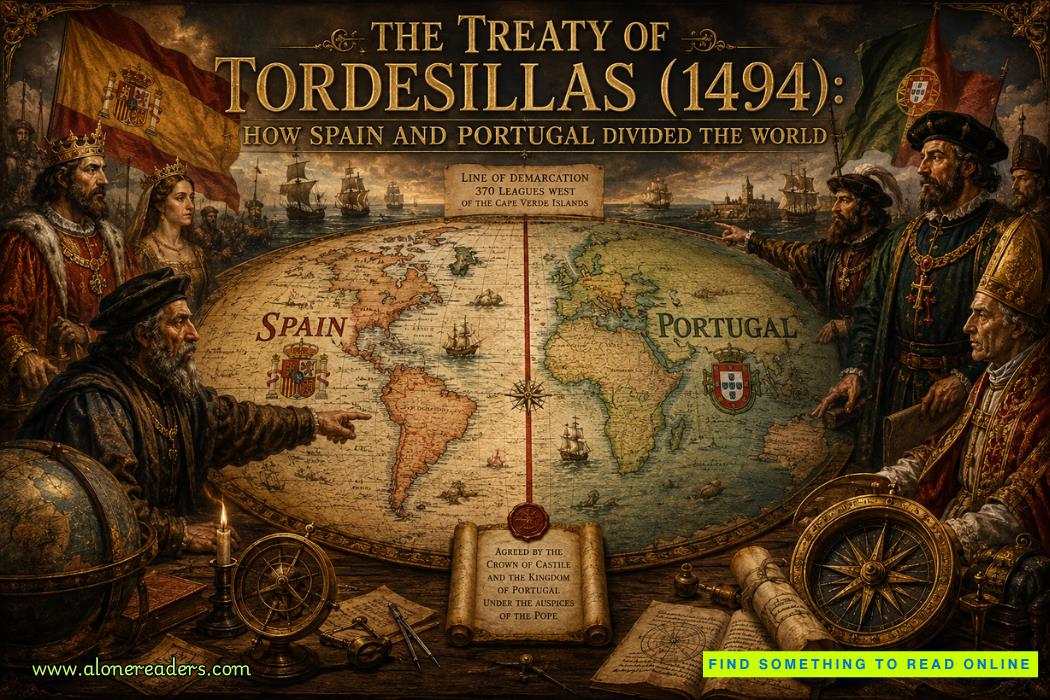
The Treaty of Tordesillas, signed in 1494, stands as one of the most audacious diplomatic agreements in human history, an agreement that quite literally attempted to divide the entire non-European world between two rising maritime powers: Spain and Portugal. At a time when maps were incomplete, oceans were mysterious, and continents were only beginning to emerge in European consciousness, this treaty imposed a bold and artificial order on a rapidly expanding world. It was not simply a political compromise; it was a declaration of dominance, ambition, and belief in divine entitlement.
The roots of this treaty lie deeply embedded in the fierce rivalry between Spain and Portugal during the late 15th century, an era now known as the Age of Discovery. Portugal had already established itself as a pioneer in maritime exploration, methodically navigating the African coastline in search of a sea route to Asia. Spanish ambitions, however, were ignited by Christopher Columbus’s voyage in 1492, which—though intended to reach Asia—led instead to the European “discovery” of the Americas. Suddenly, both kingdoms found themselves competing for control over lands that neither fully understood but both desperately wanted.
Tensions escalated quickly, and the risk of conflict became real. Both Spain and Portugal were devout Catholic nations, and in an era where religion and politics were inseparable, the authority of the Pope became central to resolving disputes. Pope Alexander VI, himself of Spanish origin, issued a series of papal bulls in 1493 that attempted to grant Spain rights over newly discovered lands west of a certain meridian. Portugal, unsurprisingly, found this unacceptable, viewing it as a direct threat to its exploratory ambitions and established maritime routes.
Negotiations between the two kingdoms led to the Treaty of Tordesillas, signed on June 7, 1494. The agreement established a demarcation line approximately 370 leagues west of the Cape Verde Islands. Everything to the west of this line would belong to Spain, while everything to the east would fall under Portuguese control. On paper, this seemed like a neat and effective solution. In reality, it was based on limited geographical knowledge and significant assumptions about the shape and extent of the world.
One of the most fascinating aspects of the treaty is how it unknowingly shaped the cultural and linguistic landscape of modern nations. The line drawn by the treaty cut through what would later be known as South America. As a result, the eastern portion of the continent, which fell within Portugal’s sphere, eventually became Brazil—a Portuguese-speaking nation in a region otherwise dominated by Spanish language and culture. This outcome highlights how a single diplomatic decision, made with incomplete information, could have lasting global consequences.
Despite its bold premise, the treaty was far from universally accepted. Other European powers, including England, France, and the Netherlands, rejected the idea that two nations could claim exclusive rights over lands they had not even explored. These countries would later challenge Spanish and Portuguese dominance through their own voyages, colonization efforts, and naval conflicts. In this sense, the Treaty of Tordesillas was both a temporary solution and a long-term catalyst for further competition and conflict.
The treaty also reflected a broader worldview that was deeply Eurocentric and dismissive of the indigenous populations inhabiting these lands. From the perspective of Spain and Portugal, the lands beyond Europe were considered terra nullius—empty territories available for claiming and exploitation. This mindset ignored the existence of complex civilizations, cultures, and societies that had thrived for centuries. The consequences were devastating, leading to colonization, displacement, cultural destruction, and significant loss of life among indigenous peoples.
Technological limitations of the time further complicated the implementation of the treaty. Determining precise longitudinal measurements in the 15th century was extremely difficult, and navigators lacked accurate tools to establish the exact position of the demarcation line. As a result, interpretations of the treaty often varied, leading to disputes and overlapping claims. This ambiguity, while problematic, also provided opportunities for both Spain and Portugal to extend their influence beyond the agreed boundaries.
Portugal’s focus remained largely on establishing a maritime empire along the coasts of Africa and Asia, securing valuable trade routes and resources such as spices, gold, and textiles. Spain, on the other hand, concentrated its efforts on the Americas, where it established vast colonial territories and extracted immense wealth, particularly in the form of silver and gold. These differing strategies underscore how the treaty did not just divide land—it also shaped the economic and geopolitical trajectories of both nations.
Over time, the limitations of the Treaty of Tordesillas became increasingly apparent. As exploration expanded and new territories were discovered, the original demarcation line proved insufficient to address emerging complexities. This led to subsequent agreements, such as the Treaty of Zaragoza in 1529, which aimed to clarify divisions in the eastern hemisphere. Together, these treaties attempted to create a comprehensive framework for global division, though they never fully resolved the underlying tensions.
The legacy of the Treaty of Tordesillas extends far beyond the Age of Discovery. It played a crucial role in establishing patterns of colonization, language distribution, and cultural influence that continue to shape the modern world. The dominance of Spanish and Portuguese languages in large parts of the Americas, Africa, and Asia can be traced directly back to this agreement. It also set a precedent for how European powers would approach territorial claims, often prioritizing power and negotiation over justice and inclusivity.
At a deeper level, the treaty represents a moment when human ambition collided with the unknown. It reveals how early explorers and rulers sought to impose order on a world that was still largely mysterious, relying on faith, authority, and negotiation rather than accurate knowledge. This combination of confidence and uncertainty defines much of the Age of Discovery and helps explain both its achievements and its consequences.
The Treaty of Tordesillas also invites reflection on the nature of borders and ownership. The idea that a line drawn on a map could determine the fate of entire continents may seem extraordinary today, yet it underscores the enduring power of political agreements. Even in the modern era, borders continue to shape identities, economies, and conflicts, often in ways that echo the decisions made centuries ago.
In examining this treaty, it becomes clear that it was not merely a historical document but a turning point in global history. It marked the beginning of a new era in which European powers extended their reach across oceans, reshaped continents, and interconnected distant parts of the world. At the same time, it serves as a reminder of the costs associated with such expansion, particularly for those who were excluded from the decision-making process.
Ultimately, the Treaty of Tordesillas embodies both the bold vision and the profound limitations of its time. It reflects a world on the brink of transformation, driven by curiosity, competition, and a desire for dominance. Its impact continues to be felt today, not only in the languages we speak and the borders we recognize but also in the historical narratives we seek to understand and reinterpret.



 The Hundred Days Offensive: How the Allies Defeated Germany in World War I
 The Second Battle of the Marne: The Turning Point of World War I in 1918
 The Spring Offensive of 1918: Germany's Final Gamble to Win World War I
 The Treaty of Brest-Litovsk: How Russia Left World War I
 The Russian Revolution and World War I: How War Brought Down the Tsar
 The Zimmermann Telegram Explained: Germany's Secret Offer to Mexico in World War I