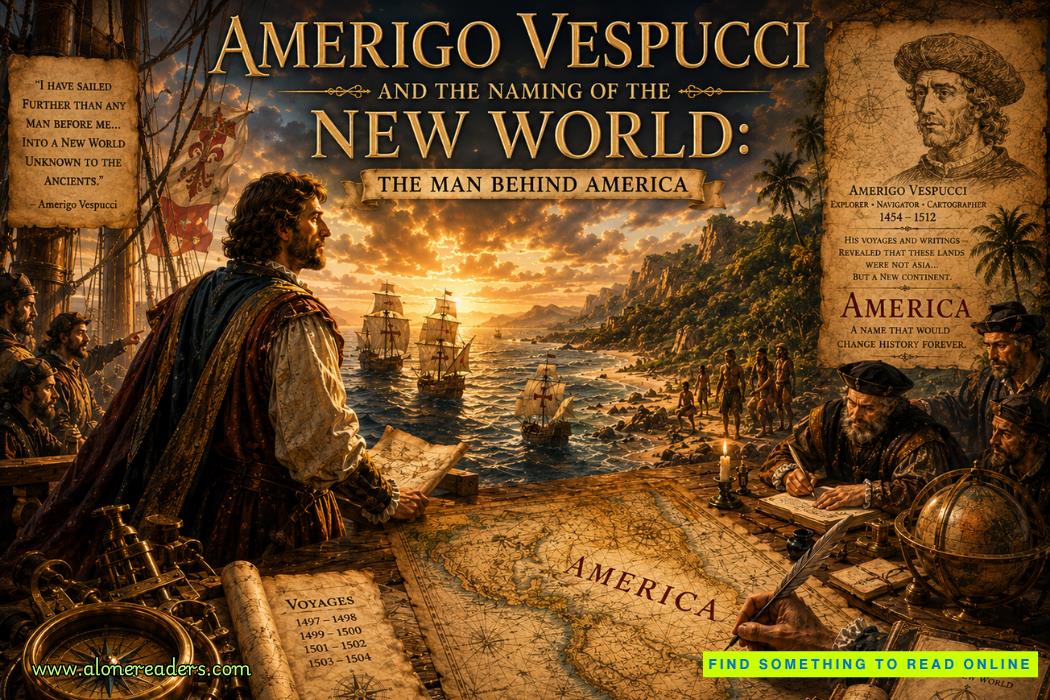
Amerigo Vespucci remains one of the most intriguing figures of the Age of Discovery, not because he was the first to reach the shores of the Americas, but because he was the first to understand what those lands truly represented. While Christopher Columbus believed he had reached the outskirts of Asia, Vespucci recognized something far more profound: this was not Asia, but an entirely new continent. That realization would ultimately lead to one of the most significant naming events in human history, giving rise to the name America.
Born in Florence in 1454, Vespucci grew up in a city that was a hub of Renaissance learning and intellectual curiosity. Unlike many explorers of his time, he was not initially a sailor but a merchant and scholar. His early career involved working for the powerful Medici family, where he gained exposure to geography, astronomy, and navigation. These skills would later become essential in his voyages across the Atlantic.
Vespucci’s entry into exploration came relatively late compared to his contemporaries. By the time he embarked on his first voyage, Columbus had already completed multiple expeditions. However, Vespucci approached exploration with a different mindset. He was not merely searching for trade routes or riches; he was deeply interested in understanding the lands he encountered. This intellectual curiosity would set him apart and shape his legacy.
During his voyages, particularly those between 1499 and 1502, Vespucci traveled along the coasts of South America. He meticulously observed the geography, climate, and people of the regions he explored. What struck him most was the vastness of the land and the diversity of its ecosystems. These were not small islands or extensions of Asia, as Columbus had believed, but part of a massive, previously unknown landmass.
One of Vespucci’s most significant contributions was his detailed letters describing his journeys. These writings, especially those later compiled and circulated in Europe, captured the imagination of scholars and the public alike. In them, Vespucci described the lands as a “New World”—a term that would redefine European understanding of global geography. His accounts were vivid, analytical, and often poetic, blending scientific observation with storytelling.
What made Vespucci’s conclusion so revolutionary was his ability to challenge prevailing beliefs. At the time, the dominant assumption was that any land reached by sailing west from Europe must be part of Asia. Vespucci, however, used evidence from his observations to argue otherwise. He noted differences in the stars visible in the sky, the length of coastlines, and the cultural practices of indigenous peoples. These details led him to conclude that this was not Asia, but an entirely separate continent.
The impact of Vespucci’s writings cannot be overstated. They spread rapidly across Europe, influencing cartographers, scholars, and explorers. Among those influenced was the German cartographer Martin Waldseemüller. In 1507, Waldseemüller created a world map that would become one of the most important documents in the history of cartography. On this map, he labeled the newly discovered lands as “America”, in honor of Amerigo Vespucci.
The choice of the name was both practical and symbolic. At the time, it was common to feminize names when naming continents, and “Amerigo” was Latinized to “Americus”, which then became “America”. Waldseemüller’s decision was based on Vespucci’s assertion that he had identified the lands as a new continent. In essence, Vespucci was credited not for discovering the land, but for understanding its true nature.
Interestingly, the naming of America was not an immediate or universally accepted decision. Early maps varied in their terminology, and some continued to refer to the lands in ways that reflected Columbus’s earlier assumptions. However, over time, the name “America” gained acceptance, particularly as Vespucci’s reputation grew and his writings continued to circulate.
There has been considerable debate among historians regarding Vespucci’s role and the accuracy of his accounts. Some have questioned whether all the voyages attributed to him actually took place, while others have argued that his writings may have been embellished or even altered by publishers. Despite these controversies, most scholars agree that Vespucci played a crucial role in shaping European understanding of the New World.
What sets Vespucci apart is not just his voyages, but his interpretation of what he encountered. Exploration is not only about reaching new places; it is about understanding and contextualizing them. Vespucci’s ability to synthesize his observations into a coherent theory about the New World demonstrates a level of intellectual rigor that was rare among explorers of his time.
Another important aspect of Vespucci’s legacy is his contribution to navigation. He worked on improving methods for determining longitude, a challenge that plagued sailors for centuries. His efforts in this area further underscore his role as both a practical navigator and a theoretical thinker. He was not simply an adventurer, but a scientist in the truest sense of the word.
The naming of America also highlights the complex interplay between exploration, communication, and recognition. Columbus, despite his groundbreaking voyages, did not lend his name to the continents he encountered. Vespucci, on the other hand, became immortalized in the very name of the land. This outcome reflects the importance of narrative and interpretation in history. It is not always the first person to arrive who is remembered, but the one who best explains what has been discovered.
Vespucci’s story also sheds light on the broader context of the Age of Discovery. This was a period marked by rapid expansion, cultural encounters, and significant shifts in worldview. The realization that the world was larger and more complex than previously thought had profound implications for science, trade, and geopolitics. Vespucci’s identification of the New World as a separate continent was a key moment in this transformation.
The legacy of Amerigo Vespucci continues to resonate today. Every time the name “America” is spoken, it serves as a reminder of his contribution to our understanding of the world. Yet, his story is often overshadowed by that of Columbus, whose voyages are more widely known. Revisiting Vespucci’s role allows us to appreciate the nuances of history and recognize the contributions of those who helped shape our global perspective.
It is also worth considering how Vespucci’s legacy might have been different if his writings had not been published or widely distributed. In many ways, his fame was a product of the early modern information network. The printing press played a crucial role in spreading his ideas, demonstrating how technology can amplify the impact of individual achievements. Without this dissemination, the name “America” might never have come into existence.
The story of Amerigo Vespucci and the naming of the New World is ultimately a story about insight, communication, and legacy. It illustrates how understanding can be just as important as discovery, and how the way we interpret the world can shape history itself. Vespucci did not set out to have a continent named after him, but his ability to see beyond established beliefs ensured that his name would be forever linked to one of the greatest geographical revelations in human history.
In examining his life and achievements, we gain a deeper appreciation for the intellectual dimension of exploration. Vespucci’s work reminds us that the Age of Discovery was not just about ships and voyages, but about ideas and perspectives. It was a time when the boundaries of knowledge were being pushed, and when individuals like Vespucci played a crucial role in redefining humanity’s place in the world.
Today, as we look back on this period, it becomes clear that the naming of America was not a simple or inevitable event. It was the result of a complex interplay of exploration, observation, and communication. At the center of this story stands Amerigo Vespucci, a man whose curiosity and insight helped transform a series of voyages into a new understanding of the world.
His legacy serves as a powerful reminder that history is shaped not only by actions, but by ideas. And in the case of the New World, it was Vespucci’s idea—that these lands were something entirely new—that ultimately gave a name to half the globe.



 The Hundred Days Offensive: How the Allies Defeated Germany in World War I
 The Second Battle of the Marne: The Turning Point of World War I in 1918
 The Spring Offensive of 1918: Germany's Final Gamble to Win World War I
 The Treaty of Brest-Litovsk: How Russia Left World War I
 The Russian Revolution and World War I: How War Brought Down the Tsar
 The Zimmermann Telegram Explained: Germany's Secret Offer to Mexico in World War I