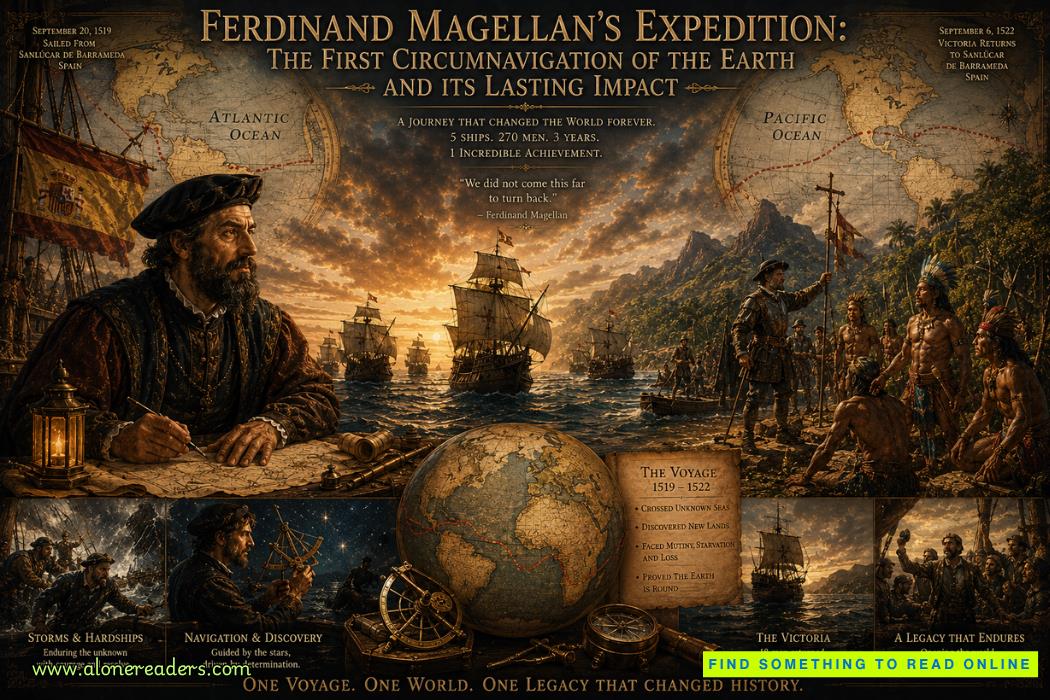
Ferdinand Magellan’s expedition stands as one of the most extraordinary achievements in human history, marking the first successful circumnavigation of the Earth and fundamentally transforming how humanity understood the world. Launched in 1519 under the Spanish crown, this ambitious voyage was not merely a journey of exploration but a bold attempt to reshape global trade, challenge existing geographical knowledge, and assert dominance in the fiercely competitive Age of Discovery. Although Magellan himself did not survive to complete the journey, his expedition irrevocably altered the course of world history, proving beyond doubt that the Earth could be circumnavigated by sea.
At the heart of this monumental expedition was Ferdinand Magellan, a Portuguese navigator with extensive maritime experience. Despite his origins, Magellan offered his services to Spain after falling out of favor with the Portuguese crown. His proposal was daring: to reach the Spice Islands, or the Moluccas, by sailing westward, thereby bypassing Portuguese-controlled eastern routes. This idea was rooted in the belief that a western passage existed through the Americas, a theory yet to be proven. The Spanish monarchy, eager to gain a foothold in the lucrative spice trade, agreed to fund the expedition, setting the stage for one of the most daring voyages ever undertaken.
The fleet that departed from Seville in September 1519 consisted of five ships: Trinidad, San Antonio, Concepción, Victoria, and Santiago. These vessels were modest by modern standards, yet they carried hopes of immense wealth and prestige. The crew, numbering around 270 men from diverse nationalities, faced not only the uncertainties of uncharted waters but also internal tensions, language barriers, and the ever-present threat of mutiny. From the outset, the expedition was a fragile enterprise, held together by Magellan’s unyielding determination and strict command.
As the fleet sailed across the Atlantic, it made its way down the eastern coast of South America, searching for a passage that would lead to the mysterious western ocean. The journey was fraught with hardship. Harsh weather conditions, dwindling supplies, and growing distrust among the crew tested their resolve. The situation reached a breaking point in Patagonia, where a mutiny erupted among several captains who doubted Magellan’s leadership. Demonstrating both strategic brilliance and ruthless authority, Magellan suppressed the rebellion, executing some leaders and abandoning others. This decisive action reinforced his control but also deepened divisions within the crew.
The expedition’s defining moment came in October 1520, when the fleet discovered a narrow and treacherous passage at the southern tip of South America, now known as the Strait of Magellan. This discovery was a monumental breakthrough, providing the long-sought gateway between the Atlantic and Pacific Oceans. Navigating the strait was an arduous process, marked by unpredictable currents, icy winds, and labyrinthine channels. During this passage, the San Antonio deserted the fleet, returning to Spain, leaving the remaining ships to continue under increasingly precarious conditions.
Upon emerging from the strait, the expedition entered a vast and previously unknown ocean, which Magellan named the Pacific Ocean due to its relatively calm waters at the time. However, this calmness proved deceptive. The crossing of the Pacific became one of the most grueling phases of the journey. For over three months, the crew sailed without sighting land, enduring severe shortages of food and fresh water. Starvation and disease ravaged the men, forcing them to consume leather, sawdust, and even rats to survive. This harrowing experience highlighted the immense scale of the Pacific and the limitations of contemporary navigation.
Despite these hardships, the expedition eventually reached the Mariana Islands and later the Philippines in March 1521. Here, Magellan sought to establish alliances and convert local populations to Christianity, reflecting the broader objectives of European exploration, which combined economic ambition with religious zeal. Initially, these efforts appeared successful, as local rulers accepted Spanish authority. However, this success was short-lived.
Magellan’s involvement in local conflicts proved fatal. In April 1521, he was killed in the Battle of Mactan while attempting to assert control over the island. His death marked a turning point for the expedition, leaving the crew without its visionary leader. Leadership passed to surviving officers, who faced the daunting task of continuing the journey with diminished resources and morale.
Despite the loss of Magellan, the expedition pressed on, driven by the imperative to complete the voyage. The remaining crew reached the Spice Islands, achieving one of the primary objectives of the mission. Laden with valuable spices, they prepared for the return journey. However, only one ship, the Victoria, under the command of Juan Sebastián Elcano, was deemed seaworthy enough to attempt the voyage back to Spain.
The final leg of the journey was no less perilous. The Victoria sailed across the Indian Ocean, avoiding Portuguese-controlled territories to prevent capture. The crew endured further hardships, including storms, hunger, and disease. By the time the ship reached Spain in September 1522, only 18 of the original 270 crew members remained. Their return marked the successful completion of the first circumnavigation of the Earth, a feat that demonstrated both the vastness and the interconnectedness of the globe.
The significance of Magellan’s expedition extends far beyond its immediate achievements. It provided conclusive evidence of the Earth’s spherical shape and revealed the true scale of the planet, challenging long-held assumptions. The voyage also reshaped global trade networks, paving the way for increased European exploration and colonization. It highlighted the strategic importance of maritime routes and underscored the potential for global economic integration.
Moreover, the expedition had profound cultural and scientific implications. It expanded European knowledge of geography, introducing new lands, peoples, and ecosystems. The journey also underscored the importance of accurate navigation and cartography, leading to advancements in these fields. At the same time, it exposed the darker aspects of exploration, including violence, exploitation, and the imposition of foreign control over indigenous populations.
One of the most remarkable aspects of the expedition is the resilience and adaptability displayed by its crew. Despite facing unimaginable challenges, they managed to navigate uncharted waters, survive extreme conditions, and complete a journey that had never been attempted before. Their experience serves as a testament to human endurance and the relentless pursuit of discovery.
It is also important to recognize that while Magellan is often credited with the first circumnavigation, it was Elcano and the surviving crew who ultimately completed the voyage. This distinction highlights the collaborative nature of exploration and the contributions of lesser-known figures who played crucial roles in this historic achievement.
In examining Magellan’s expedition, one must also consider its broader historical context. The Age of Discovery was characterized by intense competition among European powers, driven by the desire for wealth, prestige, and influence. This period saw the expansion of European empires and the establishment of global trade networks that would shape the modern world. Magellan’s voyage was both a product of this era and a catalyst for further exploration.
The legacy of the expedition continues to resonate today. It serves as a powerful reminder of humanity’s capacity to explore and understand the world, even in the face of overwhelming challenges. At the same time, it prompts reflection on the consequences of exploration, particularly in terms of cultural exchange and conflict.
Ultimately, Ferdinand Magellan’s expedition represents a defining moment in the history of exploration. It combined ambition, courage, and innovation to achieve what was once thought impossible. The voyage not only expanded the boundaries of human knowledge but also laid the foundation for a more interconnected world. Through its triumphs and tragedies, it remains a compelling story of discovery, resilience, and the enduring quest to understand the unknown.



 The Hundred Days Offensive: How the Allies Defeated Germany in World War I
 The Second Battle of the Marne: The Turning Point of World War I in 1918
 The Spring Offensive of 1918: Germany's Final Gamble to Win World War I
 The Treaty of Brest-Litovsk: How Russia Left World War I
 The Russian Revolution and World War I: How War Brought Down the Tsar
 The Zimmermann Telegram Explained: Germany's Secret Offer to Mexico in World War I










